
Spermidine 3HCl vs. Wheat Germ Extract: Selecting Forms for Heat Stability, Hygroscopicity, and Dosing Accuracy
Spermidine Trihydrochloride (99%) outperforms wheat germ extract in dosing accuracy and stability, but requires low humidity (RH ≤30%). Read our guide to audit supplier COAs and ensure smooth GMP scale-up.
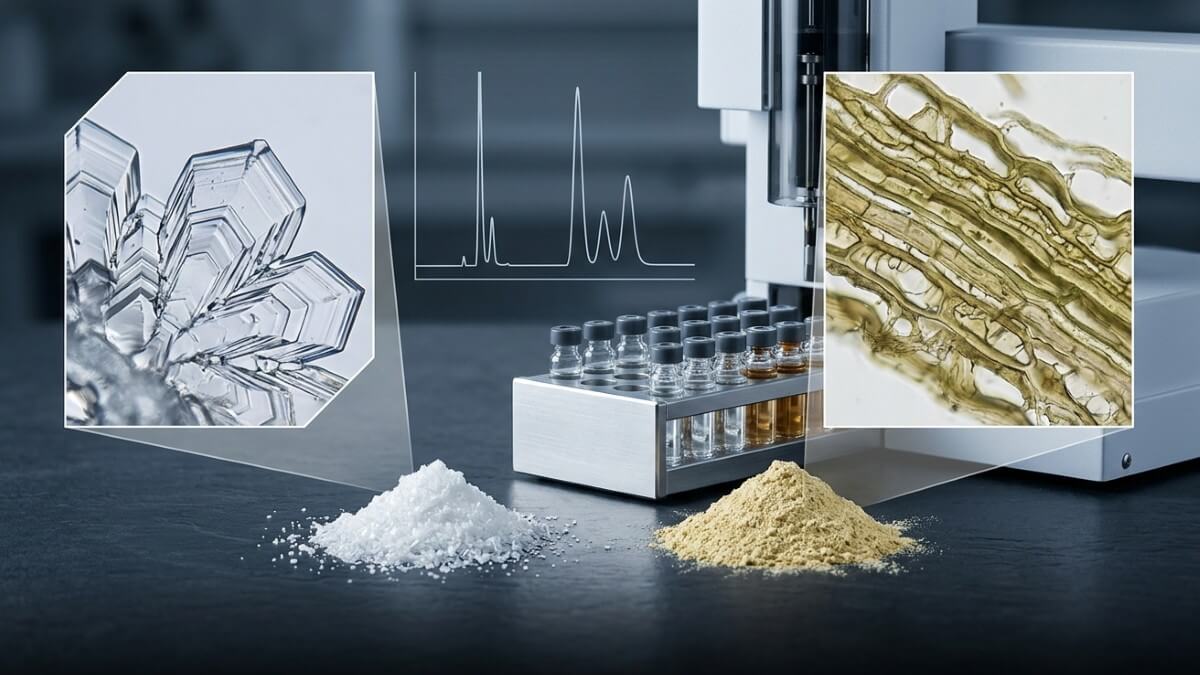
During scale-up, a brand’s production team encountered severe encapsulation sticking within 30 minutes due to a hygroscopic wheat germ extract with undefined moisture sorption. Choosing the wrong spermidine form leads to batch rejection, content uniformity failure, and regulatory delays. This guide compares Spermidine Trihydrochloride (99% purity) against natural wheat germ extract (1% spermidine) and the free base, focusing on industrial processing, stability data, and procurement audit criteria.
Physical Chemistry & Molecular Form Differences That Impact Production
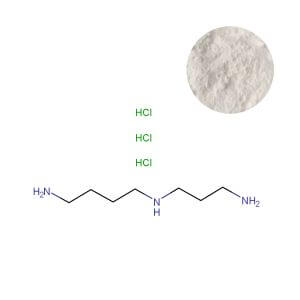
The molecular form determines handling behavior on a GMP line. Free spermidine (CAS 124-20-9) is a liquid (melting point 22-25°C) and air-sensitive, unsuitable for solid dosage forms. In contrast, the trihydrochloride salt (CAS 334-50-9) is a crystalline powder with a defined stoichiometry: 1.0 g of Spermidine Trihydrochloride provides 0.57 g of free base equivalent, enabling accurate dosing. Wheat germ extract is a complex mixture; its labeled “1% spermidine” refers to HPLC content of total polyamines, but batch-to-batch variability in other matrix components (proteins, lipids, phenolics) affects flow and hygroscopicity.
Key parameters for procurement screening:
- Purity & heavy metals: Spermidine Trihydrochloride 99% grade has total heavy metals ≤10 ppm (USP <233>); Pb ≤1.0 ppm; As ≤0.5 ppm. Wheat germ extract (food grade) typically specifies Pb ≤2 ppm, As ≤0.5 ppm, total heavy metals <10 ppm, but the natural matrix may introduce higher microbial loads (TPC ≤1000 CFU/g vs. ≤100 CFU/g for the pure salt).
- Loss on drying: ≤1.0% for the trihydrochloride; ≤2.0% for wheat germ extract. However, the pure salt is hygroscopic and requires low-humidity processing (RH ≤30%) to prevent deliquescence and caking.
- Bulk density: Wheat germ extract has low bulk density (approx. 0.4–0.6 g/mL), demanding larger capsule sizes. The trihydrochloride’s crystalline nature allows smaller capsules for the same spermidine content.
| Parameter | Spermidine Trihydrochloride 99% | Wheat Germ Extract (1% spermidine) | Free base (reference) |
|---|---|---|---|
| Physical state | Crystalline powder | Yellowish fine powder | Liquid (22-25°C) |
| Hygroscopicity | High (requires RH ≤30%) | Moderate (plant matrix buffers) | Extreme, air-sensitive |
| Heavy metals (Pb) | ≤0.5 ppm | ≤2.0 ppm | Not applicable |
| Loss on drying | ≤1.0% | ≤2.0% | N/A |
| Spermidine content accuracy | ±1% (absolute) | ±0.1% (relative to 1% label) | Liquid handling error |
Stability Under Thermal Stress and Humidity: What the Data Show
A 2022 review summarizes spermidine’s behavior during physical and chemical processing (Comprehensive Reviews in Food Science and Food Safety, 2022; doi: 10.1111/1541-4337.12963). Spermidine is moderately heat-sensitive; high temperatures (>80°C) or extreme pH trigger degradation. For wheat germ extract, natural components (e.g., tocopherols) provide some antioxidant protection but introduce off-notes and color changes when heated. In contrast, the trihydrochloride salt offers predictable degradation kinetics, albeit requiring strict humidity control. A 2023 capillary electrophoresis study demonstrated that polyamines (spermidine, spermine) degrade significantly when stored at room temperature or 4°C compared to -20°C; the degradation is moisture-driven.
Practical implication for formulators: For wet granulation or high-speed encapsulation without dehumidification, wheat germ extract is more forgiving but content varies due to low purity. For precise dosage – such as delivering 2 mg of spermidine per capsule – the trihydrochloride 99% grade is superior because it allows small fill weights (e.g., 3.5 mg of salt for 2 mg base equivalent) and consistent content uniformity. Yet the market currently over-indexes on “natural” source claims. Smart procurement teams redirect focus to dosing accuracy, batch-to-batch consistency, and auditable heavy metal control – supply chain metrics that directly reduce rejection rates and regulatory risk.
From a commercial scale-up perspective, these moisture-driven degradation patterns directly dictate equipment choices on high-throughput encapsulation lines. If your facility operates above 30% RH, the trihydrochloride form will cause sticking and fill-weight variation – forcing either capital investment in dehumidification or a switch to a less precise but more forgiving extract.
Bioavailability and Label Claim Strategy: Lessons from Human Pharmacokinetics
A placebo-controlled PK study in healthy adults examined high-dose spermidine (15 mg/day) (Nutrients, 2023; doi: 10.3390/nu15081852). Oral spermidine does not increase plasma or saliva spermidine; it is presystemically converted to spermine. Absorption pathway is independent of physical form or source. Therefore, marketing claims focused on “superior bioavailability” of a particular salt or extract are not supported by current evidence. What truly matters for the end consumer is consistent dosing and stability throughout shelf life.
For R&D directors, this knowledge prevents overpromising and guides labeling toward clinically relevant endpoints (e.g., cellular autophagy support). For procurement, it redirects the evaluation criteria away from unverifiable “absorption enhancers” and toward verifiable quality attributes: heavy metal profiles, residual solvents, and stability under ICH conditions.
Scale-Up Challenges and Dosage Form Recommendations
Processing Spermidine Trihydrochloride 99% requires dedicated low-humidity zones (RH ≤30%) during blending and encapsulation. If your facility cannot guarantee that, consider outsourcing to a contract manufacturer with dry-room capabilities. Wheat germ extract, due to its lower hygroscopicity, is easier to handle in standard GMP environments, but the low active content requires larger fill weights (e.g., ~200 mg for 2 mg spermidine, typically a size 0 or 1 capsule) and introduces excipient interactions (e.g., Maillard reaction with reducing sugars).
At >30% RH, Spermidine Trihydrochloride causes sticking and content uniformity failure on high-speed encapsulators.
- Hard capsules: Preferred for trihydrochloride. Use aluminum blister packs or HDPE bottles with desiccant.
- Tablets: High compression forces may degrade spermidine; direct compression with low-moisture lubricants (e.g., sodium stearyl fumarate) is possible but requires validation.
- Powder sticks: Trihydrochloride dissolves completely (100 mg/mL, clear solution); wheat germ extract yields turbidity and sediment.
- Gummies: Not recommended for either form due to high water activity and heat.
| Dosage form | Spermidine Trihydrochloride 99% | Wheat Germ Extract (1%) |
|---|---|---|
| Hard capsule | Optimal – small size (e.g., size 4 for 2 mg base) | Acceptable – larger fill weight (size 0-1 capsule) |
| Tablet | Possible with dry-room control | Poor – high fill weight, binder interactions |
| Powder stick | Excellent – clear solution, fast dissolution | Poor – turbidity, slow dissolution |
| Gummy / softgel | Avoid (heat & moisture) | Avoid (heat & moisture) |
Procurement Audit: COA Red Flags and Certification Requirements
When auditing suppliers of crystalline-grade Spermidine Trihydrochloride Powder (≥99.0%), demand the following in each certificate of analysis:
- HPLC purity (≥99.0%) with chromatogram attached.
- Heavy metals (USP <233>): Pb ≤1.0 ppm, As ≤0.5 ppm, Cd ≤0.5 ppm, Hg ≤0.1 ppm.
- Residual solvents: Class 2 solvents (e.g., methanol, acetonitrile) below ICH limits.
- Microbial limits: TPC ≤100 CFU/g; absence of E. coli, Salmonella, S. aureus.
- Loss on drying ≤1.0% and particle size distribution (e.g., D90 ≤100 μm).
For wheat germ extract, request full speciation of polyamines (spermidine, spermine, putrescine) and allergen declaration (gluten, wheat). The absence of a USP monograph for spermidine salts means that compliance is demonstrated via in-house validated methods and reference to general chapters. As of November 2025, Spermidine Trihydrochloride has a filed NDI (No. 1392) with the FDA, providing a clear regulatory pathway for US dietary supplement brands. Suppliers should also provide stability data under ICH conditions (25°C/60% RH and 40°C/75% RH for 6 months).
Conclusion: Matching the Form to Your Production Reality
Spermidine Trihydrochloride 99% is the form of choice for precision dosing, small capsules, and clean label potency. However, it demands strict humidity control (RH ≤30%) and low-moisture packaging. Wheat germ extract offers easier handling and a “natural” positioning but sacrifices dose accuracy and increases capsule size. Before finalizing your specification, request a technical sample and conduct a small-scale encapsulation trial under your actual plant conditions. For a detailed spec sheet and a customized environmental control protocol, contact our application engineering team.
Share this article
Found this helpful? Share it with others!
Related Products
Products mentioned in this article
Want to learn more?
Explore our products or contact our team for personalized solutions and expert advice.