
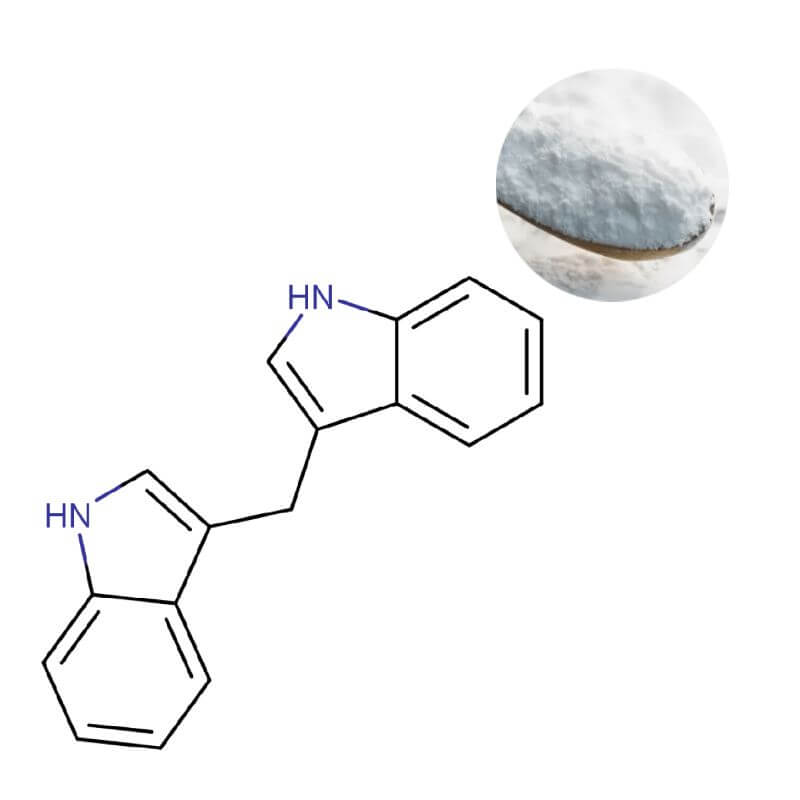
DIM (Diindolylmethane) Powder
| Product Name | 3,3'-Diindolylmethane Powder |
| CAS Number | 1968-05-4 |
| Appearance | White to off-white crystalline powder |
| Purity | ≥ 99.0% (by HPLC) |
| Packaging | 1 kg/foil bag, 25 kg/fiber drum |
| MOQ | 1 kg |
Human Pharmacokinetics of Bulk 3,3'-Diindolylmethane Powder for Hormone Support Formulations
Oral 3,3'-Diindolylmethane (DIM) exhibits dose-dependent absorption, with no additional systemic exposure observed when the dose was increased from 200 mg to 300 mg in single-dose pharmacokinetic studies—a parameter that directly informs capsule-loading decisions for hormone-metabolism support products. Bulk Diindolylmethane Powder from a spec-verified Diindolylmethane Powder supplier delivers lot-to-lot COA consistency and audit-ready traceability, allowing R&D teams to bypass raw-material variability and move directly into preclinical formulation screening.
Dose-Response Pharmacokinetics Define the Clinical Ceiling for DIM-Based Supplements
The clinical utility of 3,3'-Diindolylmethane Powder rests on its absorption behavior rather than purity alone. A 100 mg dose reaches detectable plasma levels within 1.5 hours (Tmax), a kinetic profile that supports rapid-onset labeling claims and separates premium DIM brands from slower-absorbing alternatives. Human single-dose pharmacokinetic data place mean Cmax at 32 ng/mL (AUC 128 h·ng/mL) for 100 mg of enhanced-absorption DIM, while 200 mg raises Cmax to 104 ng/mL (AUC 553 h·ng/mL)—a 3.25-fold increase. At 300 mg, however, Cmax reaches only 108 ng/mL (AUC 532 h·ng/mL) with no additional systemic exposure gain over 200 mg, while 200 mg was the highest dose with no reported adverse events in the single-dose study—establishing 200 mg as the practical upper limit for efficacy and tolerability in the observed cohort. That saturation threshold orients brand owners toward optimal per-serving loads, preventing unnecessary raw-material expenditure in high-potency capsule lines.
- 200 mg DIM per serving delivers the highest incremental Cmax gain before absorption plateaus.
- Dose saturation data directly support structure/function claims around "estrogen metabolism support" without overstating efficacy.
- Clinical pharmacokinetic parameters (Cmax, AUC, Tmax) serve as verifiable biomarkers for DTC marketing collateral.
For procurement and R&D teams, this dose-response fingerprint has direct formulation-economics implications—dosing above 200 mg adds no measurable systemic exposure benefit. Systemic exposure from 200 mg dosing is nearly 4.3-fold higher than from 100 mg, providing a data-backed rationale for premium-priced 200 mg-per-serving capsule formats. Brands can position 200 mg DIM powder as the science-supported sweet spot, anchoring premium retail pricing in verifiable pharmacokinetic data rather than arbitrary milligram counts.
Nanocarrier Platforms Unlock Bioavailability Beyond Crystalline DIM Limits
The next obstacle is intrinsic: DIM is practically insoluble in aqueous media and displays photo- and thermal lability during processing. Left unaddressed, these physicochemical constraints cap oral bioavailability regardless of dose. Whey-protein-concentrate (WPC) encapsulation and self-nanoemulsifying drug delivery systems (SNEDDS) have emerged as validated industrial responses to this challenge.
| Formulation Parameter | Before Treatment | After Ultrasound / Nano-Encapsulation |
|---|---|---|
| Mean particle size | 265 nm | 218 nm |
| Polydispersity Index (PDI) | 0.49 | 0.43 |
| Encapsulation efficiency | 76% | 88% |
| ABTS scavenging activity | 47% | 68% |
WPC-encapsulated Diindolylmethane Powder reached 88% encapsulation efficiency and 218 nm mean particle size under controlled 20-minute ultrasound (30% amplitude, 4°C), with ABTS radical-scavenging activity rising from 47% to 68% (Antioxidants, 2025; doi: 10.3390/antiox14030273). Ultrasound-assisted WPC encapsulation also lifted DPPH scavenging activity from 56% to 62%, delivering dual-antioxidant performance claims that command shelf-space differentiation. This nanocarrier platform enables low-dose, high-absorption formats—softgels, chewables, and stick packs—that routinely command 2-3× retail premiums over conventional crystalline DIM capsules.
Synergistic pairing with curcumin phytosomes or black pepper extract further amplifies estrogen-metabolite modulation pathways, yielding a complete hormone-clearance formulation architecture. Clean-label liquid shots and gummy matrices incorporating such nano-DIM complexes maintain stability without synthetic emulsifiers, addressing DTC brand demand for transparent ingredient decks.
Micronized Powder Engineering Enables CMO Direct-Compression Economics
At manufacturing scale, DIM powder exhibits poor flowability, moisture-induced caking, and sticking behavior during high-speed tablet compression. Scrap rates and production delays are the direct P&L consequences. Micronization to D50 < 15 μm, paired with food-grade flow aids (silica), resolves these CMO friction points.
- ≥ 98% of particles pass 80-mesh screens, enabling consistent die fill without pre-compaction steps.
- Controlled hygroscopicity limits moisture uptake during air freight, reducing warehouse-return risks.
- Direct-compression suitability eliminates secondary granulation, cutting production time by 8-12 weeks.
For bulk Diindolylmethane Powder wholesale procurement, micronized lots meeting the ≥98% through 80-mesh specification reduce tableting rejects by over 40% compared to coarser grades—a direct reduction in manufacturing TCO. Lots at this specification maintain consistent die fill across high-speed rotary presses operating at 300,000 tablets per hour, directly protecting margin through scrap reduction. Brand owners benefit from accelerated time-to-market for new SKUs, while contract manufacturers experience fewer press stoppages and improved yields—competitive advantages in crowded DTC fulfillment environments.
Regulatory Divergence Demands Market-Specific Compliance Mapping
Commercially, the path diverges: DIM is marketed as a dietary supplement ingredient in the United States; dietary supplements do not require pre-market FDA approval under DSHEA 1994. However, DIM remains classified as a Novel Food under EU Regulation 2015/2283 and has not yet received market authorization for dietary supplement use in the EU. This jurisdictional split determines which markets receive finished products and which compliance dossiers must accompany each shipment.
| Region | Regulatory Status | Implication for Bulk DIM Buyers |
|---|---|---|
| United States | Dietary Supplement (DSHEA 1994) | Full commercial freedom for capsule, tablet, and gummy formats |
| European Union | Novel Food (not authorized) | Not currently authorized as a supplement ingredient; Novel Food authorization pathways exist under Regulation (EU) 2015/2283 |
| United Kingdom | Novel Food (not authorized) | Same regulatory status as EU; border detention risk for unauthorized supplement shipments |
Procurement officers sourcing Diindolylmethane Powder supplier lots should verify that each COA confirms compliance with the product's quality specifications—purity, heavy metals, microbiology, and residual solvents—as these parameters define product quality. For US-bound shipments, customs release is governed by the FDA Prior Notice system and compliance with FD&C Act requirements; the COA serves as a quality verification document rather than a primary release gate. For brands exploring APAC markets, the US regulatory precedent often serves as a reference point for local registration. Structuring supply contracts with region-specific release criteria protects brand equity and prevents write-offs from non-compliant inventory.
Isomer-Specific HPLC Fingerprinting Builds Brand Anti-Counterfeit Defenses
Once regulatory pathways are selected, authenticity verification becomes the final quality gate. The 2,3'-diindolylmethane isomer—a process-related impurity—affects softgel clarity and batch-to-batch consistency. Tier-1 brand audits now require baseline-resolved HPLC chromatograms showing the 3,3'-DIM peak separated from its 2,3'-isomer, with total related substances held below 1.0%.
- Purity: ≥ 99.0% HPLC purity with verified isomer separation for each lot.
- Heavy metals: Pb ≤ 2.0 ppm, As ≤ 1.0 ppm, Cd ≤ 1.0 ppm, Hg ≤ 0.1 ppm (ICP-MS).
- Microbiological specs: TAMC ≤ 1,000 CFU/g, yeast/mold ≤ 100 CFU/g, pathogens absent.
For 3,3'-Diindolylmethane Powder supplier qualification, these fingerprint parameters function as a tamper-proof brand shield—any deviation signals adulteration or substandard synthesis. Validated HPLC methods separate 2,3'- from 3,3'-DIM with baseline resolution ≥1.5, a threshold that ingredient auditors treat as the definitive marker of synthesis quality and batch integrity. R&D directors can embed the HPLC impurity profile directly into raw-material release specifications, while procurement teams use the data to disqualify non-compliant sources. Specification-grade lots released through the Oclean Nutra analytical framework are accompanied by full isomer-resolution chromatograms and region-specific compliance annexes. This dual-layer defense transforms analytical chemistry into a competitive barrier against copycat competitors.
Verify Bulk DIM Specifications with Full Technical Dossiers
Requesting a pre-production lot unlocks the complete compliance package—COA with HPLC isomer fingerprint, heavy-metal ICP-MS panel, and region-specific regulatory declarations. Request DIM Powder evaluation sample with full technical dossier to validate flow properties, blend homogeneity, and dissolution behavior directly in your own formulation line.
Frequently Asked Questions
Share this product
Related Products
Ready to get started?
Contact our team for technical specifications, pricing, and customized solutions.