
Epicatechin vs. EGCG for Sports Nutrition and Active Aging: A Technical Sourcing Guide on Bioavailability, Stability, and Mechanism Differentiation
Choosing between Epicatechin and EGCG impacts scale-up success. This guide dissects human pharmacokinetics, 25-fold chiral potency differences, and pH stability to de-risk encapsulation and optimize cost-in-use.
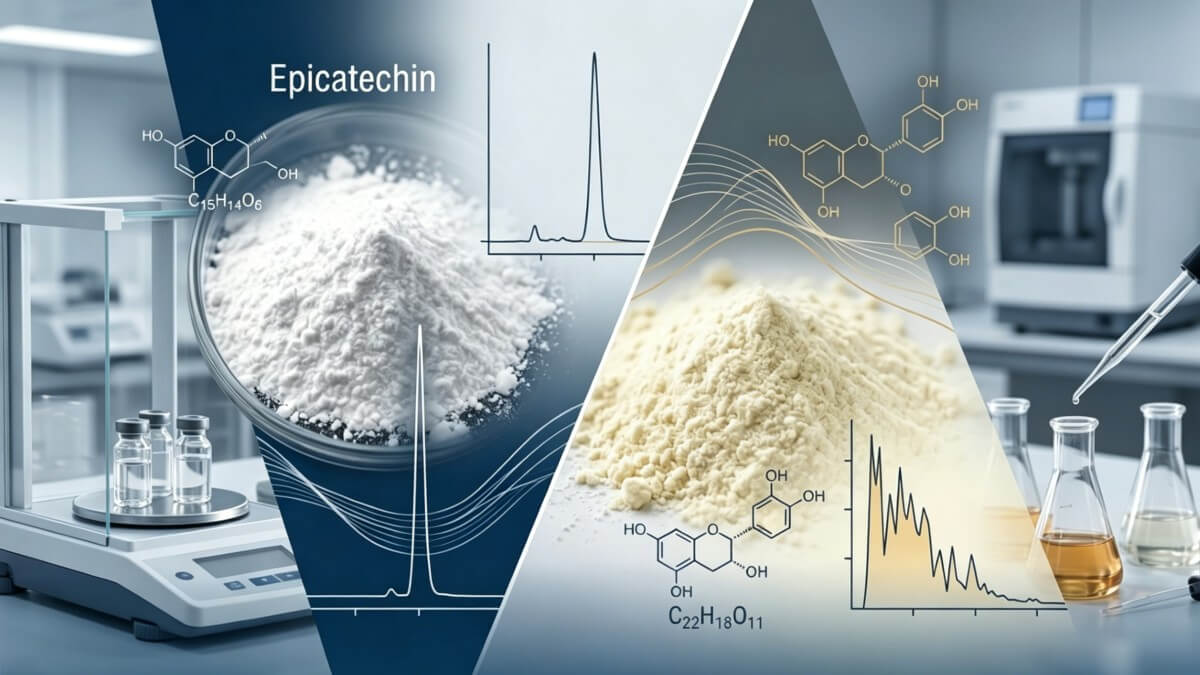
Reformulating a performance or active aging product often stalls at the selection point between two catechins that appear similar on a specification sheet but diverge sharply in human pharmacokinetics and manufacturing behavior. Procurement and R&D teams encounter finished goods that fail to deliver expected functional outcomes because the chosen raw material degrades during processing or lacks the specific receptor affinity required for the intended effect. This guide dissects the quantitative pharmacokinetic, stability, and cost-in-use divergences between Epicatechin and EGCG, equipping sourcing professionals with an analytical framework to de-risk scale-up and substantiate differentiated label claims.
Mechanism and Bioavailability Divergence: Myostatin Modulation versus Nonspecific Antioxidant Scavenging
Epicatechin directly modulates the myostatin-follistatin axis. Human data confirm that (−)-epicatechin suppresses myostatin while upregulating follistatin, shifting the anabolic-catabolic balance toward skeletal muscle maintenance. It stimulates myogenic regulators (MyoD, Myf5, myogenin) and activates AKT/mTOR signaling—a pathway directly linked to muscle protein synthesis. EGCG operates as a nonspecific ROS scavenger without established affinity for myostatin or follistatin. This mechanistic precision translates into distinct pharmacokinetics. Human [2-14C]-epicatechin studies show ~95% absorption from urinary excretion (20% SREMs plus 42% 5C-RFMs), with SREM metabolites reaching a combined Cmax of 1,223 ± 104 nM at a Tmax of 1.0 hour. Under comparable oral dosing, EGCG exhibits a Cmax of approximately 170 nM with inter-individual variability exceeding 6-fold—a significant barrier to batch-to-batch consistency (standardized EGCG Powder (98%) carries higher formulation risk). Market trends toward "high-potency" EGCG labels often overlook this variability; sourcing decisions should prioritize batch-to-batch plasma exposure predictability over label potency claims. For brands targeting strength, Epicatechin provides a mechanism-driven pathway, whereas EGCG offers generalized antioxidant protection that is difficult to translate into specific functional claims (Nutrients, 2024; doi: 10.3390/nu16020326).
| Pharmacokinetic and Targeting Parameter | Epicatechin (EC) | EGCG | Sourcing Implication |
|---|---|---|---|
| Primary Receptor Target | Myostatin Inhibition and Follistatin Elevation | Nonspecific ROS Scavenging | EC supports direct performance claims; EGCG suits general antioxidant positioning. |
| Absorption Rate (Human) | ~95% (urinary excretion derived) | Low (extensive first-pass and efflux) | EC requires lower active input to achieve systemic exposure. |
| Plasma Cmax (Human Equivalent) | 1,223 nM (total SREMs; Tmax 1.0 h) | 170 nM (Tmax 1.6 h; 6x inter-individual variability) | EC delivers more predictable, consistent plasma levels across batches. |
| Label Claim Differentiation | Muscle strength, myostatin management, mitochondrial support | General cellular antioxidant defense | EC enables premium, mechanism-validated claims for active nutrition. |
Physicochemical Stability and Production-Scale Engineering Constraints
EGCG presents substantial stability challenges under standard processing conditions. In pH 7.4 phosphate buffer—relevant for oral solids and liquids—EGCG and EGC degrade almost entirely within hours, whereas EC and ECG show significantly lower degradation. Low-temperature storage (4°C) extends EGCG's half-life to seven days, but ambient processing reduces this to just two days. For high-speed encapsulation and tableting, EGCG's hygroscopicity and poor flow often necessitate costly polysaccharide blends (e.g., pectin) to mitigate sticking and weight variation.
EGCG's hygroscopicity triggers sticking and weight variation above 35% RH; validate flowability at production humidity before committing to high-speed encapsulation.
Epicatechin demonstrates better chemical resilience near neutral pH, though its aqueous solubility remains limited—but this can be managed through lipid carriers or co-solvent systems without compromising structural integrity during mixing.
- Hard Shell Capsules and Tablets: EGCG demands low-RH environments (<30% RH) and desiccant packaging to prevent amorphous-to-crystalline transitions; EC shows better compatibility with direct-compression excipients.
- Gummies and Chewables (Hot Pour Processing): EGCG degrades rapidly above 80°C, often losing greater than 40% activity without advanced microencapsulation; EC retains superior stability under thermal stress, though taste-masking for astringency remains a required investment.
- Beverage Powders and Instant Mixes: EGCG's hygroscopicity accelerates caking during high-humidity packaging; EC's lower moisture affinity extends flowability and reduces cleaning downtime.
From a commercial scale-up perspective, stability data directly inform equipment selection and process design decisions. High-speed tablet presses and encapsulators demand raw materials that maintain consistent flow and compression characteristics across multi-ton batches—academic degradation kinetics translate into real-world downtime costs and rejection rates.
Analytical Methodology, Supplier Auditing, and Cost-In-Use (CIU) Logic
Procurement decisions require scrutiny beyond the certificate of analysis. Epicatechin sourcing from diverse botanicals (Acacia catechu, cocoa, or green tea) can introduce price variation based on source and purity, yet standard HPLC-UV with detection limits of 1.25–15 ng may not reliably distinguish adulterated cuts without specific chromatographic fingerprinting. A critical gap identified in the literature is the absence of standardized chiral HPLC for (−)- versus (+)-epicatechin—synthetic routes can generate racemic mixtures with substantially different bioactivity. Published pharmacokinetic data indicate that the naturally occurring (−)-enantiomer can exhibit up to 25-fold higher plasma exposure compared to its (+)-counterpart, making chiral purity verification a non-negotiable audit item for brands claiming consistent clinical performance. For EGCG, auditors should request full GC-MS residual solvent profiles, as extraction processes vary and can introduce undeclared contaminants. Per-serving cost analysis based solely on price per kilogram is insufficient. Given EC's higher absorption, the net active exposure per milligram is greater, often resulting in lower total ingredient expenditure to reach the required plasma threshold, even if per-kilogram pricing differs. Regulatory status further differentiates the two: both face EU Novel Food classification for isolates, but EC's US GRAS status for specific applications offers faster market access than EGCG's more dose-restricted ODI (Old Dietary Ingredient) position.
| Supply Chain and Procurement Criterion | Epicatechin Powder | EGCG Powder | Strategic Sourcing Verdict |
|---|---|---|---|
| Raw Material Cost Variability | Origin- and purity-dependent (wide range) | Origin- and purity-dependent (wide range) | Price per kilogram alone is misleading; CIU provides real economic comparison. |
| Effective Dose Cost (CIU) | Lower (derived from ~95% absorption and precise myostatin targeting at low doses) | Higher (requires larger doses to compensate for low systemic bioavailability) | EC offers superior ROI for targeted performance formulations. |
| Regulatory Access (EU / US) | US GRAS applicable; EU Novel Food for isolates | US ODI; EU Novel Food with EFSA dose limitations | EC allows broader dosage flexibility in the US market. |
| Critical Audit Item | Chiral purity verification; botanical origin fingerprint | Residual extraction solvents; degradation by-products at pH above 6 | Request chiral HPLC chromatograms and comprehensive solvent profiles. |
Formulation Decision Matrix: Dosage Form Compatibility
The following matrix consolidates engineering data into a direct decision-support framework for R&D and plant operations teams selecting between the two catechins for specific finished formats.
| Dosage Form | Epicatechin Compatibility and Strategy | EGCG Compatibility and Strategy | Critical Scale-Up Intervention |
|---|---|---|---|
| Hard Shell Capsules (Powder Fill) | Angle of repose 35°–38° (excellent flow); bulk density 0.45–0.55 g/mL; stable at ambient temperature | Poor flow; high hygroscopicity; requires glidants and low-RH manufacturing zone | For EGCG: add anti-caking agents (silica) and humidity-controlled encapsulation suite |
| Gummies and Chewables (Hot Pour) | Acceptable thermal stability; requires intensive taste-masking for astringency | Unstable above 70°C; rapid degradation without microencapsulation; not recommended | For EC: invest in cyclodextrin or lipid coating for taste masking |
| Beverage Powders and RTD Mixes | Limited aqueous solubility; requires suspension aids or modified starch systems | High water solubility but chemically unstable in neutral pH liquids | For EC: use micronized dispersion; for EGCG: acidify to pH below 4 and add antioxidants (ascorbate) |
Strategic Procurement Conclusion and Technical Support Access
The selection between Epicatechin and EGCG ultimately reduces to a choice between generalized antioxidant protection and a clinically validated, mechanism-specific anabolic agent. For sports nutrition and active aging formulations where verifiable muscle performance and mitochondrial function are primary endpoints, the quantitative advantages of high-purity Epicatechin Powder (≥98%)—myostatin targeting, ~95% absorption, and superior ambient stability—provide a defensible technical rationale for product differentiation. EGCG remains suitable for broad antioxidant blends, yet its high inter-individual PK variability and poor process stability hinder batch-to-batch clinical consistency.
Navigating these sourcing complexities demands more than standard specification sheets—it requires direct technical engagement. Qualified brands can request formulation feasibility assessments and accelerated stability data packages specific to their target dosage form. The quality team provides full chiral HPLC chromatograms, residual solvent profiles, and regulatory documentation supporting US and EU market entries. Technical samples for scale-up validation are available through the company's dedicated consultation channel.
Contact the technical sourcing team for formulation support and sample qualification.
Share this article
Found this helpful? Share it with others!
Related Products
Products mentioned in this article
Related Articles
You might also be interested in

Beyond Muscle: Epicatechin’s Role in Epigenetic Aging and Sarcopenia Intervention
A 2026 network meta-analysis repositions epicatechin ahead of whey for sarcopenia, while new COSMOS data links it to delayed epigenetic aging. This R&D brief decodes global compliance and high-purity supply realities.

The Dark Side of the Functional Food Boom: An Honest Look at Epicatechin Claims and Controversies
The epicatechin market is surging, but hype obscures real science. We cut through the noise, analyzing controversies, bioavailability challenges, and how brands can build trust with transparent, high-quality ingredients for lasting success.

Meeting the Demand for Clean-Label Energy: Formulating with Natural Epicatechin
Consumers are demanding clean-label energy beyond caffeine. Discover how natural Epicatechin, a potent flavanol from green tea, supports sustained cellular energy and aligns with clean-label trends for innovative supplement and functional food formulations.
Want to learn more?
Explore our products or contact our team for personalized solutions and expert advice.