
Beyond Single Ingredients: Building a Synergistic “Male Vitality” Stack with Maca, Fenugreek, and Shilajit
Maca, Fenugreek, and Shilajit form a powerful synergy for male vitality. This article analyzes the clinical evidence, formulation strategies, and market success of this stack, providing actionable insights for brands aiming to create differentiated, science-backed products.
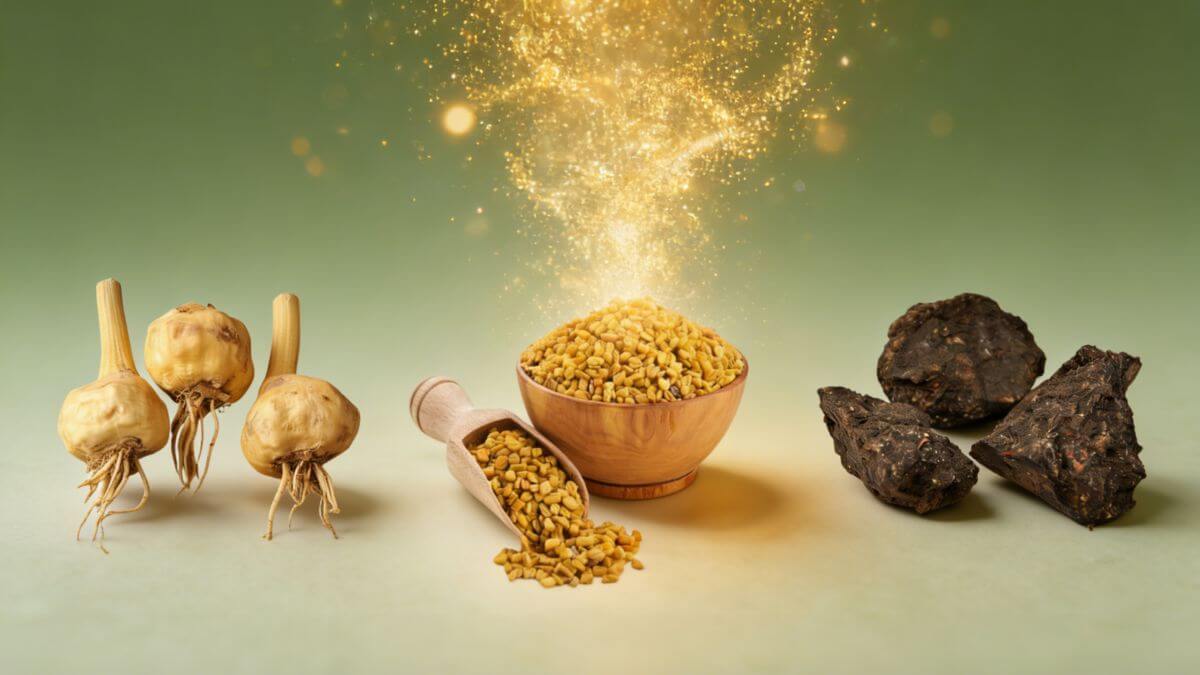
The men’s health supplement market is undergoing a profound shift. For years, products centered on isolated benefits—testosterone support, energy, or libido—and often relied on a single hero ingredient. Today’s consumers, armed with information from social media and peer-reviewed studies, expect more. They seek holistic solutions that address energy, hormonal balance, physical performance, and recovery in one seamless formula. According to SPINS 2023 data, the “male vitality” segment within the dietary supplement market grew by 12% over the previous year, with multi‑ingredient formulas outperforming single‑ingredient products by a factor of two. Euromonitor projects that the global plant extract market will reach $103.6 billion by 2034, driven by demand for science‑backed, multifunctional blends (Cepok, ONdrugDelivery, 2025). For brands aiming to capture this opportunity, the path forward lies not in a single blockbuster ingredient, but in intelligent, synergistic combinations. This means the competitive advantage will increasingly belong to brands that master formulation science, not just ingredient sourcing. This article explores how the strategic pairing of three clinically studied botanicals—Maca Root Extract Powder, Fenugreek Seed Extract Powder, and Shilajit Extract Powder—can create a comprehensive “male vitality stack” that resonates with informed consumers and differentiates brands in a crowded market.
The Science of Synergy: Why Multi‑Target Formulations Win
The modern understanding of male vitality recognises it as a multidimensional state involving libido, muscle function, stress resilience, and metabolic health. A 2025 comprehensive review of herbal therapies for male sexual health (doi: 10.4236/health.2025.179071) confirms that effective interventions work through multiple pathways—both hormonal (hypothalamic‑pituitary‑gonadal axis) and non‑hormonal (nitric oxide signalling, antioxidant activity). Single ingredients, no matter how potent, can only cover part of this spectrum. By combining ingredients with complementary mechanisms, formulators can create products that deliver more complete and noticeable results. This shift is already visible on retailer shelves: products labelled “testosterone support” are plateauing, while those marketed as “total vitality” or “energy + strength + stamina” are gaining share. Google Trends data from 2024 shows a 40% increase in searches for “male health stack” compared to the previous year. For brand decision‑makers, this signals a clear opportunity to move beyond me‑too single‑ingredient offerings and invest in research‑backed combinations. The implication: products that tell a story of holistic, multi‑pathway support will capture the attention of today’s educated consumer.
Deconstructing the Stack: Three Ingredients, One Goal
A well‑designed stack leverages the distinct mechanisms of each component to create a cascade of effects—from initiation to execution to recovery. Understanding the unique role each ingredient plays is the first step; the real value emerges when they are combined to mirror the body's own complex systems. Below we examine the scientific foundation of three ingredients ideally suited for a male vitality formula.
Maca Root Extract: The Libido and Energy Catalyst
Maca (Lepidium meyenii), a root vegetable native to the Peruvian Andes, has been used traditionally to enhance stamina and sexual function. Modern clinical studies, including the classic Gonzales trial (Andrologia, 2002), demonstrate that maca improves sexual desire without altering serum testosterone—pointing to a non‑hormonal pathway. More recent research (Heliyon, 2025) reveals that maca’s effects may be mediated by increasing total antioxidant capacity and reducing pro‑inflammatory cytokines such as TNF‑α and IL‑6. This positions maca as the “excite” component, priming the body for vitality. For formulators, a standardized extract (typically 4:1 or 10:1) ensures consistent dosing and allows for flexible incorporation into capsules, tablets, or powdered blends. When sourcing, brands should look for suppliers that provide documentation of glucosinolate and macamide content—key markers of quality. For brands, maca offers a clinically supported entry point into the vitality conversation without the regulatory complexities of hormone‑modulating ingredients. For brands seeking a reliable supply of this foundational ingredient, Maca Root Extract Powder with full traceability and GMP compliance is available.
Fenugreek Seed Extract: Hormonal Support and Beyond
Fenugreek (Trigonella foenum‑graecum) seeds are rich in furostanolic saponins, compounds shown to support healthy testosterone levels. A 2024 randomized double‑blind controlled trial (PMID: 39288153) found that supplementation with a standardized fenugreek extract significantly increased both plasma and salivary testosterone in healthy men. Earlier work by Rao et al. (The Aging Male, 2016) demonstrated that a 600 mg daily dose of a saponin‑standardized extract improved age‑related androgen decline and sexual function. By supporting the HPG axis, fenugreek acts as the “synthesizer,” providing the hormonal foundation for vitality. In addition to its role in testosterone modulation, fenugreek has been shown to support insulin sensitivity and lipid metabolism, offering ancillary benefits for metabolic health—a growing concern among middle‑aged men. Fenugreek's dual action makes it a versatile anchor for formulations targeting active men over 35. For product developers, Fenugreek Seed Extract Powder standardized to 50% saponins is available with full analytical support.
Shilajit: Mitochondrial Support and Recovery
Shilajit, a mineral‑rich exudate from the Himalayan rocks, is prized for its high fulvic acid content, which acts as a powerful antioxidant and enhances mitochondrial function. A landmark 2019 randomized trial (PMID: 30728074) investigated its effects on fatigue‑induced muscle weakness. Sixty‑three active men received either 250 mg or 500 mg of a standardized shilajit extract, or a placebo, for eight weeks. The high‑dose group (500 mg/day) experienced significantly less decline in maximal voluntary contraction after exercise (8.9% vs. 17.0% in placebo, p<0.05) and lower serum hydroxyproline levels, indicating reduced connective tissue breakdown. Shilajit’s role in mitochondrial bioenergetics and its ability to reduce oxidative stress make it the “sustainer” component, enabling faster recovery and prolonged endurance. Shilajit’s emerging science on recovery positions it as a key ingredient for the growing ‘active aging’ demographic. For brands formulating with shilajit, standardization to fulvic acid (typically ≥50%) is essential to guarantee efficacy. Shilajit Extract Powder with guaranteed fulvic acid content and third‑party testing supports consistent product performance.
Formulation Strategies for a Synergistic Stack
The scientific rationale for a stack is only as good as its practical execution in a scalable, stable format. Combining three active extracts into a stable, bioavailable finished product requires attention to several formulation challenges. Plant extracts can be hygroscopic, sticky, or prone to oxidation, and their interactions may affect dissolution and stability. Here are key considerations for R&D teams:
- Dosing and standardization: Clinical evidence points to effective daily doses of approximately 1000 mg for maca root extract, 600 mg for fenugreek seed extract (standardized to 50% saponins), and 500 mg for shilajit extract (standardized to 50% fulvic acid). These levels are already validated in commercial products available in the market. Formulators should verify that their chosen extracts meet these specifications and request certificates of analysis (COA) from suppliers. Formulators should verify that their chosen extracts meet these specifications and request certificates of analysis (COA) from suppliers.
- Excipient selection: To address the stickiness of fenugreek or the density of shilajit, water‑soluble filler‑binders such as isomalt or microcrystalline cellulose can improve flow and compaction during tableting. For capsule fills, the use of silicon dioxide as a glidant may prevent clogging.
- Stability testing: Accelerated stability studies under ICH conditions are recommended to assess potential interactions. For example, the high mineral content of shilajit could affect the disintegration of certain tablet coatings; working with an experienced contract manufacturer can help optimise the blend.
- Dosage form innovation: While capsules are the simplest route for high‑load powders, tablets offer cost advantages at scale. For brands targeting younger demographics, stick packs or gummies are emerging as popular formats, though they require specialised taste‑masking and often lower doses per serving.
For brands sourcing bulk ingredients, partnering with a supplier that provides comprehensive documentation—GMP compliance, heavy metal testing, and stability data—is critical to ensure batch‑to‑batch consistency and regulatory compliance. What these formulation considerations underscore is that a successful stack requires collaboration between R&D and procurement from the outset—clinical efficacy must be matched by manufacturing feasibility.
Real‑World Validation: The Stack in the Marketplace
One of the most compelling proofs of concept for this three‑ingredient combination can be found in commercial products already available to consumers. Each four‑capsule serving delivers 1000 mg of maca root extract, 600 mg of fenugreek extract (50% saponins), and 500 mg of shilajit (50% fulvic acid), alongside supporting nutrients like zinc and vitamin B6. The product’s marketing emphasises a “triple‑layer” approach: a “Herbal Desire Blend” (maca), a “Pro‑Test Blend” (fenugreek + shilajit + zinc), and an “Anti‑Fatigue Blend” (schisandra + B6). This transparent communication of the formulation logic resonates with consumers who seek products grounded in science. The success of such products lies not just in their ingredient selection but in their ability to translate complex science into a simple consumer narrative—a lesson for any brand entering this space. The existence of such a product demonstrates that the stack is not just theoretical—it is already succeeding on the market, providing a blueprint for other brands.
Key Takeaways for Brand Decision‑Makers
For R&D and procurement leaders evaluating new product concepts, the following insights can guide strategic decisions:
- Prioritise synergy over hero ingredients: Multi‑target formulations address the multifaceted nature of male health and align with consumer demand for comprehensive solutions.
- Demand clinical evidence: Insist on extracts backed by human trials, such as those cited for fenugreek (PMID: 39288153) and shilajit (PMID: 30728074). The 2025 review (doi: 10.4236/health.2025.179071) provides a helpful overview of the evidence base.
- Partner with transparent suppliers: Look for suppliers that offer full traceability, third‑party testing, and technical support for formulation challenges.
- Stay ahead of regulatory trends: While structure‑function claims (e.g., “supports healthy testosterone”) are permissible in many regions, always consult with regulatory experts to ensure compliance.
Conclusion: Building the Next Generation of Male Vitality Products
The era of single‑ingredient male health supplements is giving way to sophisticated, science‑driven stacks that address the complete picture of vitality. By combining Maca Root Extract Powder, Fenugreek Seed Extract Powder, and Shilajit Extract Powder in a well‑formulated product, brands can deliver on the promise of holistic wellness—energising, synthesising, and sustaining the active male consumer. The market data, clinical research, and existing commercial examples all point to a clear opportunity. The evidence is in: the future of male health is synergistic. For brands, the path forward involves moving beyond hero ingredients to embrace holistic formulation science—and partnering with suppliers who can support that vision. For brands ready to innovate, the next step is to dive into the technical details: request our product specifications, review our stability data, and discuss your custom formulation needs with our team. Contact our technical experts to start building your next best‑seller.
Share this article
Found this helpful? Share it with others!
Related Products
Products mentioned in this article
Want to learn more?
Explore our products or contact our team for personalized solutions and expert advice.