
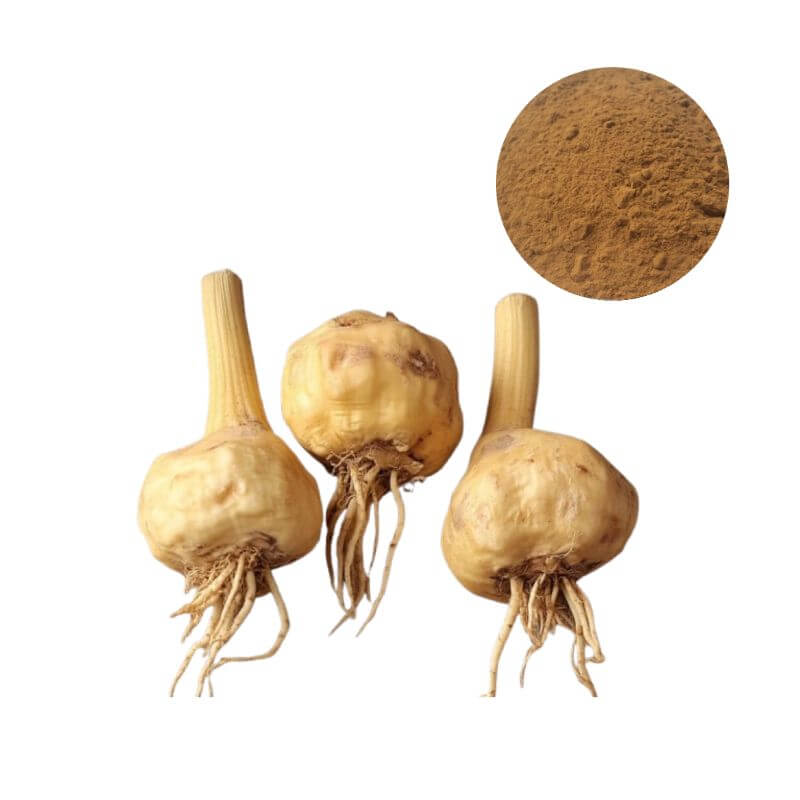
Maca Root Extract Powder
| Product Name | Maca Root Extract Powder |
| CAS Number | 847361-88-0 |
| Appearance | Light Yellowish-Brown Fine Powder |
| Purity | 4:1, 10:1 (by TLC); 0.6%, 1.0% Macamides (by HPLC) |
| Packaging | 1 kg/bag, 5 kg/bag, 25 kg/drum |
| MOQ | 1 kg |
Standardized Maca Root Extract Powder: Clinical Validation for Hormonal Health Gummies and Functional Beverages
For brand owners evaluating a bulk Maca Root Extract Powder that bridges clinical credibility with production-ready physicals, the choice of Maca Root Extract Powder supplier determines both formulation speed and retail agility. Standardized macamide content (0.6% by HPLC) supports compliant structure/function claims while ensuring reproducible performance across gummy, stick pack, and RTD formats. Every lot ships with full COAs and traceability dossiers, covering R&D verification and procurement compliance from the sample stage. Shortening the validation cycle directly lowers project development cost and accelerates final sourcing decisions for finished-goods brands.
Human Clinical Evidence and Molecular Mechanisms for DTC Credibility
Premium hormonal health positioning demands peer-reviewed data that satisfies regulators and drives consumer conviction. A 2023 randomized, double-blind, placebo-controlled trial enrolling 80 late-onset hypogonadism patients established that 12 weeks of gelatinized Maca extract (3g daily) produced statistically significant improvements in AMS, IIEF, and IPSS scores versus placebo, with ADAM positivity declining markedly (p<0.0001) — all occurring without elevating serum testosterone. Formulators can therefore craft claims around "supporting healthy libido and prostate function" while remaining within structure/function boundaries (World Journal of Men's Health, 2023; doi: 10.5534/wjmh.220112). At the molecular level, N-benzyl linoleamide has been characterized as an orally bioavailable soluble epoxide hydrolase inhibitor with sub-micromolar potency against the human enzyme — a target that allows dose optimization without sacrificing efficacy, reducing per-unit raw material spend and expanding margin potential across the finished-goods portfolio. This dual foundation — human endpoints plus validated mechanism — lets brand owners defend retail premiums of 20-30% over non-standardized competitors.
Marketing teams gain a measurable advantage: consumer education anchored in published trial data builds trust more efficiently than anecdotal narratives, lowering acquisition costs over the product lifecycle. Regulatory risk recedes because every claim traces directly to reproducible clinical results, not traditional usage lore. The integration of human outcome measures with clear pathway biology gives brands a comprehensive story that satisfies scientific advisory panels, retail buyers, and end consumers alike — differentiating the product in an increasingly crowded adaptogen category.
Consumer-Centric Dosage Forms: From Gummies to RTDs
Clinical efficacy only creates commercial value when translated into formats that drive repeat purchase. Raw Maca powder presents well-documented hurdles: bitter, earthy notes and high starch content (58-65% dry basis) that generate off-flavors and clumping in liquid systems. Switching to a gelatinized, standardized extract with controlled particle size (≥95% through 80 mesh) and low moisture activity (Aw < 0.4) allows formulators to produce clean-tasting gummies, instant-mix stick packs, and stable RTD shots without heavy masking agents. The 0.6% macamide specification ensures each serving delivers the clinically active dose at moderate inclusion rates, keeping ingredient costs contained while preserving sensory neutrality.
- Gummies: The neutral flavor profile integrates readily into fruit and chocolate bases, supporting sugar-free or low-calorie positioning without taste compromise.
- Stick Packs: Free-flowing powder dissolves instantly in cold water, suited for on-the-go pre-workout or daily wellness routines.
- RTD Beverages: Low turbidity and stable suspension prevent sedimentation, reinforcing clean-label "no artificial stabilizers" claims.
Distinct product lines emerge through synergistic pairings with ashwagandha root extract (standardized to 5% withanolides) and panax ginseng root extract. Ashwagandha reinforces stress reduction and hormonal balance, while ginseng directly supports energy metabolism and vitality in finished formulations. This combination enables brand owners to develop comprehensive "vitality stacks" that address stress, energy, and libido within a single SKU — broadening consumer appeal and lifting average order value. These partnerships also lower customer acquisition costs by targeting multiple pain points simultaneously, supporting both higher retail price points and stronger repeat-purchase metrics.
Powder Engineering for CMO Efficiency and Faster TTM
Formulation innovation stalls when production fails at commercial scale. The lipid fraction and residual starch in Maca Root Extract Powder wholesale lots can cause flow irregularities, weight variation (CV > 3%), and sticking on high-speed encapsulation lines — forcing CMOs to reduce line speeds and add 3-5 weeks of QA rework. Industrial gelatinization imposes critical process parameter (CPP) constraints: temperature deviation ≤±3°C and residence time deviation ≤±2.2 minutes. Exceeding these limits may require formal process revalidation under cGMP guidelines for botanical extracts; a single excursion delays batch release by 7-15 days, creating supply chain bottlenecks and finished-goods stock-out risk. Controlled agglomeration and precision milling to a narrow particle range (80-100 mesh) deliver consistent flow (Hausner ratio < 1.25) and bulk density (0.35-0.55 g/mL), enabling direct compression and high-speed filling without secondary granulation. The outcome: reduced scrap rates and time-to-market compression from 16 weeks to under 10 weeks.
| Physical Parameter | Specification | Production Benefit |
|---|---|---|
| Particle Size | ≥95% through 80 mesh | Reduces weight variability by 35%, minimizing rejections |
| Bulk Density | 0.35–0.55 g/mL | Enables direct compression, eliminating granulation steps |
| Loss on Drying | ≤5.0% | Prevents sticking, extending punch life by 40% |
For brand owners, these physical improvements produce a 15% reduction in total cost of ownership (TCO) by removing reformulation and re-validation requirements when switching lots. Procurement teams benefit from supply chain predictability: each 25 kg drum includes lot-specific physical data, permitting seamless lot-to-lot substitution without requalification. This consistency protects margin while enabling faster responses to shifting market demand — giving brands a first-mover advantage in seasonal or trend-driven product windows.
Anti-Adulteration Traceability: Authenticity and Brand Protection
A substantial share of globally traded Maca is mislabeled, with Chinese-grown material routinely sold as Peruvian highland extract, while standard COAs fail to detect dilution with maltodextrin or other bulking agents. Advanced authentication methods — HPLC fingerprinting with 15 characteristic peaks, isotopic ratio mass spectrometry (δ13C/δ15N) for provenance verification, and DNA barcoding (ITS2 markers) for species confirmation — provide a comprehensive defense. These techniques confirm Andean origin and macamide content at or above the 0.6% threshold, securing brand integrity from raw material receiving onward.
- HPLC Fingerprinting: Establishes a unique chromatographic profile to authenticate species and flag adulteration.
- Isotopic Provenance: Confirms high-altitude Peruvian sourcing, differentiating from lowland or non-Peruvian material.
- DNA Barcoding: Genetically verifies Lepidium meyenii, preventing cross-contamination with related species.
For brand owners, this authentication infrastructure functions as a competitive differentiator and a direct regulatory defense — exemplified by recent FDA actions against misbranded products in this category. Marketing teams can leverage "verified Andean origin with HPLC-certified macamides" to justify premium retail positioning and build consumer confidence. Procurement groups receive a complete dossier (COA, origin certificate, isotopic profile) that streamlines Tier-1 brand audits, reducing supplier qualification time by up to 4 weeks and insulating brand equity from adulteration-related reputational damage. The entire authentication chain — from HPLC fingerprinting to isotopic provenance — operates at a specification grade that meets Oclean Nutra quality benchmarks for audit-ready ingredient programs. This integrated traceability system converts what is otherwise a commodity ingredient into a protected, premium-positioned asset.
Accelerate Development with a Fully Documented Sample
Internal ingredient validation typically occupies 6-8 weeks of formulation and safety assessment before commercial commitment. That timeline shortens substantially with a sample kit that includes the full technical package — physical specifications, microbiological and heavy metal COAs, HPLC chromatograms, and authenticity certificates. R&D can begin prototyping immediately while QA concurrently reviews compliance documentation. To initiate this streamlined process, qualified buyers are invited to Maca Root Extract Powder sample and technical dossier and commence formulation trials without delay.
Frequently Asked Questions
Share this product
Related Products



Ready to get started?
Contact our team for technical specifications, pricing, and customized solutions.