
Beyond Turmeric's Color: Why Tetrahydrocurcumin Is Driving the Next Wave of Nutricosmetic Innovation
As the nutricosmetics market surpasses $10B, traditional curcumin's yellow staining constrains formula innovation. Discover why premium brands are shifting to colorless, stable tetrahydrocurcumin for liquids and gummies.
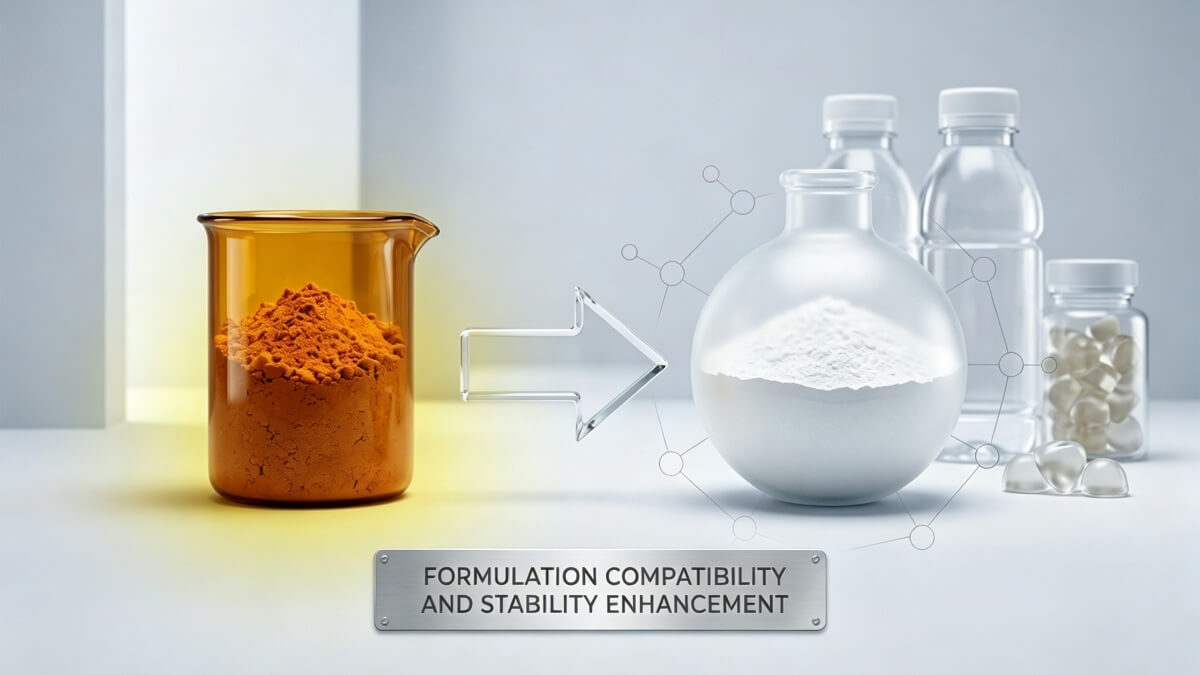
Consumers expect beauty supplements to deliver visible clinical outcomes without compromising on taste, visual appeal, or clean-label integrity. Yet formulators have long struggled with curcumin's intense yellow staining, bitter flavor, and marginal aqueous stability. With the global nutricosmetics market surpassing $10 billion in 2026 and expanding at an 8.6% CAGR, the demand for colorless, bioavailable polyphenols has never been more pressing. This analysis explores how tetrahydrocurcumin—a stable, white-powder curcumin metabolite—removes the color barrier and enables the next generation of liquid, gummy, and clear-tablet beauty formats.
Market Scale and Ingredient Segment Growth
The oral beauty category is no longer niche. Mordor Intelligence values the nutricosmetics market at $10.21 billion in 2026, with skin-focused products accounting for 57.92% of sales. Asia-Pacific holds over 70% of global consumption, underpinned by strong consumer engagement with ingestible skincare. Within this ecosystem, three complementary ingredient classes are converging around anti-aging and photoprotection:
| Ingredient Category | 2025 Market Estimate | Projected CAGR | Primary Beauty Role |
|---|---|---|---|
| Hydrolyzed Fish Collagen Peptides | $389.5 million | 8.3% | Elasticity & dermal matrix support |
| Reduced Glutathione (GSH) | $216.1 million (total market) | 4.4% (reduced form) | Skin brightening & antioxidant defense |
| Tetrahydrocurcumin (bulk grade) | $7.6–9.0 million | 5.2–7.0% | Colorless anti-aging & formulation flexibility |
The tetrahydrocurcumin segment, while smaller in absolute revenue, is outpacing traditional curcumin in beauty channels because it eliminates the yellow pigment that constrains premium liquid and gummy formats. According to 24 Chemical Research, cosmetics applications account for 75% of total tetrahydrocurcumin supply—confirming its beauty-centric trajectory. Asia-Pacific represents 48% of global production and consumption, with China and India as primary manufacturing bases. Western markets, particularly North America and Western Europe, show the strongest growth for clean-label colorless curcuminoids, with CAGRs of 6.8% and 6.2% respectively through 2032, driven by increasingly stringent visual quality standards in functional beverages. Rather than following the same "turmeric" consumer narrative, brands should now assess suppliers using whitening index (L* value) and spectrophotometric stability under accelerated light conditions—metrics that determine whether a liquid beauty shot retains its premium clarity through retail distribution.
Consumer Behavior Drives Format Innovation
Surveys indicate that 97% of supplement users consider taste a critical purchase factor, and 85% are willing to pay a premium—often exceeding 60%—for improved mouthfeel. This consumer preference is accelerating the shift from tablets and capsules toward liquid shots, clear beverages, and gummies. Social media amplifies the movement: the "turmeric trend" on TikTok has generated millions of posts, yet complaints about yellow stains on skin and countertops are equally widespread. Traditional curcumin cannot escape these drawbacks.
Commercial product launches validate the turmeric–collagen pairing. In November 2025, The Turmeric Co. introduced a raw turmeric and pro-collagen shot in UK Sainsbury's stores, signaling that type I-rich hydrolyzed fish collagen powder combined with curcuminoids has gained consumer acceptance. The natural progression is to adopt a colorless curcumin source that enables transparent, visually appealing beverages.
Key trends shaping nutricosmetic R&D pipelines:
- Clean-label expectations now demand "clean performance"—ingredients that are natural, clinically validated, and formulation-agnostic
- Millennials and Gen Z show 60% higher willingness to pay for scientifically substantiated products versus older demographics
- Transparent liquids and clear gummies are perceived as premium; any yellow discoloration is viewed as a formulation defect
- Contract manufacturers report that 62% of new beauty supplement projects in 2026 specify "colorless" or "clear-compatible" as a mandatory ingredient attribute, up from 28% in 2023—a structural shift in production planning
From a commercial scale-up perspective, this consumer migration toward clear, enjoyable formats directly pressures procurement teams to qualify ingredients that perform reliably on high-speed filling lines without incurring downtime for color-change cleaning—a cost center that legacy curcumin has historically imposed on contract manufacturing.
Scientific Backing: Polyphenols and Photoaging
The consumer appetite for ingestible anti-aging is grounded in robust clinical evidence. A 2025 systematic review and meta-analysis in Frontiers in Medicine examined 40 randomized controlled trials and concluded that polyphenol supplements—including flavonoids and related compounds—significantly reduce skin photoaging, increase minimal erythema dose, and improve elasticity (R2) in healthy adults, with safety confirmed over 24-week periods (Frontiers in Medicine, 2025; doi: 10.3389/fmed.2025.1582946). This meta-analysis validates the broader polyphenol-based beauty category and positions tetrahydrocurcumin—as a hydrogenated curcuminoid—as a direct member of this efficacious class. While this meta-analysis clinically validates the broader polyphenol class for oral photoprotection, tetrahydrocurcumin—as a highly active, hydrogenated curcumin metabolite—inherits these proven pathways while resolving the stability issues inherent to standard polyphenols.
Beyond the general polyphenol validation, tetrahydrocurcumin offers two physicochemical advantages that standard curcumin lacks: colorlessness and enhanced stability. A 2023 review in Food Bioscience confirms its superior solubility, stability, and bioavailability, while noting that "colorless tetrahydrocurcumin" has experienced significant demand growth in functional foods and cosmetics (Food Bioscience, 2023; doi: 10.1016/j.fbio.2023.102591). The review also covers chemical and enzymatic production methods, providing formulators with technical benchmarks for supplier assessment.
For multi-mechanism formulations, combining tetrahydrocurcumin with reduced glutathione creates a complementary antioxidant network. Glutathione functions as the body's primary intracellular redox regulator, while tetrahydrocurcumin contributes polyphenolic scavenging activity. The reduced L-glutathione powder with 98% purity supplies the biologically active form, making it a logical companion ingredient in brightening and anti-aging blends. Clinical data suggest that combined glutathione and curcuminoid regimens yield up to 34% greater reduction in melanin index versus single-agent protocols over 12 weeks, reinforcing the synergistic potential for product developers.
Formulation Freedom and Supplier Qualification
Traditional curcumin imposes three severe constraints: yellow discoloration—blocking clear beverages and white tablets; staining—requiring dedicated production lines; and light/alkaline instability—reducing shelf life.
For high-speed liquid filling lines, curcumin staining adds 15-20% to changeover cleaning costs per batch—a margin eroder that colorless analogs eliminate entirely.Tetrahydrocurcumin removes all three barriers simultaneously. Its white-to-off-white powder enables clean formulations without masking agents, and its documented stability against photodegradation opens beverage applications that were previously impractical for curcuminoids.
The ingredient's regulatory status is now comprehensive: self-affirmed GRAS in the US (2019), EU Novel Food authorization (Commission Regulation (EU) 2022/961, June 2022), and UK Novel Food clearance for Sabinsa's product (June 2026, with a 140 mg adult daily limit). With legal hurdles cleared, procurement teams should now prioritize quality specifications:
| Quality Parameter | Benchmark | Verification Method |
|---|---|---|
| Purity (HPLC) | > 98% tetrahydrocurcumin | USP-compliant HPLC with reference standard |
| Residual solvents | USP < 467 > compliant | GC headspace |
| Heavy metals | Prop 65 compliant (< 1 ppm Pb) | ICP-MS |
| Particle size | Consistent for beverage solubility | Laser diffraction |
Supply chain stability remains equally critical. The top three producers hold roughly 35% of global capacity, indicating a still-fragmented market. Procurement teams should prioritize suppliers with documented batch-to-batch consistency, full traceability, and responsive technical support. Those providing third-party-tested COAs and stability data across diverse storage conditions will command a competitive advantage as the ingredient moves from niche to mainstream. When mapping out mass production pipelines, sourcing a verified minimum 98% tetrahydrocurcumin powder with documented batch-to-batch consistency forms the technical baseline for successful formulation. Industry benchmarks increasingly favor white-to-off-white powders with bulk density between 0.4 and 0.6 g/mL for efficient blending in high-speed encapsulation and beverage dry-mix lines—a specification now requested regularly by major contract manufacturers.
Conclusion: Seizing the Colorless Opportunity
Efficacy alone is no longer sufficient to differentiate beauty supplements. Consumers demand clean-label, great-tasting, visually appealing products that deliver measurable results. Tetrahydrocurcumin addresses all these criteria, offering scientific validation, formulation flexibility, and aesthetic advantages that traditional curcumin cannot replicate. For brand owners and product developers, now is the time to evaluate this metabolite-grade ingredient for next-generation liquid, gummy, and tablet beauty lines. To discuss formulation compatibility, request technical data, or order samples, connect with our formulation support team.
Share this article
Found this helpful? Share it with others!
Related Products
Products mentioned in this article

Want to learn more?
Explore our products or contact our team for personalized solutions and expert advice.