
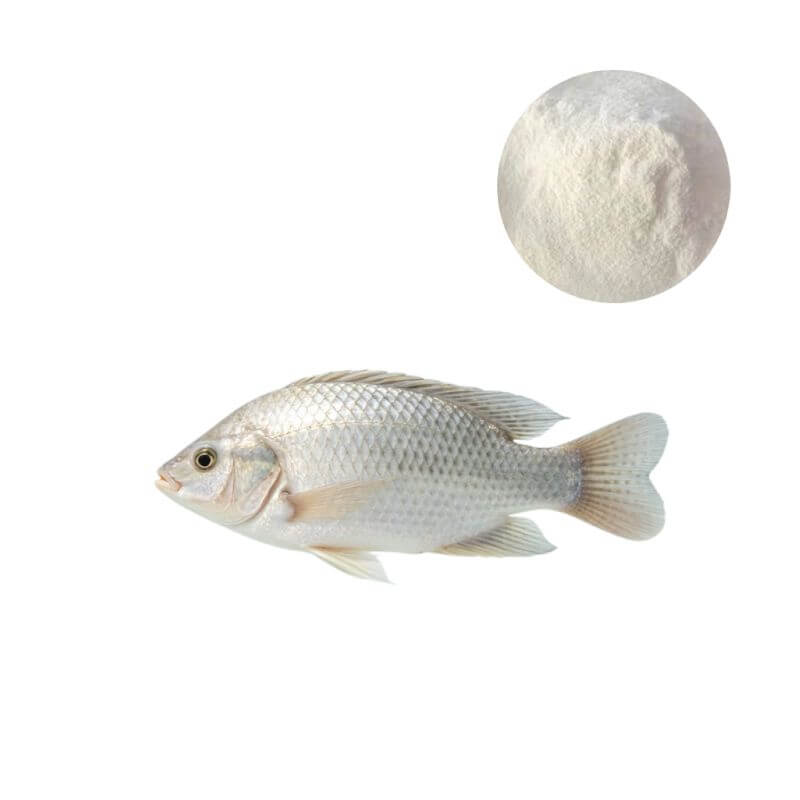
Hydrolyzed Fish Collagen Powder
| Product Name | Hydrolyzed Fish Collagen Powder |
| CAS Number | 9007-34-5 (9064-67-9) |
| Appearance | White to off-white fine powder |
| Protein Content | 90.0% min. (by Kjeldahl Method) |
| Packaging | 1 kg/bag, 5 kg/bag, 25 kg/drum |
| MOQ | 25 kg |
Hydrolyzed Fish Collagen Powder - Bioavailability Benchmark for Oral Beauty Applications
Absorption kinetics of hydrolyzed fish collagen peptides determine their functional efficacy in skin matrix support, with circulating Pro-Hyp dipeptide reaching 50-80 nmol/mL within 1-2 hours via PePT1 transport. For bulk sourcing, batch-to-batch consistency in the < 3,000 Da fraction (95th percentile by HPLC-SEC) translates to reproducible clinical outcomes. Spec-verified suppliers provide chromatographic profiles and species-authenticated COA documentation, enabling R&D teams to qualify incoming lots without redundant testing and ensure stable performance across multi-ton contracts. Securing tight control over molecular weight distribution directly fortifies a brand's competitive positioning in the premium oral beauty segment, where formulation integrity and label-backed efficacy command measurable price premiums at retail.
Dipeptide-Driven Clinical Endpoints for Skin Structure Claims
Fibroblast chemotaxis triggered by Gly-Pro-Hyp tripeptides distinguishes low-molecular-weight fish collagen from intact gelatin or higher-molecular-weight hydrolysates. A 2024 randomized double-blind trial (6 weeks, 80 subjects, 2.5 g/day of ≤ 1,000 Da fish collagen) reported a 46% reduction in wrinkle volume (p < 0.001) and 34% increase in skin hydration (p < 0.001) using Visioscan and Corneometer. A separate 12-week study (100 subjects, 1650 mg/day) confirmed significant improvements in elasticity (p=0.009) and dermal density (p<0.05). These biomarker shifts provide formulators with defensible data for structure/function claims. The 3,000 Da ceiling ensures peptide fragments remain within the size window for receptor-mediated activity, avoiding the inert bulk-protein effect observed in hydrolysates exceeding this threshold.
| Clinical Endpoint | Improvement | Duration | Dosage |
|---|---|---|---|
| Wrinkle volume (Visioscan) | -46% (p < 0.001) | 6 weeks | 2.5 g/day |
| Skin hydration (Corneometer) | +34% (p < 0.001) | 6 weeks | 2.5 g/day |
| Elasticity (R2 parameter) | Significant (p=0.009) | 12 weeks | 1650 mg/day |
| Dermal density (ultrasound) | Significant (p<0.05) | 12 weeks | 1650 mg/day |
Processing Stability and Synergist Compatibility in High-Load Liquids
Ready-to-drink (RTD) formulations containing >8% w/v fish collagen peptides face stability constraints tied to the peptide's amine functionality. Maillard reaction with reducing sugars drives pH drift (0.3-0.6 units over 3-6 months) and browning (A420 rise) above pH 4.5, especially when storage exceeds 40°C. Commercial solutions include citric/malic acid buffering to pH 3.8-4.2 and EDTA-2Na chelation to suppress metal-catalyzed oxidation. ascorbic acid Vitamin C, the most validated synergist, acts as a prolyl hydroxylase cofactor to stabilize triple-helix conformation; however, at >0.5% w/w in aqueous systems, competitive oxidation requires nitrogen-blanketed mixing and oxygen-barrier packaging to preserve both actives. For powder blends, peptide hygroscopicity demands packaging with low water-vapor transmission rates and moisture-barrier inner liners to prevent caking during ambient storage. Managing these physical stability parameters at the raw-material stage enables formulators to reduce costly production rework, compress batch release timelines, and maintain consistent organoleptic quality across high-volume RTD production runs.
| Formulation Risk | Trigger Condition | Critical Control | Industrial Corrective |
|---|---|---|---|
| Maillard browning / off-flavor | pH > 4.5, temp > 40°C | pH ≤ 4.0, process < 40°C | Citrate buffer + EDTA-2Na |
| Viscosity increase (gelation) | Peptide > 8% w/v at >25°C | Storage < 25°C | Low-DH grade; chilled distribution |
| Vitamin C oxidation in co-formulations | Dissolved O2 > 1 ppm | O2 < 1 ppm | N2 blanketing, foil-lined primary pack |
Emergent Finished-Good Formats Reshaping the Nutricosmetic Pipeline
The market is shifting from powder sachets toward sensory-driven liquid and solid formats that exploit the high solubility and low viscosity of fish collagen peptides. Clear protein water - a transparent, zero-sugar sparkling beverage delivering 10-15 g collagen per 330 mL - requires peptides with transmittance >90% at 600 nm and a neutral flavor profile, achieved via activated carbon polishing and low-temperature spray drying. For stick-pack beauty products targeting the overnight recovery segment, particle size ≥ 95% through 80 mesh and tapped bulk density 0.35-0.45 g/mL are essential to avoid bridging on high-speed filling lines, while controlled hygroscopicity prevents caking in humid environments. Functional gummies represent another growth vector but require a heat-stable peptide grade (withstanding up to 80°C processing) and pH management to suppress Maillard browning in sugar-based matrices.
- Clear RTD protein water - clarity >90% transmittance; neutral taste; 10-15 g per serving; cold-fill compatible; zero-sugar.
- Overnight beauty stick packs - 5 g single dose; co-formulated with GABA and polysaccharides; rapid cold-water dispersion; anti-caking granulation.
- Functional gummies / jellies - heat-stable grade (80°C processing); pectin/gelatin base; pH control to prevent browning in sugar syrups.
Regulatory Gateways for US and EU Market Entry
Fish-derived collagen peptides follow distinct US and EU regulatory pathways. In the US, the ingredient holds GRAS status (GRN 725) and does not require NDIN submission, but species authenticity remains a focus for FDA audits - documentation must accompany each shipment. In the EU, the ingredient is listed in the Novel Food Catalogue as a traditional food under Regulation (EC) No 853/2004; however, EFSA has not approved any direct skin-health claim under Article 13. Permissible claims are limited to general wording such as "supports normal connective tissue function," which can be coupled with vitamin C's approved claim. Critical compliance triggers include species declaration and a valid catch certificate; failure to provide these can lead to customs detention at EU entry ports. Maintaining a complete regulatory dossier with species-specific PCR validation and catch-area documentation compresses customs clearance cycles, reduces port-of-entry inspection holds, and delivers a verifiable compliance buffer that procurement teams can present during supplier quality audits without last-minute document chasing.
| Parameter | United States (FDA) | European Union (EFSA/EC) |
|---|---|---|
| Regulatory classification | GRAS (GRN filings) | Novel Food Catalogue (traditional food) |
| Pre-market filing required | No NDIN | No specific filing; comply with (EC) 853/2004 |
| Approved health claims | Structure/Function (no pre-approval) | Article 13 generic; "normal connective tissue" via vitamin C synergy |
| Mandatory audit documentation | Species declaration | Species + catch certificate (anti-IUU) |
Aqueous Processing and Clean-Label Certifications for Premium Brand Positioning
Commercial production of fish collagen peptides relies exclusively on water-based enzymatic hydrolysis - no chlorinated solvents (methylene chloride, chloroform), ketones, or hydrocarbons are introduced at any stage, aligning with ICH Q3C Class 1 and Class 2 prohibitions. The purification train includes ceramic membrane ultrafiltration (10 kDa MWCO) and activated carbon decolorization, delivering a peptide powder free of processing aids. Clean-label qualification is supported by Non-GMO Project verification, MSC sustainable fisheries certification, and allergen-free declarations validated via PCR to exclude gluten, soy, and dairy cross-contamination. For brands targeting European retailers operating under BRCGS or IFS standards, these certifications act as procurement filters; missing any one disqualifies a supplier from the annual vendor shortlist. Complete traceability from fishing vessel to finished powder - including catch area, species DNA barcode, and processing date - enables brands to substantiate sustainability and origin claims on finished-product packaging. For procurement directors conducting total-cost-of-ownership assessments, the combination of full-chain traceability and multi-certification coverage eliminates the financial exposure tied to rejected shipments, off-spec reruns, and brand-reputation damage from unsubstantiated origin statements - risks that carry far greater weight than the per-kilogram price differential in the final vendor selection calculus.
- 100% aqueous process - No Class 1 and Class 2 organic solvents; ceramic UF fractionation; ICH Q3C compliant.
- Non-GMO & allergen-free - PCR-verified; gluten, soy, dairy absent at trace levels.
- MSC-certified sourcing - Sustainable fisheries chain-of-custody documentation provided per batch.
- BRCGS / IFS-ready - HACCP and allergen control protocols meet European retailer food safety benchmarks.
Accelerate Formulation Development with Documented Peptide Performance Data
Securing qualification samples with accompanying HPLC-SEC profiles, species-authenticated COAs, and MSC traceability records bypasses redundant in-house testing and shortens the supplier qualification cycle. Procurement and R&D teams are invited to request a spec-verified peptide sample with full technical documentation to validate processing parameters and claim-supporting data in their own formulation trials.
Frequently Asked Questions
Share this product
Related Products
Ready to get started?
Contact our team for technical specifications, pricing, and customized solutions.