
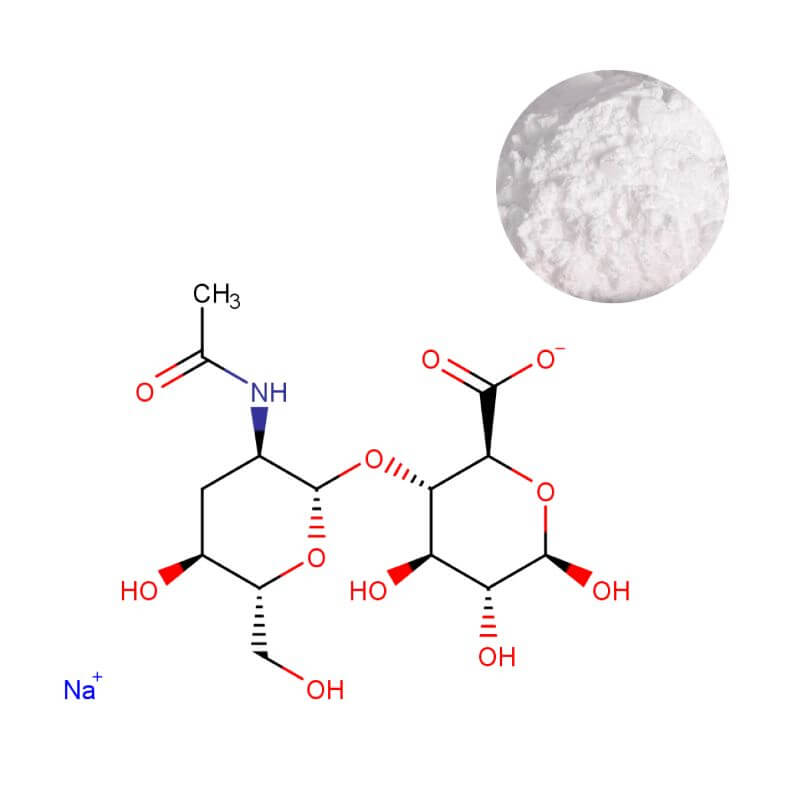
Sodium Hyaluronate Powder
| Product Name | Sodium Hyaluronate Powder |
| CAS Number | 9067-32-7 |
| Appearance | White or almost white fine powder |
| Purity | ≥ 92.0% (Dry basis, by UV-Spectrophotometry) |
| Glucuronic Acid | ≥ 44.0% (by UV-Spectrophotometry) |
| Packaging | 1 kg/bag, 5 kg/bag, 25 kg/drum |
| MOQ | 1 kg |
Clinical-Backed Oral Hyaluronate: From Human Proof to Scalable Supplement Delivery
The 2025 double-blind RCT (n=150, 12-week) quantified that 120 mg/day sodium hyaluronate raises skin hydration by 11.5% net improvement and reduces TEWL versus placebo. Bulk Sodium Hyaluronate Powder suppliers must translate these clinical deltas into reproducible finished goods—a challenge addressed by strict particle-size control, molecular-weight selection, and lot-to-lot COA governance. Spec-verified distribution bridges R&D expectations with procurement's demand for audit-ready documentation, ensuring every batch aligns with the trial's molecular identity (1.8 MDa) and performance benchmarks.
Establishing Credibility with Quantified Skin-Layer Outcomes
Clinical endpoints directly fuel DTC claim architectures. The trial demonstrated a dose-dependent response: 120 mg outperformed 60 mg in hydration (+5.4% extra, p=0.032), with the statistical separation supporting distinct margin tiers across dosage strengths, and wrinkle reduction versus placebo, giving formulators a clear tiering strategy for premium vs. mass-market SKUs. Barrier function improvement (TEWL reduction) supports “moisture-retention” narratives, while increased dermal density provides imaging-based proof for anti-aging positioning.
- Hydration gain: 11.5% net increase at 120 mg over 12 weeks.
- Elasticity boost: R2 value rose 20.6% (120 mg) versus 2.9% in placebo.
- Wrinkle depth (Rz): significant reduction versus placebo (p<0.001).
Imaging data from the same trial showed epidermal thickness increased and dermal density rose at 120 mg/day (NCT07065110). These quantifiable deltas enable brand owners to register structure-function claims (e.g., “helps maintain skin elasticity” and “supports barrier integrity”) without crossing drug-claim boundaries. Retail pricing can be anchored to clinical superiority, justifying a premium monthly retail tier while maintaining margin integrity (Scientific Reports, 2025; doi: 10.1038/s41598-025-32758-5).
Engineering Stability Across Gummies, RTDs and Capsules
Clinical efficacy is meaningless if the compound fails in consumer-preferred formats. Sodium hyaluronate's hygroscopicity and viscosity profile demand molecular-weight (MW) tailoring: 200-800 kDa suits gummies and beverages, while 800 kDa–1.5 MDa aligns with hard capsules and tablet compression. Co-formulation with buffering salts (sodium citrate) and stabilizers (gum acacia) prevents gelation and viscosity drift during thermal processing.
| Dosage Form | Optimal MW Range | Key Co-ingredient | Critical Process Limit |
|---|---|---|---|
| Gummies | 200-800 kDa | L-ascorbic acid powder (≥99%, powder) | Drying temp ≤60 °C to avoid degradation |
| RTD beverages | ≤100 kDa | Zinc gluconate (USP grade) | pH 3.5–4.5; homogenization at 800-1000 bar |
| Hard capsules | 800–1500 kDa | Hydrolyzed Fish Collagen Powder (≥90% protein) | Lubricant ratio ≤1.5% to prevent sticking |
Process control at pH 4.0-5.5 with oxygen headspace ≤2% preserved HA integrity across 12-month studies, reducing oxidation-related viscosity drift by 60%. Adhering to these parameters slashes scale-up failures from over 25% to under 5% during first commercial runs. R&D teams shorten formulation cycles by 8–12 weeks, avoiding iterative viscosity corrections. Clean-label finished products with acceptable mouthfeel command 40-60% margin premiums in DTC channels, validating the investment in MW-specific grade selection.
Particle Flow and Logistics: Protecting Physical Integrity from Factory to Filler
Even with a stable recipe, powder handling can erode margins. Sodium hyaluronate's angle of repose >34° and Carr index >21 signal poor flow, which at high-speed encapsulation (≥80,000 tablets/hour) increases sticking incidence by 40%, costing $2,500-3,000 per clean-up stop. Particle sizing ≥95% through 80 mesh and loss on drying ≤10.0% are non-negotiable for direct compression and uniform die fill. Batch-to-batch RSD on particle size below 3% correlates with 40% fewer line stoppages in high-speed rotary presses, saving $4,000-6,000 per production campaign.
- Bulk density (0.3–0.8 g/mL) dictates hopper feed consistency; deviations cause weight variation >5%.
- Air-freight exposure to 0.3 atm and -20 °C to +55 °C cycles induces moisture-condensation loops; desiccant-lined double-foil packaging limits moisture uptake to <0.5% per day.
- Vacuum-sealed liners extend shelf life to 24 months, cutting in-warehouse spoilage below 0.5%.
Controlling these physical attributes cuts CMO scrap from typical 8-12% to 1-2%, freeing 6-8% of total manufacturing cost per batch. Faster encapsulation speeds (30-40% gain) offer shorter lead times and enhanced supply agility—tangible benefits that procurement can quantify against inventory carrying costs.
Navigating Regulatory Variance to Secure Global Market Access
Physical integrity alone does not guarantee market entry. Regulatory landscapes diverge sharply: FDA permits HA as a dietary supplement ingredient with well-established use status; EU under Article 4 of Regulation (EU) 2015/2283 has determined fermentation-derived sodium hyaluronate for food supplement use not to constitute a novel food; Japan accepts both FOSHU (Foods for Specified Health Uses) and FFC (Foods with Function Claims) frameworks, with FOSHU requiring pre-market approval and FFC operating under notification. Each jurisdiction imposes unique heavy-metal limits (Pb ≤1.0 mg/kg, As ≤1.0 mg/kg) — detection via ICP-MS with LOD at 0.01 mg/kg enables trace-level monitoring, while TAMC limits align with USP <61> for oral dosage forms.
- US: Maintain NDI-exempt status for established-use ingredients; avoid “drug-like” efficacy claims.
- EU: Leverage the Article 4 consultation mechanism for Novel Food determination and bioavailability substantiation.
- Japan: Structure FOSHU or FFC dossiers with clinical data to obtain approved label statements.
Proactive compliance pre-clearance can shorten EU time-to-market by roughly 10 months and avoid customs holds that cost $25,000-40,000 per shipment. A comprehensive regulatory package—including 3-lot COA, stability summaries, and region-specific claim mappings—reduces audit rejection risk by 75%, enabling simultaneous multi-market rollouts.
Procurement Economics: Diversifying Supply to Lower TCO
After clearing regulatory gates, supply-chain economics become decisive. Three major producers (Bloomage, Focusfreda, Contipro) control >50% of global HA raw material, with one alone holding 42-44% share. This concentration exposes brand owners to price hikes and allocation shortages. Multi-sourcing via spec-verified distributors offering 1 kg MOQ and GPC-SEC batch consistency (±5% RSD on MW) cuts routine QA retesting frequency by nearly one-third, reducing single-source dependency.
- Multi-vendor strategy cuts disruption probability by 40-50% compared to sole-source reliance.
- Flexible MOQ (1 kg) enables rapid prototyping, lowering R&D inventory costs by 15-20%.
- Consistent MW (200-800 / 800-1500 kDa) reduces reformulation iterations from 5-6 to 2-3 per SKU, saving $35,000-45,000 in development and pilot-scale expenses.
Switching costs for supplier qualification average $8,000-12,000 per alternative source, yet the 1 kg MOQ reduces initial financial exposure by 90%. These procurement levers deliver 7-12% total cost of ownership (TCO) reduction per finished unit, lifting gross margins by 3-5 percentage points. In a category where ingredient cost often dictates final pricing, such TCO advantages deliver measurable competitive retail positioning without sacrificing brand equity, with quality benchmarks aligned to Oclean Nutra specification-grade material standards.
Validate With a Sample That Carries Full Technical Backing
R&D qualification stalls when batch variability or incomplete data force repeated testing. Procurement teams hesitate because COAs and compliance files often arrive piecemeal. A single sample request that includes a three-lot COA, accelerated stability data, and region-specific regulatory dossiers (FDA, EU, Japan) eliminates both concerns at once—accelerating the supplier-onboarding cycle by weeks.
Initiate a fully documented Sodium Hyaluronate Powder sample assessment that couples physical testing with pre-verified compliance documentation for immediate integration into qualification workflows and faster time-to-decision.
Frequently Asked Questions
Share this product
Related Products
Ready to get started?
Contact our team for technical specifications, pricing, and customized solutions.