
Beyond Single-Ingredient Longevity: Strategic Urolithin A Synergies for Next-Gen Mitochondrial & Cellular Health Formulations
Clinical data and supply constraints drive the pivot toward Urolithin A formulation stacks. Discover key raw material market dynamics, NMN synergies, and strategic sourcing solutions for next-gen cellular health products.
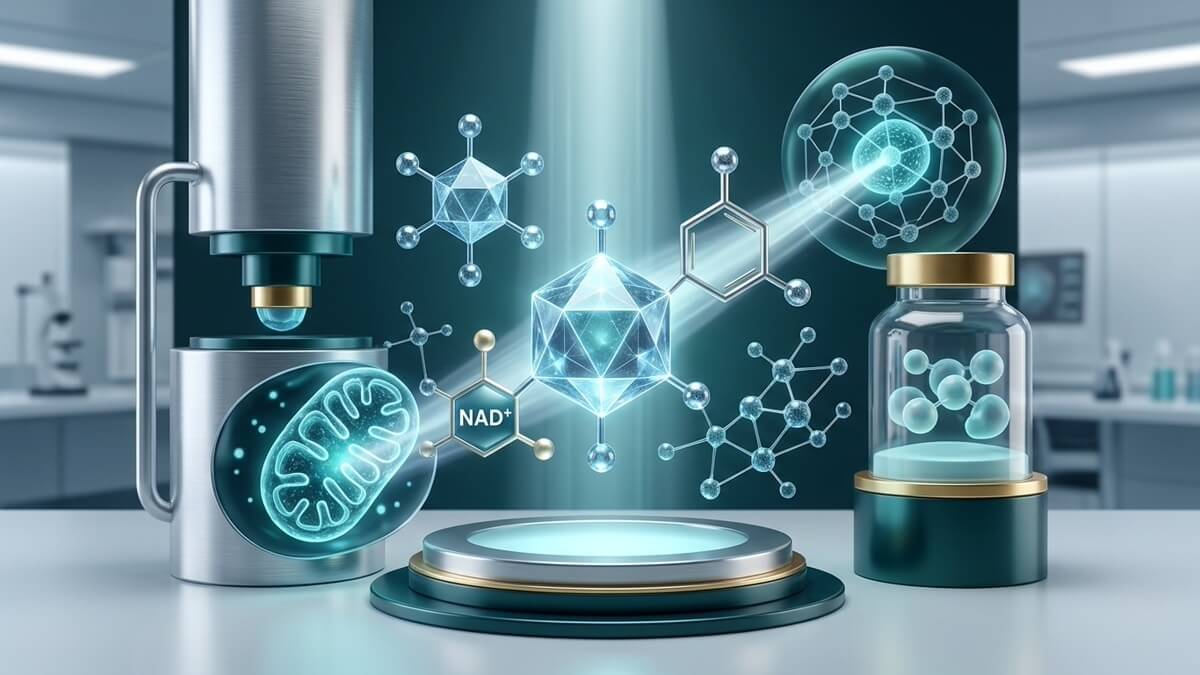
The 2025 Nature Aging clinical trial on urolithin A catalyzed a decisive shift in the cellular health category. For B2B procurement executives and product strategists, the emerging signal is not merely rising consumer curiosity, but a tightening raw material supply curve and a distinct pivot toward multi-target, high-AOV formulation stacks. This evolution demands a fundamental reassessment of sourcing baskets and supplier qualification criteria.
Global Raw Material Demand Dynamics and Supply Gaps
The commercial trajectory of urolithin A is defined by aggressive compound growth across multiple market tiers. The global food-grade urolithin A raw material sector, valued at $113.82 million in 2025, is projected to reach $292.47 million by 2032, reflecting a CAGR of 14.43%. Simultaneously, the finished supplement segment specifically targeting mitophagy has reached $1.0 billion in 2025 (MarketIntelo, 2025), with forecasts indicating a CAGR of 15.2% through 2034, ultimately scaling to $3.6 billion. This expansion is not abstract; it translates directly into a significant metric-ton demand gap for high-purity powders (≥98% by HPLC), placing upward pressure on contract manufacturing lead times and bulk pricing structures. North America accounted for approximately 42% of global market revenue in 2025 (MarketIntelo), but emerging regulatory clarity in Europe and Asia is rapidly redistributing this demand, with the Asia-Pacific region alone expected to see substantial growth through 2032, compelling procurement teams to lock in long-term supply agreements for Urolithin A Powder before capacity constraints escalate. Brands that anchor procurement specifications on particle size uniformity and dissolution rate profiles, rather than chasing generic purity claims, will secure manufacturing agility and avoid the commoditization trap that erodes margins in saturated longevity markets.
| Segment | 2025 Value | 2032/2034 Projection | CAGR | Implied Demand Driver |
|---|---|---|---|---|
| Food-Grade UA Raw Material | $113.82M | $292.47M (2032) | 14.43% | Capacity expansion required |
| UA Mitophagy Finished Supplements | $1.0B | $3.6B (2034) | 15.2% | Formulation differentiation |
| Global Longevity Supplements | $9.2B | ~$15.8B (2033) | 7.7% | Broad market tailwind |
This escalating demand for UA, driven by rising consumer awareness of mitophagy mechanisms, is now forcing procurement teams to re-evaluate supplier qualification protocols, especially regarding batch-to-batch consistency in emerging gummy and RTD production lines where flowability and compressibility are critical.
Strategic Stacking: Mitophagy Clearance Meets NAD+ Regeneration
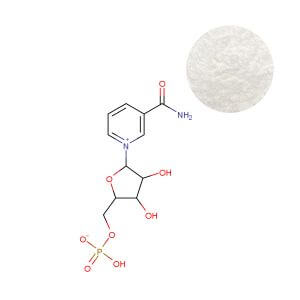
Procurement logic for 2026 must pivot from single-ingredient spot buying to integrated synergistic baskets. Urolithin A functions as the cellular "clearance" engine via mitophagy, but its standalone efficacy is significantly amplified when paired with NAD+ precursors. The mechanistic rationale is reinforced by high-level clinical quantification: a 2025 randomized controlled trial demonstrated that 1,000 mg/day supplementation for four weeks expanded CD8+ naive-like T cells by 0.50 percentage points (P=0.0437) and boosted fatty acid oxidation capacity by 14.72 percentage points (P=0.0061) in healthy adults (Nature Aging, 2025; doi: 10.1038/s43587-025-00996-x). This validates the metabolic remodeling potential, yet the commercial edge lies in stacking UA with NMN Powder to fuel the newly cleared mitochondrial network with NAD+ substrates, thus driving a "clear-and-renew" narrative that supports a distinct premium over single-molecule competitors. Given that the global NMN supplement market was valued at approximately $1.05 billion in 2025 and is expanding at a CAGR of 10.55%, dual-sourcing UA and NMN offers procurement leverage and ensures formulation continuity across production cycles.
Format Evolution and the Bioavailability Specification Shift
The introduction of urolithin A gummies in April 2025 by a category leader represents more than a consumer convenience trend; it signals a fundamental shift in raw material specification requirements. Traditional hard capsule powders are insufficient for high-moisture or chewable matrices. The primary technical barrier remains UA's extremely low aqueous solubility, resulting in sub-1% baseline bioavailability. For R&D and sourcing teams, this necessitates a move toward liposomal encapsulation or co-crystal technologies. Recent comparative studies confirm that pH-driven liposomal encapsulation significantly enhances stability and bioaccessibility, delivering a 1.91-fold increase in bioavailability (Int. J. Biol. Macromol., 2023; doi: 10.1016/j.ijbiomac.2023.127554). With gummies and RTD formats now representing a growing share of new cellular health product launches, formulators are prioritizing dispersible grades that reduce batch rejection rates during high-speed encapsulation or molding. Consequently, forward-looking brands are now specifying encapsulated or highly dispersible UA grades.
Dispersible UA grades with controlled particle size distribution are non-negotiable for high-speed gummy lines rejecting over 4% of batches due to content uniformity failures.
This industrial shift is directly addressed by utilizing liposomal-encapsulated urolithin A powder supplied by Oclean Nutra, a technical ingredient partner recognized for rigorous specification control and comprehensive regulatory dossier support, which specifically tailors particle engineering to support stable suspension in RTD beverages and uniform distribution in gummy matrices, thereby mitigating batch rejection risks during scale-up.
Global Regulatory ADI Limits and Market Entry Barriers
Regulatory statuses vary sharply across key geographies, imposing distinct constraints on formulation dosage and market launch timelines. Procurement and compliance teams must align ingredient sourcing with these permissible thresholds. In the United States, GRAS status (GRN No. 000791) permits incorporation into functional foods and beverages at up to 500 mg or 1,000 mg per serving, while structure-function claims are permissible, though therapeutic claims remain strictly off-limits. The European Union presents a more complex landscape; EFSA issued its scientific opinion on Urolithin A as a novel food (EFSA Journal 2020;18(1):5969) and confirmed a positive safety opinion for up to 500 mg/day for adults in 2022, with the final regulatory authorization decision still pending under the ongoing Novel Food application (NF 2018/0538). Australia recently opened a definitive regulatory window via TGA Determination No. 3 (2025), effective September 2025, formally listing UA as a permitted listed medicine ingredient. Meanwhile, the UK's ACNFP has requested additional identity and toxicology data, pushing projected approval to late 2027, which creates a near-term bottleneck for brands targeting the British market. For brands evaluating adjacent synergies, incorporating Trans-Resveratrol Powder requires similar dossier checks, yet its established safety profile makes it a lower-risk addition. Meanwhile, PQQ Disodium Salt Powder faces fewer novel food hurdles globally, making it a highly pragmatic sourcing anchor alongside UA for rapid market entry.
- United States: GRAS GRN No. 000791 – Max 500-1,000 mg/serving. No approved clinical claims.
- European Union: EFSA scientific opinion (EFSA Journal 2020;18(1):5969) and positive safety opinion (2022) for 500 mg/day ADI; final regulatory authorization pending under NF 2018/0538.
- Australia: TGA Determination No. 3 (2025) – Formal listed ingredient status as of Sept 2025.
- Canada: NHP with established NPN precedents (e.g., 80140186) – Full market access available.
- Singapore: Approved Novel Food for chemically synthesized UA – Gateway to SE Asia.
Procurement Strategy for the Longevity Supply Chain
Beyond purity and heavy metal compliance, strategic sourcing for urolithin A now demands evaluation of supplier capabilities in format-specific particle engineering and regulatory dossier support. Technical criteria must include confirmed stability data across 24 months at varying climatic zones, HPLC purity profiles with individual impurity identification, and documented scalability for liposomal or co-processed grades. Given the extended lead times observed for encapsulated UA grades, procurement managers should prioritize suppliers offering integrated technical collaboration to shorten formulation validation cycles. A growing number of contract manufacturers now prefer pre-dispersed or cold-water-soluble UA grades to reduce blending time and improve batch-to-batch consistency, a specification trend that directly influences sourcing criteria. Engaging with a technically equipped ingredient partner enables access to these refined specifications while ensuring alignment with evolving global ADI thresholds and regional labeling requirements.
Conclusion: Strategic Sourcing as a Competitive Moat
The urolithin A market has entered a phase where raw material procurement is directly linked to product innovation speed and premium positioning. A disciplined approach combining capacity-locked UA sourcing, synergistic NMN and PQQ integration, and rigorous format-specific specification control provides the foundation for high-margin product differentiation. Procurement managers and brand strategists are encouraged to move beyond transactional quotes and engage in collaborative technical discussions to secure supply continuity and formulation excellence.
To evaluate technical specifications, request stability data packages, or co-develop a synergistic formulation architecture, contact our technical sourcing team for a consultation tailored to your regional market entry roadmap and production schedule requirements.
Share this article
Found this helpful? Share it with others!
Related Products
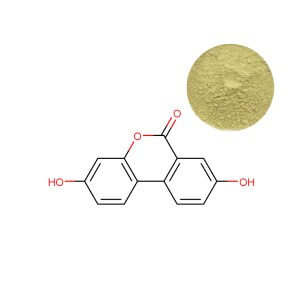
Products mentioned in this article
Related Articles
You might also be interested in

Urolithin A vs. The Rest: How to Choose the Right Anti-Aging Ingredient for Your Product Formulation
Confused by anti-aging ingredients? This guide cuts through the hype, comparing Urolithin A's targeted cellular benefits against NMN, Fisetin, and pomegranate extract. Learn key selection criteria—from clinical evidence to formulation stability—to make an informed choice for your next product.
Overcoming Urolithin A Solubility & Cohesiveness: Industrial Scale-Up and Bioavailability Optimization in Solid Dosage Forms
Overcome Urolithin A solubility barriers and punch sticking in high-speed manufacturing. This guide details particle sizing, lipid wet granulation, and stability protocols for solid dosage lines.
Want to learn more?
Explore our products or contact our team for personalized solutions and expert advice.