
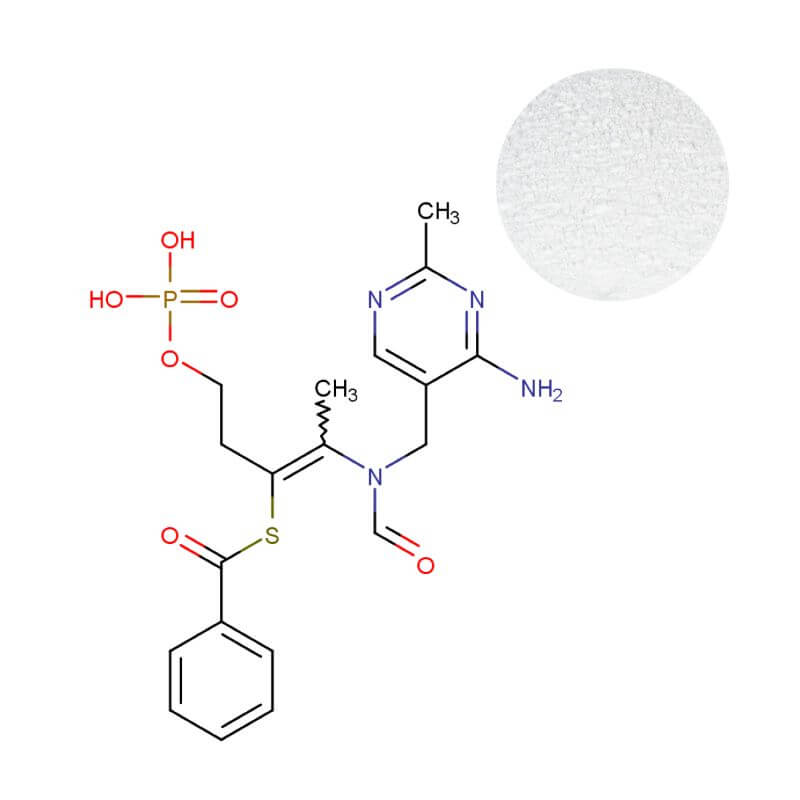
Benfotiamine Powder
| Product Name | Benfotiamine Powder |
| CAS Number | 22457-89-2 |
| Appearance | White to off-white crystalline powder |
| Purity | 99.0% min. (On Dried Basis by HPLC) |
| Packaging | 1 kg/bag, 5 kg/bag, 25 kg/drum |
| MOQ | 1 kg |
Bulk Benfotiamine Powder with Optimized Particle Kinetics: Eliminating CMO Line Downtime in Large-Scale Metabolic Health Formulations
For global supplement brands formulating glucose metabolism and cardiovascular support products, the transition from lab-scale blending to high-throughput manufacturing often exposes hidden costs: powder segregation, electrostatic bridging, and inconsistent fill weights. Benfotiamine—a fat‑soluble thiamine derivative—addresses these production bottlenecks when supplied as a standardized crystalline powder with defined particle behavior. By shifting focus from raw purity alone to engineered physical characteristics, procurement directors can directly reduce mechanical stoppage and rework expenses. A high‑purity benfotiamine grade creates a defendable formulation barrier, minimizing downstream quality deviations that erode consumer trust.
Mitigating Powder Segregation & Electrostatic Bridging During High-Speed Encapsulation
Standard benfotiamine powder exhibits a crystalline morphology with ≥95% passing 80 mesh (USP <786>), a specification that directly influences flowability and bulk density (≥0.35 g/ml). From a physical blending and stabilization standpoint, it is critical to note that this particle behavior ensures homogeneous mixing with other nutraceutical actives—such as high-stability Alpha-Lipoic Acid or free-flowing chromium picolinate—without layer separation during multi‑station rotary presses. This precise macrometric stability ensures strict adherence to USP <905> Uniformity of Dosage Units, eliminating the 2‑3% over‑fill waste common with poorly graded batches. Separately, from a biopharmaceutics perspective, this optimized physical grade fully preserves the inherent therapeutic advantages of the molecule. A phase I clinical trial (n=108) quantified the compound‘s rapid absorption (median thiamine Tmax 1.0–2.0 h) and moderate accumulation ratio (Rac=1.96–2.11 after 7 days), confirming that the material consistently delivers its signature absorption profile without formulation‑induced delays (doi: 10.2147/DDDT.S296197). For brand developers and formulators, this particle behavior directly implies that predictable die fill and minimized weight variation eliminate the over‑fill waste common with poorly graded batches. Practically speaking, specifying a benfotiamine lot that meets USP <1174> powder flow criteria can increase encapsulation line speeds by 15‑20% without retrofit investments.
- Hot‑spot shear force evaluation: High‑speed encapsulators (≥100,000 capsules/h) generate frictional heat that can melt fine particles. Premium benfotiamine grades maintain crystallinity up to 198°C melting point, preventing gumming on tamping pins.
- Humidity‑induced caking prevention: The compound‘s critical relative humidity (CRH) is ~65% at 25°C. Routine storage below 60% RH avoids agglomeration, a common cause of feeder blockages in tropical warehouses.
- Electrostatic dissipation strategies: Blending with 0.5‑1% colloidal silicon dioxide (by weight) neutralizes static charges without altering dissolution profiles, a cost‑saving trick for contract manufacturers handling benfotiamine‑heavy blends.
Supply Chain Resilience & Total Cost of Ownership (TCO) Analytics
The broader commercial implication here centers on replacing spot‑buy mentality with a TCO‑driven procurement model. Benfotiamine, as a mature synthetic molecule, suffers from price volatility driven by thiamine HCl feedstock costs. However, selecting a supplier that provides batch‑specific Certificates of Analysis (COA) with full traceability to starting materials (thiamine hydrochloride, benzoyl chloride) mitigates two hidden risks: (1) cross‑contamination from poorly cleaned reactors, and (2) residual solvent deviations (e.g., methanol ≤3000 ppm, dichloromethane ≤600 ppm per USP <467>). For procurement directors, these parameters translates to eliminating quarantine delays and third‑party re‑testing. A 2023 review in Heliyon reinforces that benfotiamine‘s superior tissue penetration compared to conventional thiamine justifies its premium pricing, but only when batch‑to‑batch consistency is guaranteed (doi: 10.1016/j.heliyon.2023.e21839). By shifting the strategic focus to a comprehensive TCO evaluation, brand owners can negotiate multi‑year frame contracts with fixed pricing, locking in the 1.8‑2× cost premium against the alternative of formulating with conventional Thiamine HCl powders that require higher doses and cause larger capsule sizes. When a batch fails incoming inspection due to residual solvent or impurity deviations, the resulting production delay and re‑validation costs can exceed 15% of the annual ingredient spend—a risk fully neutralized by demanding full‑traceability COAs before shipment.
- Full supply chain audit trail: Demand COA documents showing synthesis route (two‑step phosphorylation + benzoylation) and raw material origin. Absence of this data increases risk of adulteration with unreacted thiamine HCl (<0.1% limit).
- Non‑irradiation & non‑ETO declaration: Many benfotiamine shipments from generic sources use ethylene oxide (ETO) for bioburden control, leaving residues that violate EU limits (≤0.1 mg/kg for ETO). Request swab test records.
- MOQ flexibility vs. warehousing costs: Standard MOQ of 1 kg allows pilot trials; but for full production, 25 kg drums reduce per‑kg logistics cost by ~12%. Calculate optimum order size based on your 6‑month forecast.
Analytical Benchmarks & Adulteration Prevention – Beyond Routine Heavy Metals
From a QA/QC standpoint, the industry‘s routine heavy metal limits (Pb ≤1.0, As ≤1.0, Cd ≤0.5, Hg ≤0.1 mg/kg) and microbial specs (TPC ≤1,000 CFU/g, yeast/mold ≤100 CFU/g) are necessary but insufficient to detect sophisticated adulteration. Premium benfotiamine lots include additional identity tests: HPLC retention time matching (±2%) against USP benfotiamine RS, and verification of the S‑benzoylthiamine O‑monophosphate structure via mass spectrometry (m/z 467.1 [M+H]+). The table below contrasts typical low‑cost material against a fully characterized, GMP‑certified grade.
| Parameter | Commodity‑grade benfotiamine | Premium HPLC‑verified grade |
|---|---|---|
| Assay (on dried basis) | 98.0‑99.0% (titration) | ≥99.0% (HPLC, USP method) |
| Related substance: thiamine HCl | Up to 0.5% | ≤0.1% |
| Residual benzoyl chloride | Not routinely tested | <10 ppm (GC‑MS) |
| Polymorphic form | Mixture of crystalline habits | Uniform needle crystals (XRPD controlled) |
For product developers, this impurity control directly impacts formulation stability: excess thiamine HCl increases hygroscopicity, accelerating degradation in gummy or chewable formats. By insisting on HPLC‑verified benfotiamine with full related substances profile, QA teams can prevent downstream batch failures and regulatory warnings in markets like Canada (NHPD) where monographs specify benfotiamine identity by retention time. Routine screening for unreacted thiamine (≤0.1% by HPLC) further protects brand integrity against off‑spec degradation. Reducing batch‑to‑batch impurity variability directly shortens the QC hold time from 14 days to under 5 days.
Shelf‑Life Kinematics & Logistics Packaging for Air Freight and Express Courier Networks
Benfotiamine‘s chemical stability is pH‑ and temperature‑sensitive, degrading rapidly under alkaline conditions (pH >8) and above 40°C. For B2B shipments that predominantly move via air cargo or international express couriers—not long‑duration ocean freight—the primary risks shift to high‑altitude pressure cycles, repetitive mechanical stress from sorting facilities, and extreme temperature/humidity swings on tarmacs. Premium benfotiamine grades are therefore packaged in high‑density composite aluminum foil bags, vacuum‑sealed or nitrogen‑flushed, and placed into rigid, moisture‑resistant outer cartons. This configuration prevents bag ruptures caused by rapid cabin pressure changes during ascent/descent (which would otherwise expose the powder to ambient oxygen and humidity). From a physical blending standpoint, the low hygroscopicity of the crystalline form (≤1.5% moisture gain at 75% RH for 24h) further buffers against condensation that forms when cold‑soaked air freight pallets enter warm transit hubs. Real‑world data show that properly packaged benfotiamine experiences less than 2% annual degradation at 15‑25°C, delivering a 24‑month shelf life even after multiple handling cycles. For procurement directors, this translates to drastically reduced cross‑border return rates—no more cargo‑hold pressure leaks or moisture‑induced caking that trigger costly re‑shipments. A single damaged 25‑kg consignment due to burst inner packaging can incur $2,000‑$3,000 in disposal and replacement logistics, a loss fully avoidable by specifying vacuum‑sealed, pressure‑tested aluminum laminate packaging.
Secure Your Metabolic Health Formulation Pipeline with Verified Benfotiamine
Choosing a benfotiamine supplier is not a commodity decision—it directly impacts your CMO‘s OEE, regulatory audit outcomes, and final product’s clinical credibility. Oclean Nutra offers fully traceable, GMP‑certified benfotiamine powder with batch‑specific HPLC assay, impurity profiles, and stability protocols aligned with USP standards. Request Your Complimentary Sample & Technical Dossier to receive a 20g qualified sample plus the complete COA and method validation package within 24 working hours. This enables your formulation team to validate flowability and blend uniformity on‑site before full‑scale production.
Frequently Asked Questions
Share this product
Related Products

Ready to get started?
Contact our team for technical specifications, pricing, and customized solutions.