
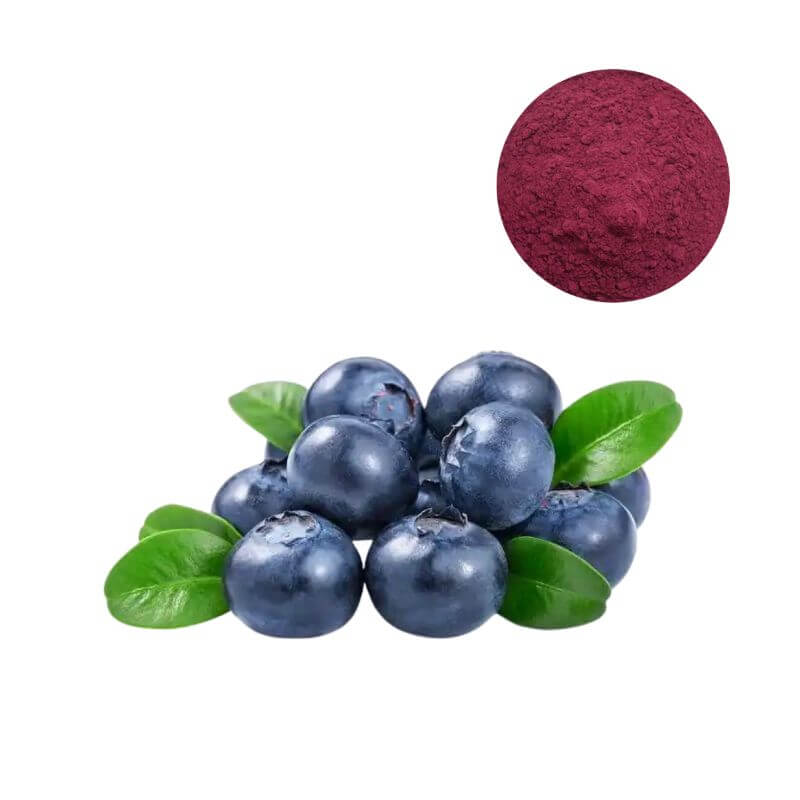
Bilberry Extract Powder
| Product Name | Bilberry Extract Powder |
| CAS Number | 84082-34-8 |
| Appearance | Deep violet to blackish-purple fine powder |
| Purity | 25% Anthocyanins (UV-VIS); 36% Anthocyanosides (HPLC) |
| Packaging | 1 kg/aluminum foil bag, 25 kg/cardboard drum |
| MOQ | 1 kg |
Bilberry Extract Powder (36% Anthocyanosides by HPLC): Evidence‑Backed Vision Support for Aging Eye Health Formulations
Formulators targeting the presbyopia and dry eye segments face a common hurdle: most botanical ingredients lack reproducible clinical data. Premium bilberry extract powder, standardized to ≥36% anthocyanosides by HPLC and ≥25% anthocyanidins by UV‑VIS, bridges this gap. This dual‑method specification ensures batch‑to‑batch consistency of the full anthocyanin fingerprint, directly supporting finished products with credible, science‑driven positioning. For brands navigating crowded eye health aisles, locking in a clinically characterized bilberry extract is no longer optional—it is the minimum barrier to premium positioning and regulatory defensibility.
Clinical Mechanisms of Bilberry Anthocyanosides: From Retinal Protection to Presbyopia Relief
Bilberry anthocyanosides are low‑molecular‑weight flavonoids that cross the blood‑retinal barrier and concentrate in ocular tissues. Their primary action involves scavenging reactive oxygen species and supporting microcirculation in the ciliary body. A 2024 randomized, double‑blind crossover trial in 23 presbyopic individuals demonstrated that an oral preparation containing bilberry extract improved near visual acuity: after the second intervention period, 92.3% of participants showed measurable improvement (doi: 10.3390/nu16070926). From a strategic formulation perspective, this clinical endpoint translates directly into a marketable claim for presbyopia‑focused supplements—a category with few evidence‑backed ingredients. Additionally, a 2023 pilot study (doi: 10.3389/fnut.2023.1061818) explored a bilberry‑containing formula (600 mg extract + DHA) in severe dry eye patients, reporting subjective symptom relief. While preliminary, it signals synergistic potential with omega‑3s. For procurement teams, this directly translates to a risk‑reduced roadmap: selecting a bilberry extract supplier that provides full HPLC fingerprinting ensures your formulation can replicate the bioactive profile used in these studies.
Key clinical insights for R&D planning:
- Presbyopia endpoint: Near vision improvement observed in over 90% of participants within 6–12 weeks.
- Dry eye signal: Subjective comfort improved after 3 months when combined with DHA.
- Dosage anchor: Effective daily intake of 36% anthocyanoside extract ranges from 160–320 mg based on trial designs.
This evidence base allows brands to move beyond generic “antioxidant” messaging toward function‑specific positioning. From a time‑to‑market perspective, aligning formulation with a published presbyopia endpoint reduces the need for costly in‑house clinical trials, accelerating launch by 6‑12 months.
Quality Benchmarks: Why Dual Standardization and HPLC Fingerprinting Separate Premium Bilberry Extract
For bulk bilberry extract, a single UV‑VIS value (e.g., “25% anthocyanins”) is no longer sufficient. Reputable bilberry extract suppliers now provide dual standardization: ≥36% anthocyanosides by HPLC (measuring intact glycosides) and ≥25% anthocyanidins by UV‑VIS (measuring aglycones). This dual‑method approach serves two critical purposes. First, it prevents adulteration with cheaper berry extracts (e.g., blueberry, black rice) that cannot replicate the full 15+ anthocyanin profile. Second, it offers a stability cross‑check: if the UV value drops while HPLC remains stable, degradation has occurred. From a compliance standpoint, a complete CoA for certified bilberry extract must include:
| Quality Parameter | Industry Benchmark | Why It Matters |
|---|---|---|
| Anthocyanosides (HPLC) | ≥36% | Authenticity & batch‑to‑batch reproducibility |
| Anthocyanidins (UV‑VIS) | ≥25% | Cross‑reference for stability monitoring |
| Loss on Drying | ≤5% | Prevents clumping and microbial growth |
| Heavy Metals (Pb, As, Cd, Hg) | ≤2.0, 1.0, 1.0, 0.1 ppm | Essential for US/EU regulatory acceptance |
For procurement teams, insisting on a supplier that provides both HPLC and UV values directly reduces two major risks: receiving adulterated material and facing stability failures during shelf‑life validation. It is worth noting that some GMP bilberry extract suppliers also offer accelerated stability data (6 months at 40°C/75% RH)—this hidden variable separates reliable partners from commodity traders. For procurement teams, insisting on such stability data directly cuts total cost of ownership by avoiding reformulation expenses and finished product write‑offs due to premature potency loss.
Formulation in Practice: Stability, Synergy, and Delivery Systems for Bilberry Extract
Bilberry anthocyanosides are water‑soluble and sensitive to light, heat, and alkaline pH. An effective formulation requires practical safeguards across three areas:
- Humidity control during manufacturing: Keep blending room humidity below 50%–55%. The powder is hygroscopic; excess moisture leads to agglomeration and uneven fill weights in capsules.
- pH management: Avoid direct combination with highly alkaline minerals (e.g., magnesium oxide). Use enteric coatings or separate beadlets if co‑formulating with zinc or calcium above pH 6.0.
- Light protection: Dark‑colored capsules or opaque blister packs are non‑negotiable for maintaining label claim over 24 months.
Synergistic combinations can enhance the final product’s value. Below is a typical compatibility matrix for bilberry extract in multi‑ingredient ocular formulas:
| Co‑ingredient | Compatibility | Formulation Tip |
|---|---|---|
| Lutein + Zeaxanthin | Excellent | Use lipid‑based carrier (MCT oil) to improve both solubilities |
| Omega‑3 (DHA/EPA) | Good – needs antioxidant | Add mixed tocopherols to prevent oil oxidation |
| Zinc (oxide or citrate) | Fair – pH risk | Separate into two‑part tablet or use coated beads |
| Vitamin C | Yes – stabilizing effect | Vitamin C helps preserve anthocyanins in aqueous systems |
From a strategic formulation perspective, combining bilberry extract with lutein and omega‑3s creates a three‑pillar approach for advanced vision support—covering photoprotection, tear film health, and near vision flexibility. For brands sourcing wholesale bilberry extract, requesting a small‑scale stability run (e.g., 3 months accelerated) before full production is a low‑cost way to de‑risk their launch.
Market Trends & Supplier Selection: Positioning Your Bilberry‑Based Product in the Aging Eye Health Category
Consumer demand for “digital eye strain” and “presbyopia support” is outpacing general antioxidant supplements. Yet most eye formulas still focus solely on macular carotenoids, leaving near vision and dry eye underserved. A premium bilberry extract powder enables three distinct product concepts:
- Presbyopia‑specific formula: Highlight the 92.3% near vision improvement from the 2024 clinical trial. Pair with low‑dose zinc and chromium for lens accommodation support.
- Dry eye comfort blend: Combine bilberry (160–320 mg) with DHA/EPA (500 mg) and hyaluronic acid; reference the 2023 pilot for concept validation.
- All‑in‑one daily vision pack: Bilberry + lutein + zeaxanthin + astaxanthin to cover blue light protection, dark adaptation, and tear stability.
For procurement teams, this market shift means that choosing a bilberry extract distributor that provides reproducible HPLC profiles is not just a quality exercise—it directly enables product differentiation. When evaluating a bilberry extract exporter, use this checklist:
- Does the CoA include both HPLC anthocyanoside and UV‑VIS anthocyanidin values?
- Are heavy metals limits aligned with USP <2232> (Pb ≤2 ppm, As ≤1 ppm)?
- Does the supplier offer 6‑month accelerated stability data for the extract alone?
- Is the botanical source certified as Vaccinium myrtillus L. (European bilberry)?
It is worth noting that some wholesale bilberry extract options from non‑specialized traders may skip HPLC fingerprinting, leaving your final product vulnerable to adulteration claims—a risk that far outweighs any upfront cost saving. A robust due diligence framework for bilberry extract prioritizes full HPLC fingerprinting and stability validation over spot price—missteps here can trigger finished product rejection by EU or US regulators.
Next Steps for Your Product Development
Integrating certified bilberry extract powder into the next ocular health formula starts with verifying technical documentation. The ideal partner provides a full CoA (dual standardization), stability summary, and regulatory support for US/EU markets. Request your complimentary sample and complete technical dossier – this allows R&D teams to test particle size, solubility, and blend compatibility before any production commitment. Request Your Complimentary Sample & Technical Dossier and receive a batch‑specific COA within 24 hours.
Frequently Asked Questions
Share this product
Related Products
Ready to get started?
Contact our team for technical specifications, pricing, and customized solutions.