
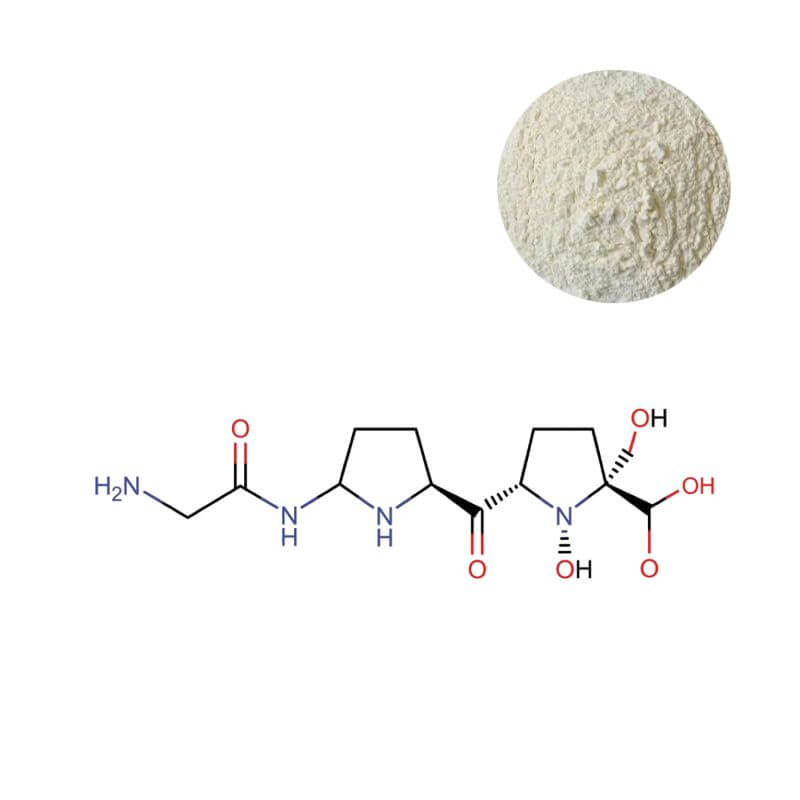
Hydrolyzed Bovine Collagen Powder
| Product Name | Hydrolyzed Bovine Collagen Powder |
| CAS Number | 92113-31-0 |
| Appearance | Off-white to light yellow powder |
| Protein Content | 95.0% min. on dry basis (by Kjeldahl Method) |
| Packaging | 25 kg/drum |
| MOQ | 25 kg |
Hydrolyzed Bovine Collagen Powder - Process Engineering & High-Speed Production Alignment
Bulk hydrolyzed bovine collagen powder for nutraceutical applications exhibits a low bulk density (0.35-0.45 g/cm³) and pronounced cohesive behavior, directly impacting automated capsule filling and tableting lines. At high throughput, electrostatic aggregation leads to bridging in feed hoppers, weight variation >5%, and unscheduled line stops. These physical constraints are mitigated by selecting agglomerated or granulated grades that improve flow without altering peptide integrity. Batch-specific characterization of flow function and compressibility - verified through COA documentation - de-risks CMO adoption and ensures reproducible run speeds. In a crowded commodity market, brand differentiation depends precisely on such particle-level control to secure higher finished-good margins and consumer trust.
Agglomerated collagen powder depresses hopper bridging and weight variation on automated lines
Standard spray-dried bovine collagen peptides generate significant inter-particle friction and air entrapment during pneumatic transfer. Agglomerated variants reorganize fine particles into larger, free-flowing granules, substantially reducing the proportion of fines passing through 200 mesh while increasing bulk density by 15-25%. This physical upgrade directly translates into fewer cleaning interventions and higher single-batch output for contract manufacturers. Maintaining water activity below 0.35 Aw further minimizes electrostatic charging and moisture-induced caking across production shifts. Surface energy control via silica-free flow agent further reduces adhesion to metal contact surfaces. Lower compressibility index (Carr index <22) allows direct-fill capsules to run at 1200 caps/min without weight drift.
| Parameter | Standard Powder (Spray-Dried) | Agglomerated / Granular Grade | Impact on Line OEE |
|---|---|---|---|
| Bulk density (g/cm³) | 0.35-0.45 | 0.45-0.55 | Higher dosing accuracy |
| Angle of repose (degrees) | 45-55 | <40 | Reduced bridging |
| Flow via orifice (g/sec, 15 mm) | 2-3 | 5-8 | Faster die filling |
For procurement managers, selecting a grade with standardized flow properties eliminates unplanned debottlenecking - fewer rejected capsules, lower scrap rates, and consistent weight uniformity. Each lot is accompanied by a Certificate of Analysis (COA) that includes tapped density, Carr index, and Hausner ratio, enabling direct validation against CMO line specifications before commercial runs. Non-irradiated and non-ETO sterilization documentation aligns with clean-label protocols required by EU and North American brands. Reducing lot-to-lot Hausner ratio variance to ≤0.1 shortens incoming QC hold time by 48 hours, accelerating raw material release for production.
Total cost of ownership: how a flow-optimized grade eliminates downstream processing steps
Many brand-owners assume that lower per-kilo pricing for standard powder drives better margins. In reality, the hidden cost of re-granulation, added lubricants (e.g., magnesium stearate), and line clearance routinely adds 8-12% to total landed cost. A flow-engineered hydrolyzed bovine collagen grade - with controlled particle size and intrinsic compressibility - removes the need for intermediate dry granulation steps.
- No secondary roller compaction: Direct-fill encapsulation without pre-processing saves two days of production scheduling and eliminates 3-5% material loss during re-work.
- Reduced glidant dependence: Less than 0.5% external lubricant required (vs. 1.5-2% for standard powder), preserving clean-label status and avoiding flow additive overuse.
- Lower scrap from weight deviation: Consistent fill weight within ±2% target reduces finished-product rejection by up to 60% on high-speed capsule fillers.
When these operational savings are annualized over a 50-ton supply contract, the total cost of ownership (TCO) decisively favors the engineered grade - a direct financial benefit that procurement directors can present to their finance teams without price negotiation alone. Each percentage point of scrap reduction translates to $0.15-0.25/kg net profit recovery, validated through third-party line audits at major North American CMOs. Shipping 40,000 kg annually in agglomerated form avoids an estimated 1200-1600 kg of re-work loss, effectively recovering 3-4% of total ingredient spend without any per-unit price adjustment.
Clinical substantiation for skin elasticity and hydration - meta-analysis evidence
Formulators require more than ingredient specifications; they need human efficacy data to support consumer claims. A 26-RCT meta-analysis comprising 1,721 participants demonstrates that oral hydrolyzed collagen significantly improves skin hydration (test for overall effect Z=4.94, p<0.00001) and elasticity (Z=4.49, p<0.00001). Importantly, no significant efficacy difference was observed among bovine, porcine, and marine sources (p=0.21) (Nutrients, 2023; doi: 10.3390/nu15092080). This evidence allows brands to support “supports skin elasticity” claims without relying on expensive marine-only positioning, while the same material also serves joint and bone health applications.
The meta-analysis provides a quantifiable baseline: average improvements in dermal thickness and wrinkle depth correlate with daily intakes of 2.5-5 g of low-molecular-weight (<3000 Da) collagen peptides. For R&D teams, this means that a well-characterized bovine hydrolysate delivers clinically relevant outcomes, and batch-to-batch consistency of molecular weight distribution (verified by HPSEC) directly underpins the repeatability of those clinical benefits. Specifying a maximum polydispersity index (PDI <2.0) further stabilizes dissolution kinetics across production lots. This aligns with USP <1058> analytical instrument qualification standards. Halving intra-batch PDI variance from 0.4 to 0.2 ensures that the 5 g serving achieves instant, lump-free wetting and dispersion within 20 seconds in cold water - a measurable consumer acceptance criterion for stick-pack beauty drinks.
Formulation synergy: co-supplementation with vitamin C, hyaluronic acid, and glucosamine
Vitamin C acts as an essential co-factor for endogenous collagen biosynthesis; combining it with hydrolyzed bovine collagen amplifies the net effect on extracellular matrix synthesis. A comprehensive 60+-study review confirms that co-supplementation with vitamin C substantially enhances skin hydration, elasticity, and dermal matrix integrity (Front. Nutr., 2025; doi: 10.3389/fnut.2025.1716166). Likewise, hyaluronic acid provides moisture retention, while glucosamine targets joint comfort - creating a structural + functional matrix for beauty-from-within and active lifestyle formulations.
| Synergist | Primary Function | Formulation Consideration (pH / Temperature) | Recommended Ratio (Collagen : Synergist) |
|---|---|---|---|
| Vitamin C (sodium ascorbate / ascorbic acid) | Co-factor for prolyl hydroxylase (collagen synthesis) | Dry blend or low-moisture barrier; avoid prolonged heating >60°C | 10:1 to 20:1 (w/w) |
| Hyaluronic acid (low MW, 50-200 kDa) | Hygroscopic moisture retention in dermis | Stable in pH 4-7; protect from high shear in liquid systems | 50:1 to 100:1 |
| Glucosamine sulfate / HCl | Cartilage matrix precursor, joint comfort | Neutral pH, compatible with collagen hydrolysate in powder blends | 2:1 to 3:1 (collagen : glucosamine) |
When developing gummies or ready-to-drink sachets, two main challenges appear: heat-induced Maillard reaction (collagen with reducing sugars) and ascorbate degradation. Both can be mitigated by using low-water-activity dry blends for stick packs or by adding microencapsulated sodium ascorbate. The bovine collagen itself remains stable at pH 3-9 and withstands pasteurization temperatures (70-80°C for short time), making it a robust base for functional beverages. Maintaining post-cooking blending temperature between 75-80°C prior to depositing preserves peptide chain length and prevents unwanted cross-linking. Formulating with microencapsulated ascorbate pushes vitamin C half-life from 6 to 24 months in liquid RTD formats, avoiding off-spec claims after warehousing.
Secure spec-verified material with complete technical dossier
Streamlined supplier qualification requires immediate access to batch-specific COA, method validation data (Kjeldahl protein ≥95% dry basis), and stability studies supporting 24-month shelf life. Agglomerated and standard grades are both available, each with documented heavy metal controls (Pb ≤ 0.5 mg/kg, As ≤ 0.5 mg/kg, Cd ≤ 0.1 mg/kg, Hg ≤ 0.1 mg/kg by ICP-MS). Long-term supply agreements include lock-in of mycotoxin and residual solvent profiles per USP <467> Class 3 limits, eliminating recurrent QC surprises at inbound inspection. A full audit trail from hydrolysis batch to finished drum cuts port-hold risk for EU importers, as each skid carries declaration for EC 853/2004 veterinary residue compliance.
Request a spec-verified hydrolyzed bovine collagen sample with complete COA package - directly validate flow properties, protein profile, and formulation compatibility before commercial commitment.
Frequently Asked Questions
Share this product
Related Products
Ready to get started?
Contact our team for technical specifications, pricing, and customized solutions.