
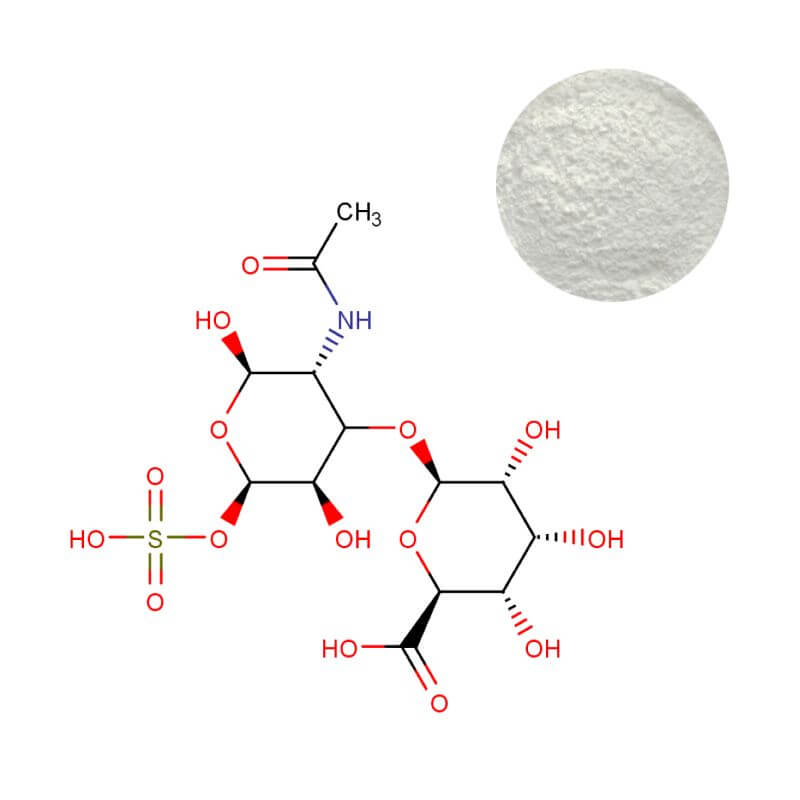
Chondroitin Sulfate Sodium Powder
| Product Name | Chondroitin Sulfate Sodium Powder |
| CAS Number | 9007-28-7 |
| Appearance | White to off-white powder |
| Purity | 90.0% min. (by HPLC) |
| Packaging | 1kg/bag, 5kg/bag, 25kg/drum |
| MOQ | 1 kg |
Chondroitin Sulfate Sodium Powder (≥90%): Structurally Supported Joint Health for Advanced Nutraceutical Blends
For supplement brands targeting the growing demographic of active agers and pet owners demanding evidence‑based mobility support, basic glucosamine formulas no longer create meaningful differentiation. The scientific consensus has shifted toward dual‑mechanism cartilage protection that combines substrate supply with enzymatic inhibition. Premium Chondroitin Sulfate Sodium Powder, standardized to ≥90% purity via HPLC and compliant with USP specifications, offers precisely this dual action. Its ability to simultaneously suppress matrix metalloproteinases (MMPs) and stimulate proteoglycan synthesis turns a routine joint product into a clinically credible, long‑term joint health solution. For formulators, this means moving beyond pain‑masking formulas to structure‑modifying interventions that resonate with educated consumers. For brands, this ≥90% purity threshold is not just a compliance checkbox but a strategic lever to justify premium pricing and differentiate in the crowded joint health category.
Mechanism at Work: Why Chondroitin Sulfate Sodium Delivers More Than Lubrication
Chondroitin sulfate is a native glycosaminoglycan in articular cartilage, where it retains water and provides compressive resistance. The sodium salt form—the dominant commercial grade—exhibits high solubility and predictable pharmacokinetics. Recent research on low‑molecular‑weight chondroitin sulfate from sturgeon cartilage (doi: 10.1016/j.ijbiomac.2025.139850) has clarified three interconnected pathways:
- Inhibition of NF‑κB and p38 MAPK signaling – Reduces the production of pro‑inflammatory cytokines (IL‑1β, TNF‑α) and suppresses MMP‑13, the enzyme primarily responsible for collagen type II degradation.
- Nrf2 upregulation – Enhances endogenous antioxidant defense, mitigating oxidative stress that accelerates cartilage senescence.
- Gut‑joint axis modulation – Increases short‑chain fatty acids (butyrate, propionate) and beneficial genera like Akkermansia, linking oral chondroitin sulfate to systemic anti‑inflammatory effects.
From a strategic formulation perspective, these pathways justify positioning chondroitin sulfate not as a simple lubricant but as a cartilage‑sparing ingredient that addresses both local degradation and low‑grade systemic inflammation. Brands that highlight this multi‑target mechanism in their marketing can command premium pricing and build long‑term consumer trust rooted in molecular science.
Quality Benchmarks: Moving Beyond “High Purity” to Functionally Relevant Specifications
For procurement teams sourcing bulk chondroitin sulfate sodium powder, the certificate of analysis (COA) must answer a critical question: does the reported purity correspond to clinically validated biological activity? Industry‑leading suppliers provide USP‑compliant assays (≥90.0% by CPC/HPLC), but two additional parameters are equally decisive:
| Quality Attribute | What It Reveals | Why It Matters for Your Final Product |
|---|---|---|
| Specific rotation (-24° to -30°) | Confirms the correct sulfation pattern and molecular conformation of the sodium salt. | Directly correlates with enzyme‑inhibitory potency; deviating values may indicate degraded or adulterated material. |
| Loss on drying (≤10.0%) | Indicates residual moisture; hygroscopic CS absorbs water easily. | High moisture leads to caking during blending, weight variation in capsules, and accelerated degradation over shelf life. |
For teams evaluating certified GMP chondroitin sulfate, it’s worth noting that USP‑grade material from bovine/porcine/avian sources is fully traceable and BSE/TSE‑certified. This directly translates to lower regulatory risk when entering markets like the EU or Japan, where animal origin documentation is mandatory. From a compliance standpoint, a supplier that provides batch‑specific COAs covering heavy metals (Pb ≤1.0 mg/kg, As ≤0.5 mg/kg, Cd ≤0.5 mg/kg, Hg ≤0.1 mg/kg) and full microbiological panels enables brands to skip redundant testing, accelerating time‑to‑market by 2‑3 weeks. For procurement, requesting a three‑batch COA history reveals inter‑batch variability in specific rotation and moisture—two silent drivers of capsule fill weight inconsistency and stability failures. Sourcing from a partner that routinely publishes three‑batch COA data reduces your in‑coming inspection workload by an estimated 15% and prevents line stoppages caused by fill weight drift.
Formulation in Practice: Stability, Synergy & Dose Optimization
Successful incorporation of chondroitin sulfate sodium into solid dosage forms requires understanding its hygroscopic nature and pH sensitivity. The ingredient remains stable at pH 5.5–7.5 and temperatures below 80°C, but acidic environments (pH <3.0) or extended exposure to high humidity (>60% RH) during granulation can induce deacetylation and reduce molecular weight. Practically speaking, formulators should:
- Use controlled‑humidity blending rooms (<45% RH) to prevent powder clumping and ensure uniform content in capsules.
- Avoid direct combination with strong organic acids (e.g., ascorbic acid in high doses) without separating layers or using enteric coatings.
- Consider low‑molecular‑weight variants (5,000–15,000 Da) for gummies or beverages where faster dissolution is desired, though standard 20,000–50,000 Da remains the most clinically documented range.
A classic synergistic pairing is chondroitin sulfate + Glucosamine Hydrochloride (HCl) (1,500 mg/800 mg per serving). Pharmacoproteomic studies confirm that this combination works additively: chondroitin inhibits MMPs while glucosamine provides the building blocks for new proteoglycan synthesis, achieving superior cartilage repair compared to either agent alone. For procurement managers, this synergy means evaluating both ingredients from a single supplier can simplify quality control and reduce logistics costs. When formulating for pet health or human nutraceuticals, the 90% purity grade delivers the optimal balance of biological efficacy and cost‑effectiveness, as confirmed by a 2024 cost‑effectiveness analysis of pharmaceutical‑grade chondroitin sulfate (doi: 10.1007/s12325-024-03007-4), which reported an ICER of €33,462/QALY – well below commonly accepted willingness‑to‑pay thresholds.
Supply Chain Resilience & Total Cost of Ownership for Chondroitin Sulfate
Price per kilogram is only one variable. For brands committing to a 12–24 month product roadmap, the true cost of ownership includes batch‑to‑batch consistency, documentation responsiveness, and supply security. Key sourcing considerations for wholesale chondroitin sulfate sodium include:
- Multiple animal origin options (bovine, porcine, avian) – allows switching between sources if one faces supply disruption (e.g., disease outbreaks or trade restrictions).
- Annual production capacity ≥100 metric tons – ensures ability to scale with your brand’s growth without requalifying a new supplier.
- 24‑hour COA turnaround – reduces the time your QC team spends on document review, enabling faster batch release.
A rigorous due diligence process that examines a supplier's documented stability of specific rotation over at least five batches can flag potential adulteration risks—an often‑overlooked step that safeguards your brand's regulatory standing.
From a strategic formulation perspective, partnering with a distributor that maintains safety stock in regional warehouses (e.g., North America, Europe, Asia) lowers the risk of production stoppages. This directly translates to avoided revenue loss – a single day of line downtime for a mid‑size brand can exceed the annual price difference between low‑cost and premium chondroitin sulfate. For procurement leaders, the decision should therefore weigh supplier reliability and technical support (custom particle sizing, premix options) more heavily than spot pricing. Requesting a batch‑specific COA before the first order is the simplest way to verify compliance with USP <61>, <62>, and heavy metal limits, effectively de‑risking the entire supply chain. A long‑term supply agreement with quarterly pricing reviews not only stabilizes budgeting but also secures priority allocation during raw material shortages, a hidden value rarely captured by spot buyers. From a total cost of ownership perspective, this contractual stability translates directly into faster speed‑to‑market—every week saved in supplier qualification adds measurable revenue for seasonal product launches.
Next Steps: Validate Your Formulation with a Technical Dossier & Complimentary Sample
Accelerate your product development by accessing the same data used by leading sports nutrition and pet health brands. We provide a complete technical package including the HPLC‑verified COA, stability study summary, and allergen declaration. Request your complimentary sample and full technical dossier today – and receive formulation support from our application specialists within 24 working hours.
Frequently Asked Questions
Share this product
Related Products
Ready to get started?
Contact our team for technical specifications, pricing, and customized solutions.