
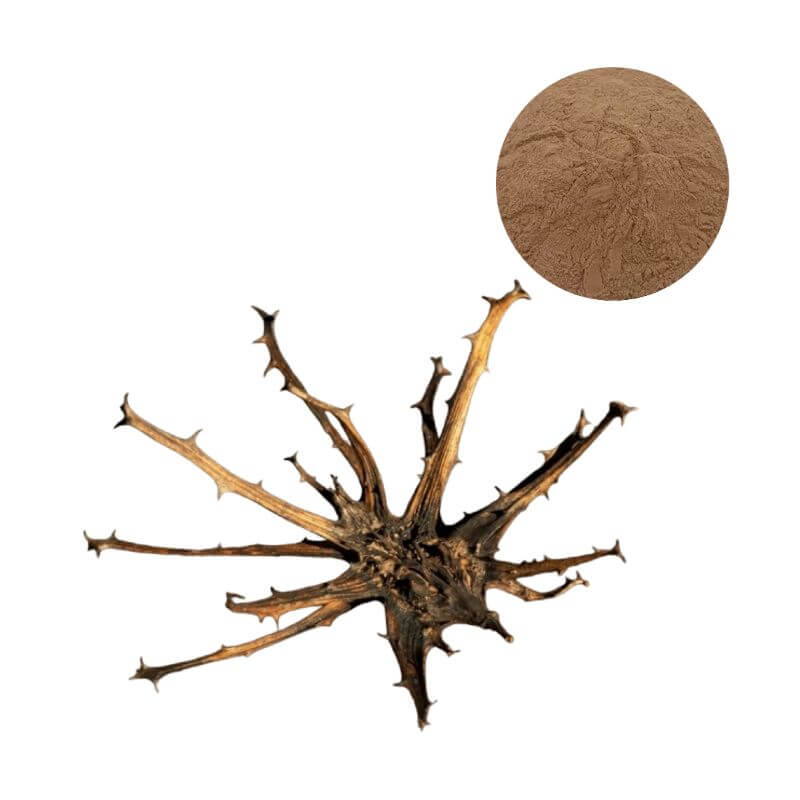
Devil's Claw Extract Powder
| Product Name | Devil's Claw Extract Powder |
| CAS Number | 19210-12-9 (Harpagoside) |
| Appearance | Brown yellow to brown fine powder |
| Purity | 2.5%, 5.0% Harpagoside (by HPLC) |
| Packaging | 1 kg/aluminum foil bag, 25 kg/cardboard drum |
| MOQ | 1 kg |
Devil‘s Claw Extract Powder (2.5% & 5.0% Harpagoside): A Clinically‑Backed Ingredient for Joint & Mobility Supplements
Developing a joint health formula that stands out in a crowded market requires more than standard glucosamine and chondroitin blends. Brands face growing pressure to deliver clean‑label, clinically‑substantiated ingredients while maintaining supply chain transparency. Devil's Claw Extract Powder, standardized to precise Harpagoside levels (2.5% or 5.0% by HPLC), offers a plant‑based anti‑inflammatory anchor backed by decades of research. For procurement teams and R&D leads, the key differentiator lies not just in the active compound, but in the rigorous quality documentation—batch‑specific COAs, heavy metal controls, and microbial compliance—that transforms a commodity into a reliable formulation asset. Choosing a verified 5.0% grade directly supports higher‑margin “clinically dosed” positioning, turning a basic joint supplement into a science‑led product that commands premium shelf pricing.
Quality Benchmarks: What Defines a Premium Devil's Claw Extract Powder for Global Formulations
When sourcing bulk Devil's Claw Extract Powder, many buyers focus solely on Harpagoside percentage. However, an expert assessment goes deeper. A premium ingredient must consistently meet three interlocking quality pillars: active compound accuracy (verified by HPLC), contaminant safety (heavy metals & microbial limits), and physical consistency (particle size, loss on drying). For instance, a specification of “2.5% or 5.0% Harpagoside by HPLC” is meaningless without corresponding data on ≤5% loss on drying and ≤2.0 mg/kg lead. From a compliance standpoint, this directly translates to fewer rejected batches during finished product testing and smoother regulatory filings across the US, EU, and Canada. For brand owners, this level of purity assurance means a dramatically lower risk of label claim violations — a hidden cost that can erase margins and delay market entry by months.
| Quality Parameter | Typical Industry Benchmark | Why It Matters for Your Final Product |
|---|---|---|
| Harpagoside content (HPLC) | 2.5% or 5.0% (min.) | Ensures batch‑to‑batch efficacy; allows precise label claims. |
| Loss on Drying | ≤5.0% | Prevents microbial growth and maintains flowability in encapsulation. |
| Lead (Pb) | ≤2.0 mg/kg | Meets USP and Prop 65 thresholds; reduces compliance risk for US brands. |
Reliable suppliers provide a COA covering these metrics plus residual solvent/pesticide screens. For procurement teams, requesting a batch-specific COA before purchase is a non-negotiable filter—it separates genuine GMP material from undocumented lots. This quality consistency supports EU Novel Food and US NDI exemptions, simplifying market entry.
Formulation in Practice: Stability, Synergy, and Dosage Strategies
Integrating Devil's Claw Extract Powder into finished dosage forms (tablets, capsules, or stick packs) requires attention to two practical challenges: bitter taste and hygroscopicity. The extract’s natural earthiness can be masked by encapsulating with enteric coatings or blending with citrus flavours in powder drinks. More importantly, its moisture absorption potential means that during manufacturing, controlling room humidity below 50% RH is as critical as the final packaging. For R&D formulators, a smart approach is to pair Devil's Claw with synergistic ingredients that enhance its anti‑inflammatory profile without compromising stability.
- Boswellia serrata extract – Both act on the 5‑lipoxygenase pathway; using a 2:1 ratio (Boswellia to Devil's Claw) can reduce the required individual doses.
- Curcumin extract powder (typically co-formulated with piperine to enhance bioavailability) – Jointly inhibits NF‑κB and COX‑2; often formulated at 100 mg Harpagoside with 200 mg curcuminoids per daily serving.
- MSM or glucosamine sulfate – Complementary cartilage support; Devil's Claw tackles the inflammatory component while MSM supplies sulfur for connective tissue.
The clinically effective daily dose of Harpagoside ranges from 50–100 mg. Using a 5% extract, that is 1–2 g per day—easily two capsules. For gummies or chewables, a 2.5% extract allows higher fill weight with the same active content. Recent literature (doi:10.1016/j.fitote.2025.107029) decodes the mechanistic landscape of harpagoside, confirming its multi‑target action on inflammation pathways—a fact that adds scientific credibility when you market your finished supplement to health‑conscious consumers. From a production efficiency standpoint, starting with a 5% grade cuts capsule count per serving by half — directly improving consumer adherence and reducing packaging costs for high‑volume orders.
Supply Chain Resilience & Total Cost of Ownership for Devil's Claw Extract
Price per kilo is the first filter, but total cost of ownership includes quality failures, delays, and re-testing. When evaluating bulk Devil's Claw Extract Powder suppliers, consider these hidden cost drivers:
- Batch‑to‑batch variation – A supplier without strict HPLC standardisation may deliver 4% Harpagoside one month and 6% the next, forcing you to re‑adjust your formulation or accept label claim deviations.
- Heavy metal spikes – Even a single contaminated batch can trigger a product recall, costing 10–100x the material price.
- Lead time reliability – For 25 kg drums, a two‑week delay disrupts production schedules and retailer commitments.
For procurement teams, this translates to working with a partner that maintains safety stock of both grades, provides HPLC chromatograms, and follows GMP guidelines. A slightly higher upfront cost per kilo that eliminates re‑testing and supply interruptions is almost always the more economical choice. Furthermore, having a documented quality agreement and a supplier that offers formulation support (e.g., compatibility tests with your excipients) reduces your internal R&D expenses—a factor often overlooked in initial price comparisons.
Mitigating Risk: An Objective Checklist for Sourcing Devil's Claw Extract Powder
To de‑risk your ingredient procurement, apply this five‑point checklist to any potential supplier. These items represent industry best practices, not proprietary claims, and help you separate premium suppliers from commodity traders.
| Checkpoint | What to Verify | Red Flag to Avoid |
|---|---|---|
| Full COA per batch | Includes Harpagoside %, loss on drying, heavy metals (Pb, As, Cd, Hg), microbial counts. | “Typical analysis” without lot‑specific data. |
| Auditable traceability | Botanical source (Harpagophytum procumbens), country of harvest, extraction method (water/ethanol). | Vague “Devil's Claw” without species or root part. |
| GMP certification | Facility certified to NSF or similar GMP standard for dietary supplements. | No third‑party certification or expired certificate. |
| Stability data | 24‑month shelf life under recommended storage (cool, dry, away from light). | No stability study available. |
| Regulatory documentation | NDI exemption rationale (US) or Novel Food status (EU) statement. | Supplier unable to provide compliance letter. |
For R&D and sourcing leads, this checklist transforms an opaque buying process into a transparent, data‑driven decision. A supplier that openly shares its quality management system—including standard operating procedures for particle size testing (≥95% through 80 mesh) and residual solvent analysis (USP <467>)—demonstrates the kind of operational maturity that directly lowers your own audit and qualification costs. It's worth noting that many high‑volume buyers now require a supplier quality agreement before the first purchase; having a partner already accustomed to such requests accelerates your time‑to‑market significantly. Using this due diligence framework prevents catastrophic batch failures — a single out‑of‑spec heavy metal result can block an EU import and cost the equivalent of 50x the ingredient price in wasted finished product.
Next Steps for Your Joint Health Formulation Project
You now have a clear framework for evaluating Devil's Claw Extract Powder: from HPLC‑verified Harpagoside levels (2.5% or 5.0%) and full heavy metal disclosure to practical formulation tactics and supply chain risk management. The next action is simple and without obligation. Request your complimentary sample and technical dossier—including a batch‑specific COA, stability summary, and formulation guide. This allows your team to perform in‑house testing, verify blend compatibility, and confirm the ingredient's performance in your specific delivery system before any commercial commitment.
Frequently Asked Questions
Share this product
Related Products
Ready to get started?
Contact our team for technical specifications, pricing, and customized solutions.