
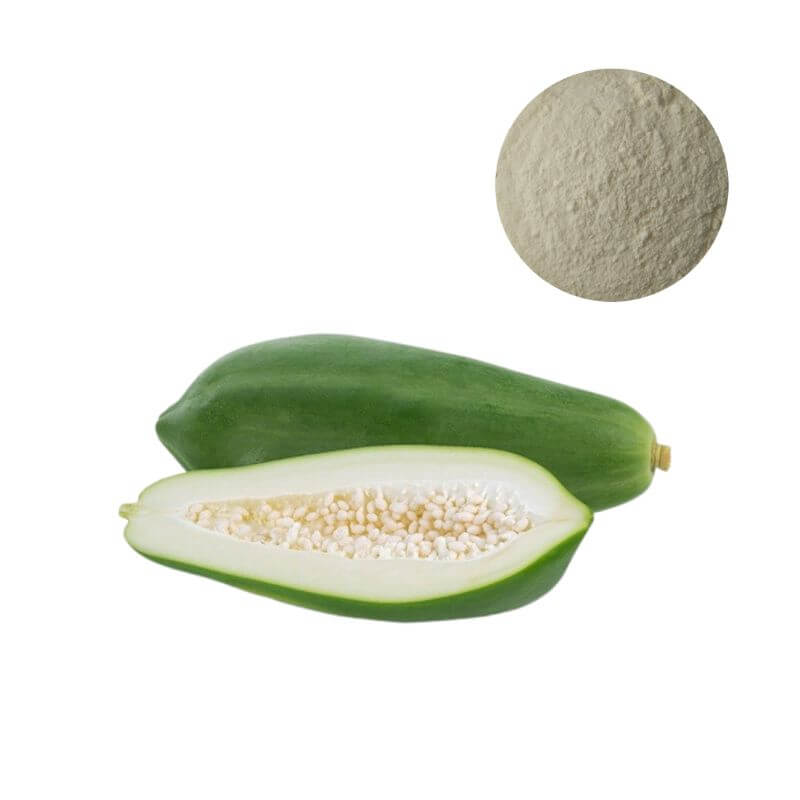
Papain Powder
| Product Name | Papain Powder |
| CAS Number | 9001-73-4 |
| Appearance | White to light yellow powder |
| Activity | 6,000 / 30,000 / 60,000 USP U/mg |
| Packaging | 1 kg/bag, 5 kg/bag, 25 kg/drum |
| MOQ | 1 kg |
Papain Powder (30,000 USP U/mg): A High-Activity Proteolytic Enzyme for Digestive Health Formulations
For brands formulating digestive enzyme blends, the challenge is securing a protease that balances potency, stability, and regulatory compliance. Premium papain powder, standardized to 30,000 USP U/mg, provides a fivefold increase over USP minimum requirements, directly translating to lower inclusion rates and smaller final dosage forms. A reliable papain powder supplier ensures this activity is consistently verified through batch-specific COA data, not just theoretical claims. Standardizing to this activity grade allows brands to build a defensible scientific foundation that streamlines regulatory submissions and supports premium market positioning.
Quality Benchmarks: What Defines a Premium Papain Powder Supplier for GMP-Certified Ingredients
When sourcing bulk papain, activity grade is the primary differentiator. Three commercial tiers exist: 6,000 USP U/mg (baseline), 30,000 USP U/mg (high-activity), and 60,000 USP U/mg (ultra-concentrated). The 30,000 grade offers optimal formulation flexibility – high enough to reduce capsule count but not so concentrated that low-dose blending becomes inconsistent. For procurement teams, this directly translates to lower excipient costs and the ability to market a “high-potency” digestive enzyme without complex manufacturing adjustments. Key quality indicators for a certified papain ingredient include loss on drying ≤5.0% (USP <731>), pH (1% solution) 4.8–6.2 (USP <791>), and heavy metals within Pb ≤2.0, As ≤1.0, Cd ≤1.0, Hg ≤0.1 mg/kg. The table below compares activity grades against formulation outcomes.
| Activity Grade (USP U/mg) | Typical Use Case | Strategic Benefit |
|---|---|---|
| 6,000 | Standard digestive aids, cost-competitive lines | Meets USP minimum; lowest raw material cost |
| 30,000 | Premium digestive health, age‑related formulas | Reduces pill burden; enables clean label claims |
| 60,000 | Ultra‑high potency, medical nutrition | Minimal excipient volume; ideal for micro-dosing |
From a compliance standpoint, a GMP-certified papain supplier provides full traceability and CoA documentation that meets FDA GRAS criteria (21 CFR § 184.1585) and EU food enzyme regulation (EC 1332/2008). This directly reduces regulatory review time for finished product registrations.
Formulation in Practice: Stability, Synergy & Delivery Solutions for Papain in Solid Dosage Forms
An effective formulation using papain requires managing its sensitivity to moisture, high compression forces, and acidic environments. Practical insights from industry practice include:
- Tablet compression: Keep papain concentration above the percolation threshold (approx. 18.5% w/w) when using plastic excipients like microcrystalline cellulose to prevent activity loss under high pressure.
- Humidity control: Blend and encapsulate in environments below 45% relative humidity – papain is hygroscopic and moisture uptake above 6% accelerates activity decay.
- Enteric protection: For formulas requiring intestinal release, apply a pH-sensitive coating (e.g., Eudragit L100) to bypass the acidic stomach (pH 1.5–2.5) and deliver the enzyme to the small intestine where pH 5.5–7.0 maximizes proteolytic action.
A clinically evaluated synergy involves combining papain with alpha-amylase. A 2023 retrospective study in the Indian population (doi: 10.59793/ijcp.v34i4.595) reported that the combination was rated effective or very effective in nearly 49% of cases, particularly for individuals aged 40–60 years. From a strategic formulation perspective, this enables brands to target the age-related enzyme decline segment with a well-documented, dual-enzyme matrix.
It’s worth noting that papain tolerates higher processing temperatures (up to 60°C) than many other plant proteases, allowing for standard dry granulation steps without significant activity loss. This directly translates to fewer production deviations and lower rejection rates.
Practically speaking, avoid direct blending with uncoated mineral salts such as ferrous sulfate or copper gluconate, as transition metal ions can oxidize the active cysteine residue (Cys-25) and reduce enzymatic activity over time. This precaution is especially relevant for multi-mineral formulas where papain is co-processed.
This formulation knowledge prevents common scale-up failures, such as activity loss from mineral incompatibility, directly translating to shorter development cycles and lower pilot-stage attrition. For brand owners, this level of formulation insight means fewer costly surprises when moving from lab to commercial production.
Supply Chain Resilience & Total Cost of Ownership for Bulk Papain Powder
Evaluating a papain powder supplier solely on price per kilogram ignores the total cost of ownership (TCO). Hidden costs arise from batch-to-batch activity variation, delayed COA issuance, or non-compliant microbial levels. A trusted papain distributor mitigates these risks by:
- Providing batch-specific COAs that confirm activity, loss on drying, heavy metals (ICP-MS), and full microbiological panel (total count ≤10,000 CFU/g, absence of E. coli, Salmonella, and S. aureus).
- Maintaining cold chain logistics (storage below 25°C, protected from humidity) to preserve enzymatic activity over a 24-month shelf life.
- Offering dual-sourcing agreements to prevent supply disruptions – especially critical for high-volume wholesale papain contracts.
A 2024 comprehensive review of papain’s industrial applications (doi: 10.1002/jsfa.13776) highlights its “cost-effectiveness, biodegradability, and ability to withstand a wide range of pH and temperature conditions.” For procurement teams, this directly translates to lower TCO because the ingredient requires fewer stabilizers and less frequent re-testing compared to more fragile enzymes.
Choosing a 30,000 USP U/mg grade over 6,000 may have a higher unit price, but the required dosage per capsule is one-fifth – reducing capsule shell, packaging, and shipping costs per finished bottle. This often leads to net savings at scale while supporting sustainability goals.
For procurement teams, a prudent practice is to request accelerated stability data at 25°C/60% RH and schedule a re-test every 12 months for bulk inventory – this safeguards against gradual activity decline in warm, humid warehouses. Proactive monitoring ensures that finished product labels remain accurate throughout shelf life.
Embracing a total-cost-of-ownership framework shows that documented stability protocols reduce hidden costs from retesting, warehousing disputes, and under-potency complaints that erode brand trust. This perspective transforms supplier selection from a price-driven exercise into a value protection strategy.
Mitigating Risk: A Procurement Checklist for Sourcing Papain Powder
To ensure consistent quality and compliance, procurement professionals should verify the following items with any papain powder supplier. This checklist is presented as an industry-standard risk management tool.
- Activity confirmation: Does the COA explicitly state the USP U/mg value and reference the USP cassein digestion method?
- Stability data: Is accelerated stability data available for 24 months under recommended storage (cool, dry place, below 25°C)?
- Allergen management: Papain is a known respiratory sensitizer – does the supplier provide an allergen control statement and dedicated production lines to prevent cross-contamination?
- Traceability: Are batch records maintained from raw latex (Carica papaya) to final packaged powder, enabling recall readiness?
- Regulatory documentation: Does the ingredient comply with FDA GRAS (21 CFR § 184.1585) and EU food enzyme regulations? Are supporting dossiers available?
A rigorous due diligence process prioritizes suppliers that offer real-time COA access and documented cold-chain handoffs, because these factors directly predict batch-pass rates and protect against import holds.
During supplier audits, pay special attention to the drying method (spray-dried vs. freeze-dried) and in-process moisture monitoring. A well-controlled spray-drying process with outlet temperature below 70°C typically yields better batch-to-batch activity consistency than less regulated alternatives. Paper documentation alone is insufficient – verify actual process parameters.
From a compliance standpoint, partnering with a papain exporter that offers full documentation reduces your in-house quality burden and accelerates new product introduction in regulated markets.
Next Steps for Your Product Development
High-activity papain powder, especially the 30,000 USP U/mg grade, empowers brands to create differentiated digestive health products with smaller dose sizes and strong scientific backing. By sourcing from a certified papain supplier that provides batch-specific COA, stability data, and regulatory support, you can avoid common pitfalls like activity loss and delayed registrations. Request your complimentary sample and full technical dossier today – and de-risk your formulation journey with verified, traceable ingredients.
Frequently Asked Questions
Share this product
Related Products
Ready to get started?
Contact our team for technical specifications, pricing, and customized solutions.