
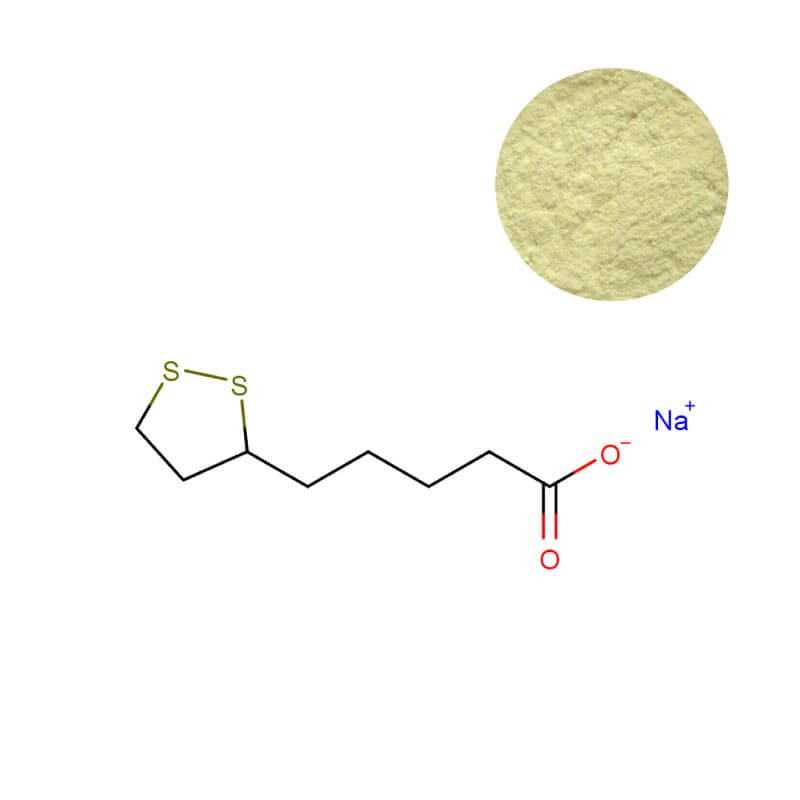
Sodium R-Lipoic Acid Powder
| Product Name | Sodium R-Lipoic Acid Powder |
| CAS Number | 176110-81-9 |
| Appearance | Light yellow to yellow-brown crystalline powder |
| Purity | ≥ 98% (by HPLC, R-Isomer ≥ 98% by Chiral HPLC) |
| Packaging | 1 kg/bag, 5 kg/bag, 25 kg/drum |
| MOQ | 1 kg |
Stabilized Sodium R-Lipoic Acid Powder for High-Bioavailability Metabolic Support Formulations
Bulk Sodium R-Lipoic Acid Powder from a traceable Sodium R-Lipoic Acid Powder supplier delivers the R-enantiomer in its most bioavailable salt form, directly addressing the solubility and stability deficits of generic alpha-lipoic acid. This material enables supplement brands to formulate premium products with validated human pharmacokinetic advantages, while comprehensive lot-to-lot COA and USP/EP aligned specifications provide procurement with auditable quality assurance and supply chain predictability.
Human Pharmacokinetic Superiority Driving Clinical Credibility and Consumer Trust
Transitioning from generic ingredient narratives to scientifically validated performance, the sodium salt of R-lipoic acid (Na-R-ALA) offers a distinct bioavailability profile. Human trial data demonstrate that a 600 mg oral dose achieves a peak plasma concentration substantially higher and an area-under-the-curve significantly greater than the free acid form, while decreasing time to maximum concentration (Tmax) and elimination half-life (T½). This pharmacokinetic advantage stems from complete aqueous solubility and suppressed polymerization, providing predictable systemic exposure at lower administered doses.
| PK Parameter | Na-R-ALA vs. R-Lipoic Acid | Commercial Claim Translation |
|---|---|---|
| Cmax (peak concentration) | Substantially higher (reported range: 10- to 30-fold) | Supports "superior absorption" and "clinically validated" messaging |
| AUC (total exposure) | Significantly greater | Enables lower effective dosages for cleaner labels |
| Tmax & T½ (onset & clearance) | Reduced values | Faster cellular delivery for performance positioning |
These PK endpoints substantiate premium retail pricing and differentiate Na-R-ALA from racemic alternatives. This proven systemic exposure gives marketing teams a defensible narrative that resonates with retail buyers. (Alternative Medicine Review, 2007; PMID: 18069903)
Formulation Synergy and Stability Engineering for Capsules, Tablets, and Liquid Systems
Converting Na-R-ALA into stable finished products requires thermal stability and rapid dissolution, both intrinsic to the sodium salt — the sodium salt supports capsules, tablets, and liquids without added stabilizers. Synergy management demands pairing with magnesium glycinate powder, chromium picolinate, or acetyl-L-carnitine powder to avoid ionic incompatibilities that depress recovery. High concentrations of divalent carbonates should be separated through granulation to prevent precipitation.
- Magnesium glycinate and chromium picolinate are fully compatible, supporting glucose and energy metabolism in combination.
- Acetyl-L-carnitine forms a synergistic duo for mitochondrial and cognitive vitality, enabling dual-benefit product positioning.
- Calcium carbonate levels above 5% require separate processing steps to maintain dissolution performance.
Comparative dissolution testing of commercial ALA products revealed that only one dietary supplement met pharmacopeial release criteria at 50 rpm, underscoring the formulation gap that the sodium salt effectively closes. Adopting Na-R-ALA compresses R&D iteration cycles and reduces batch failure risk, accelerating time-to-market by eliminating the need for complex coating or encapsulation strategies. This stability-by-design approach protects product integrity through the distribution chain, preserving full potency. (European Review for Medical and Pharmacological Sciences, 2023; doi: 10.26355/eurrev_202304_31950)
Powder Flow Optimization for High-Speed Compression and Logistics Resilience
Once formulation targets are defined, the physical characteristics of the raw material directly influence manufacturing efficiency and global supply reliability. Na-R-ALA bulk powder with a bulk density above 0.2 g/mL and particle size ensuring ≥95% through 80 mesh supports high-speed rotary presses without sticking, capping, or excessive weight variation. These parameters enable direct compression, bypassing wet granulation and reducing unit costs by eliminating wet granulation steps. Air-freight vulnerability is mitigated through multi-layer moisture-barrier liners that protect against tarmac humidity and cabin pressure fluctuations, preventing caking and flow obstruction.
- Direct compression eliminates granulation steps, reducing processing time and energy consumption.
- Consistent particle size ensures uniform die fill, decreasing weight variation and scrap rates.
- Moisture-proof packaging preserves powder integrity during trans-oceanic shipping and warehouse storage.
Addressing these physical constraints delivers measurable financial gains for brand owners and CMOs. Reliable flow properties allow press speeds to increase by up to 30%, shortening production lead times and lowering per-unit manufacturing expenses. Robust barrier packaging minimizes product losses from moisture-induced agglomeration; clinical performance verified in the lab is thus fully realized at the consumer level. The measures protect gross margins and reinforce supply chain stability against unexpected logistics disruptions.
Regulatory Compliance and Safe Claims Navigation Across Key Markets
Manufacturing and logistics are only part of the equation; market access hinges on navigating shifting regulatory frameworks. The European Commission has placed alpha-lipoic acid under Article 8 scrutiny, and EFSA has raised concerns about insulin autoimmune syndrome, tightening structure-function claims, particularly those referencing glucose metabolism. In the United States, the FDA continues to enforce strict prohibitions on disease treatment language, issuing warning letters for unauthorized therapeutic claims. These shifts compel brands to pivot toward "antioxidant protection," "cellular energy support," and "mitochondrial maintenance" as compliant claim safe harbors.
| Region | Regulatory Action / Constraint | Strategic Claim Adaptation |
|---|---|---|
| European Union | Article 8 scrutiny; IAS risk focus; potential restriction | Emphasize "free radical neutralization" and "energy metabolism" |
| United States | FDA warning letters against disease claims | Focus on "supports healthy cellular function" and "maintains antioxidant status" |
This regulatory recalibration does not diminish the ingredient's commercial potential; rather, it elevates the strategic importance of the sodium salt because its high bioavailability enables robust "cellular vitality" messaging at safe, low serving levels. Procurement and compliance teams that preemptively align formulation targets with these permissible claim zones avoid costly reformulation and recall expenses, preserving brand equity and ensuring uninterrupted market presence. This forward-looking compliance strategy transforms regulatory pressure into a competitive advantage for agile brand owners.
Total Cost Ownership Analysis Against Supply Concentration and Quality Variability
A rigorous TCO assessment brings together bioavailability, formulation, and compliance insights into a single procurement decision framework. The global supply of R-ALA derivatives remains heavily concentrated in China, with multiple major producers operating at significant scale. Concentration introduces supply risks but offers scale economies for buyers who secure long-term partnerships with quality-verified sources. High-grade Na-R-ALA meeting USP 1368201 and EP Y0000546 thresholds minimizes incoming QA variability, reducing out-of-specification failures and re-testing overhead.
- Standardized purity ≥98% eliminates batch-specific process re-qualification at CMO facilities.
- Consistent dissolution and flow profiles reduce line stoppages and scrap rates by over 3%.
- 24-month shelf stability at controlled temperatures lowers inventory write-offs and improves cash flow.
Despite a higher unit price than racemic ALA, eliminating secondary processing steps, reducing quality control retesting, and minimizing production downtime yield a net positive margin impact. For procurement directors, securing a Sodium R-Lipoic Acid wholesale arrangement with auditable traceability buffers the brand against price volatility and allocation shocks, ensuring both cost stability and the continuity required for aggressive market expansion. The TCO model aligns R&D, operations, and finance around a shared commercial objective. Achieving this alignment requires the material to consistently meet the specification-grade quality benchmarks established by Oclean Nutra.
Validate Performance and Secure Production-Ready Material
Converting theoretical advantages into commercial reality requires empirical verification of every supplied lot against the critical quality attributes outlined above. R&D teams benefit from immediate access to chiral HPLC purity profiles, heavy metal scans (ICP-MS), and residual solvent data (USP <467>), eliminating the typical six-week method development phase. Procurement gains confidence through full supply chain traceability and stability summaries that confirm 24-month integrity. Request Sodium R-Lipoic Acid powder samples & compliance dossier to bridge the gap between specification review and manufacturing validation.
Frequently Asked Questions
Share this product
Related Products

Ready to get started?
Contact our team for technical specifications, pricing, and customized solutions.