

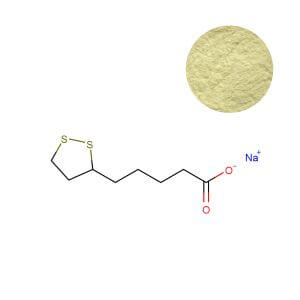
Alpha Lipoic Acid Powder
| Product Name | Alpha Lipoic Acid Powder |
| CAS Number | 1077-28-7 |
| Appearance | Light yellow to yellow crystalline powder |
| Purity | 99.0% min. (by HPLC) |
| Packaging | 1 kg/bag, 5 kg/bag, 25 kg/drum |
| MOQ | 1 kg |
High-Density Alpha Lipoic Acid Powder for High-Speed Formulation Lines
Bulk Alpha Lipoic Acid Powder with a melting point at 60-62°C and high electrostatic charge directly depresses die fill uniformity and triggers thermal sticking on tooling above 45°C-elevating scrap rates to 3-5% per batch. For procurement teams qualifying an Alpha Lipoic Acid Supplier, the critical decision hinges on particle engineering that eliminates bridging without post-milling. Batch-to-batch flow consistency is verified via tapped density and angle-of-repose protocols. For procurement and R&D directors, selecting a physical grade that actively resists heat-induced adhesion and static aggregation directly determines whether a metabolic health formulation can sustain margin integrity in an increasingly price-transparent wholesale channel.
Particle Engineering for ALA: Mitigating Thermal Adhesion and Electrostatic Agglomeration in Rotary Presses
Rotary presses above 80 rpm generate frictional heating elevating punch faces to 45-50°C-within 15°C of the ALA melting threshold. This proximity, combined with crystalline habit and resistivity >1012 Ω·cm, produces two failure modes: surface sticking and electrostatic bridging of hopper cones. Both force unscheduled stoppages every 15-20 minutes for cleaning, consuming production capacity.
| Physical Property | Typical Specification | Impact on High-Speed Encapsulation/Press Lines |
|---|---|---|
| Melting Range | 60-62°C | Frictional heat above 45°C tooling temperature initiates sticking within the first 5 minutes of continuous operation |
| Bulk Density (poured) | 0.50-0.65 g/mL | Below 0.50 g/mL, flow variability produces tablet weight RSD exceeding 5% |
| Electrostatic Resistivity | >1012 Ω·cm | Charge accumulation induces bridging in feed frames, reducing hopper throughput by 20-30% |
Granulated ALA grades with controlled particle size distribution-specifically ≥95% through 80 mesh-reduce specific surface area and interparticle friction, depressing both thermal transfer and charge generation during compaction. Material processed under the Oclean Nutra specification undergoes dynamic flow testing to verify Hausner ratio below 1.25, a threshold that correlates with uninterrupted feed-frame performance. Direct-compressible granules eliminate the need for pre-compression lubrication, preserving tooling life and reducing die-table cleaning cycles by more than 60% across a standard 8-hour shift. Mitigating frictional heat and electrostatic charge through optimized particle morphology enables formulators to reduce tablet core weight without compromising active loading-a critical lever for dose-flexible, small-format finished products that command premium retail positioning.
- Thermal buffer through particle coarsening: Coarser granulated particles (40-80 mesh) reduce specific surface area and interparticle friction, lowering punch face temperature rise by 8-10°C under identical press conditions
- Anti-static packaging intervention: High-barrier aluminum foil bags with internal anti-static HDPE liners prevent tribocharging during transport, ensuring that bulk density upon receipt matches the factory COA within ±2% tolerance
- Air-freight validation under low pressure: Vacuum-sealed packaging with molecular-sieve desiccants maintains moisture ingress below 0.1% after 72-hour transpacific transit, preserving flow properties documented at dispatch
The Hidden Cost of ALA Sticking: Downtime, Scrap Rates, and the Granulation Bypass
A 3% scrap rate on a high-speed press line equates to 18,000 rejected tablets per million. Combined with 30-minute stoppages twice per shift, cumulative downtime consumes 12% of production time. For multi-line brands, these losses cascade through labor, packaging, and QC-adding no saleable inventory.
- Secondary granulation elimination: Direct-compressible ALA granules remove the need for wet or dry granulation entirely, saving an average of $12-15 per kilogram in binder and lubricant costs
- Scrap rate compression: Switching from crystalline powder to granulated ALA reduces press-related rejects from 3-5% to below 0.5%, recovering approximately 45,000-60,000 tablets annually per million-unit run
- OEE recovery through reduced stoppages: With sticking events cut from twice per shift to once per month, overall equipment effectiveness improves by 8-10 percentage points across a typical 5-line encapsulation suite
The capital avoidance from these operational gains directly offsets any premium associated with granulated specifications. Procurement managers evaluating bulk ALA powder should treat the cost-per-kilogram as a partial metric at best; the true total ownership cost is dominated by the downstream behavior of the powder on automated lines. Qualifying a granulated grade with verified flow parameters effectively insulates the brand from unplanned overtime, expedited freight for replacement batches, and the compliance burden of reworking out-of-specification finished goods.
Formulation Strategies for ALA: Liquid-Fill Capsules and Synergistic Metabolic Blends
The low aqueous solubility of ALA (~0.9 g/L at 20°C) and thermal sensitivity complicate powder-fill capsule production. Blending with hygroscopic or alkaline excipients accelerates degradation via Maillard reactions or metal-catalyzed oxidation, particularly with iron or copper in the matrix. These constraints have historically limited ALA to simple blends with minimal synergy.
| Formulation Matrix | Release Performance | Stability Outcome | CMO Adaptability |
|---|---|---|---|
| PEG-400 liquid-fill (hard gelatin) | >85% released within 5 minutes | No significant potency loss over 6 months at 25°C | Standard rotary encapsulation lines require no modification |
| PEG-400 + 2.5% colloidal silica (semi-solid) | Release maintained at >82% (5 min) | Prevents leakage; 6-month stability confirmed | Silica addition improves viscosity for high-speed filling |
| β-Cyclodextrin inclusion complex | Enhanced aqueous dispersion; Tmax 1.8 h | Protects against thermal degradation up to 50°C | Requires specialized spray-drying equipment |
Among these validated approaches, PEG-400 liquid-fill formulations offer the most direct scalability (Pharmaceutics, 2024; doi: 10.3390/pharmaceutics16070892). The semi-solid matrix containing 2.5% colloidal silica was identified as the optimum balance of release kinetics and leak prevention. This matrix eliminates the risk of gelatin shell embrittlement while maintaining dissolution profiles within USP acceptance criteria. For brands targeting metabolic health, pairing this liquid-fill technology with chromium picolinate powder and D-biotin crystalline powder in a single capsule achieves documented glycemic support through complementary insulin-sensitizing pathways, while the liquid matrix itself protects the actives from moisture-induced degradation during transport. Standardizing dissolution profiles and leak-prevention parameters across multiple production lots effectively shortens port-of-entry quarantine windows and accelerates customs clearance, providing multi-jurisdictional compliance portability without revalidation costs.
Clinical Validation of ALA in Glycemic Management: AGEs Reduction as a Label-Ready Endpoint
Translating ALA's biochemical mechanisms into compliant label claims remains a key challenge. Advanced glycation end-products (AGEs) serve as a mechanistically anchored, quantifiable biomarker connecting ALA to metabolic improvement via pathways accepted by both FDA and EFSA.
- 600 mg/day ALA for 6 months: Serum AGEs decreased from 11.89 to 10.95 AU/μg (p=0.017) in subjects with impaired glucose tolerance
- Functional correlation: AGEs reduction correlated with peripheral comfort improvement (r=0.32, p=0.012), linking biochemical change to functional outcomes
- Glycemic control marker: HbA1c declined from 7.4% to 7.0% (p=0.008) across the intervention group
These clinical endpoints directly support label language describing ALA as an agent that "helps maintain healthy glucose metabolism" and "supports cellular antioxidant defense systems" (Biomedicines, 2025; doi: 10.3390/biomedicines13020438). For commercial teams, the correlation between AGEs reduction and functional improvement offers a scientifically defensible narrative that moves beyond generic antioxidant messaging, enabling differentiation in an increasingly crowded metabolic health category.
Securing ALA Supply Continuity Amid Global Sourcing Volatility
With over 95% of ALA production based in East Asia, procurement risk includes price volatility, environmental audits, and logistics disruptions. EU scrutiny listing and EFSA claim restrictions add compliance layers requiring validated dossiers. Traceable, spec-verified ALA cuts audit friction and accelerates supplier qualification. Batch-stable grades avoid rejected lots and unplanned downtime, directly safeguarding financial performance. Request a spec-verified Alpha Lipoic Acid Powder sample with complete technical dossier to validate line performance and secure compliant inventory ahead of peak production cycles.
Frequently Asked Questions
Share this product
Related Products
Ready to get started?
Contact our team for technical specifications, pricing, and customized solutions.