
Optimizing Bioavailability: Formulating High-Purity 98% Dihydromyricetin for Advanced Liver Support Capsules
Dihydromyricetin (DHM) is a powerhouse for liver health, yet its low bioavailability remains a challenge. This technical guide explores advanced formulation strategies like SEDDS and cocrystallization to unlock the full potential of 98% DHM.
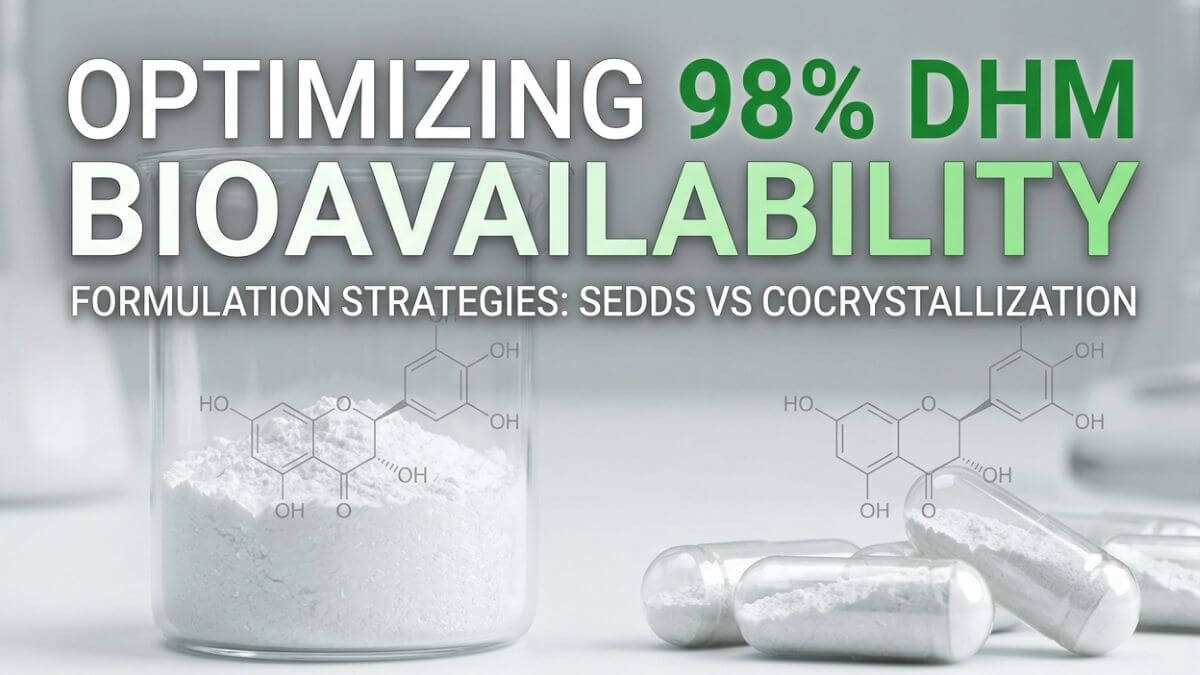
The global liver health supplement market, valued at approximately $1.64 billion in 2025, is projected to reach $2.56 billion by 2034, growing at a CAGR of 4.75%. What this means for brands: The category is far from saturated, but competition is shifting from “more ingredients” to “better science.” Within this expanding landscape, Dihydromyricetin (DHM) has emerged as a scientifically compelling ingredient, particularly for alcohol metabolism and daily liver support. However, brands formulating with DHM face a critical challenge: its notoriously low oral bioavailability due to poor aqueous solubility and chemical instability. This article provides formulation scientists and procurement leaders with evidence-based strategies to unlock the full potential of 98% DHM in capsule and solid supplement formats, turning a scientific hurdle into a competitive advantage.
The Liver Health Market Opportunity – Why DHM Stands Out
Unlike traditional liver health ingredients that focus primarily on antioxidant support, DHM offers a dual mechanism: it acts as a GABAA receptor antagonist to mitigate alcohol’s sedative effects while simultaneously activating Nrf2 pathways to reduce oxidative stress. A Phase I clinical trial (NCT06124677) has already evaluated its safety and pharmacokinetics in healthy volunteers. The takeaway: DHM is not just another botanical – it has a distinct pharmacological fingerprint that appeals to evidence-driven supplement brands. Yet, despite these promising attributes, the ingredient’s full commercial potential remains untapped. The bottleneck? Formulation science. For brands sourcing high-purity 98% Dihydromyricetin Powder, transitioning from raw material to a clinically effective supplement requires deliberate formulation design.
The Bioavailability Challenge of Dihydromyricetin – Key Parameters
DHM’s physicochemical profile directly impacts its absorption. Below are the critical parameters every formulation team must evaluate before selecting a DHM grade for capsule production:
- Aqueous Solubility: Approximately 4% (w/v) at 25°C in water; slightly higher in hot water but still classified as poorly soluble.
- pH Stability Window: Stable in acidic conditions (pH 3–6); rapid degradation observed at pH ≥ 8.0 (retention drops to 25% after 2 hours at pH 8.0, and to 5% at pH 9.0).
- Metal Ion Sensitivity: Cu²⁺ and Fe³⁺ significantly accelerate degradation – critical for mineral-fortified formulas.
- Log P (octanol-water): ~1.7, indicating moderate lipophilicity but still limited membrane permeability without formulation aids.
What these numbers mean for your formula: A DHM capsule that simply mixes the raw powder with excipients will deliver inconsistent, often negligible plasma levels. To achieve predictable effects – whether for alcohol recovery or daily liver maintenance – formulators must actively counteract these physicochemical limitations. The good news: recent advances in drug delivery systems have transformed this landscape, making capsule-based products not only feasible but highly effective.
Formulation Strategies to Enhance DHM Absorption
Two distinct yet complementary formulation approaches have demonstrated significant bioavailability gains for DHM in peer-reviewed studies. Both are readily adaptable to hard or soft capsule formats. Why two strategies? Because the optimal choice depends on your target price point, manufacturing capability, and desired speed of onset.
| Technology | Principle | Bioavailability Gain | Capsule Compatibility | Key Limitation |
|---|---|---|---|---|
| Self-Emulsifying Drug Delivery System (SEDDS) | Lipid-based formulation that forms fine oil-in-water emulsions in the GI tract, promoting lymphatic transport | AUC increased 4.13× vs. DHM suspension (doi: 10.3390/pharmaceutics15092296) | Ideal for softgels or liquid-filled hard capsules | Requires precise surfactant selection; potential for gastric irritation in sensitive populations |
| Salt Cocrystallization | Crystal engineering with a pharmaceutically acceptable salt (ciprofloxacin) to alter lattice energy and improve dissolution | 2–8× solubility enhancement; 8× relative bioavailability improvement (doi: 10.3390/pharmaceutics17091209) | Direct encapsulation of crystalline powder; no process change required | High humidity (>60% RH) reduces stability; requires desiccant packaging |
Insight for decision-makers: The SEDDS approach not only boosted AUC by more than fourfold but also significantly enhanced alcohol-metabolizing enzyme activity (hepatic ADH and ALDH, p<0.05) and reduced blood alcohol concentration in acute intoxication models (p<0.01). For brands targeting the “next-day recovery” segment, SEDDS-formulated DHM provides a turnkey solution with functional proof. Meanwhile, salt cocrystallization offers a dry-powder alternative that maintains capsule manufacturing workflows while achieving the highest reported bioavailability gain (8×) for DHM to date – albeit with strict humidity control requirements. Which path to choose? If you have liquid-fill capsule capabilities and prioritize speed of absorption, SEDDS is your answer. If you operate a dry-powder encapsulation line and want a patentable crystalline form, salt cocrystallization is worth exploring.
Synergistic Combinations – Building Multi-Target Liver Support Formulas
No single ingredient addresses all facets of liver health. Formulators increasingly combine DHM with complementary botanicals to create broad-spectrum hepatoprotective products. Two evidence-backed partners deserve particular attention.
Milk Thistle Extract Powder (standardized to 80% silymarin) has over 2,000 years of traditional use and recent meta-analyses confirming its ability to improve liver enzymes in NAFLD and alcoholic liver disease. However, like DHM, silymarin suffers from low bioavailability. Novel micellar formulations have demonstrated substantial bioavailability gains in human trials. What this means for your blend: When formulating a dual-ingredient capsule, consider co-delivery using a shared lipid-based vehicle – both DHM and silymarin are flavonolignans compatible with SEDDS or phytosome technologies. This approach can reduce development costs while maximizing the absorption of both actives.
Curcumin Extract Powder (≥95% curcuminoids) addresses the inflammatory component of liver stress via NF-κB inhibition. Its bioavailability challenges are well-documented, with solutions including γ-cyclodextrin metal-organic frameworks and potato-starch-based capsules. Critical formulation insight: When combining curcumin with DHM, pay attention to gastric pH: curcumin is stable in acidic conditions but degrades rapidly in neutral to alkaline environments, while DHM degrades above pH 8. A delayed-release capsule targeting intestinal pH 6–7 can optimize absorption for both. The takeaway: synergy is not just about ingredient selection – it requires aligned delivery conditions.
Practical Formulation Checklist for DHM Capsules
Based on current scientific literature and formulation best practices, here is a technical checklist for brands developing a DHM-based liver support capsule. Why a checklist? Because moving from concept to production-ready capsule involves dozens of decisions. This list highlights the most consequential ones.
Ingredient Specifications (per batch)
- DHM purity: ≥98.0% by HPLC (USP reference standard) – lower purities introduce unpredictable degradation kinetics
- Residual solvents: Meet USP <467> Class 3 limits – critical for clean-label claims
- Heavy metals: Lead ≤1.0 ppm, Arsenic ≤1.0 ppm, Cadmium ≤0.5 ppm – daily liver supplements require higher safety margins
- Particle size: D90 ≤50 µm for homogeneous blending in powder-filled capsules – prevents content uniformity failures
Formulation Parameters for Optimized Absorption
- If using SEDDS: Oil phase (e.g., MCT) 30-40%, surfactant (Tween 80 or Kolliphor EL) 50-60%, cosurfactant (PEG 400) 10-20% – aim for droplet size <200 nm
- If using salt cocrystal DHM: Include desiccant (silica gel, 1-2 g per bottle) and use HDPE bottles with induction seals; store below 40% RH – humidity control is non-negotiable for this technology
- For blended capsules with silymarin: Add black pepper extract (piperine 5 mg per serving) to inhibit glucuronidation – increases both curcumin and DHM AUC by 2–3×
- pH-targeting: Enteric coating or acid-resistant capsule shell (e.g., DRcaps) to delay release until small intestine, where DHM solubility is higher (pH 5.5–6.5)
Stability Protocol Recommendations
- Accelerated stability: 40°C / 75% RH for 6 months (monitor DHM content by HPLC every 2 months)
- Long-term: 25°C / 60% RH for 24 months
- For salt cocrystal formulations, include a 30°C / 65% RH condition to simulate humid storage – anticipate real-world warehouse conditions
Conclusion: From Ingredient to Differentiated Product
The science is clear: unformulated DHM cannot deliver its clinical promise. But with deliberate formulation strategies – whether SEDDS for rapid absorption or salt cocrystallization for dry-powder simplicity – brands can transform 98% DHM into a high-performance liver support ingredient. The strategic insight: In a market where consumers increasingly demand “science-backed” claims, bioavailability data is no longer a nice-to-have – it is a competitive necessity. The growing market for functional supplements rewards products backed by bioavailability data and innovative delivery systems. For procurement teams, this means prioritizing suppliers that provide not just certificates of analysis but also formulation support and stability data for their DHM lots. To explore our range of standardized DHM, milk thistle, and curcumin extracts with full technical documentation, visit our product pages or contact our technical formulation team for a confidential consultation.
Share this article
Found this helpful? Share it with others!
Related Products
Products mentioned in this article
Want to learn more?
Explore our products or contact our team for personalized solutions and expert advice.