
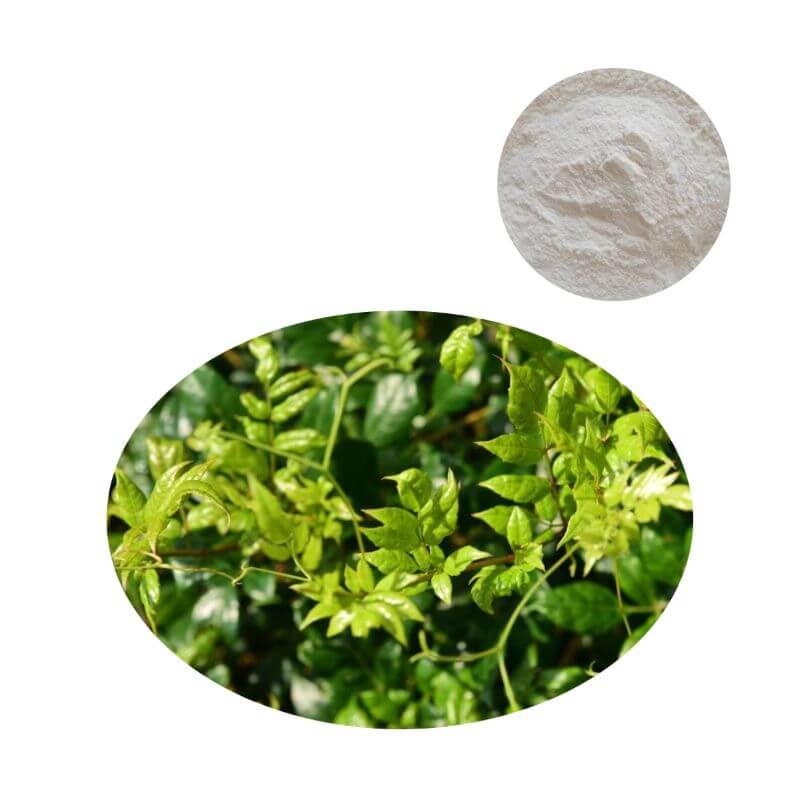
Dihydromyricetin Powder
| Product Name | Dihydromyricetin Powder |
| CAS Number | 27200-12-0 |
| Appearance | White to off-white fine powder |
| Purity | ≥ 98.0% (by HPLC) |
| Packaging | 1 kg/foil bag, 5 kg/tin, 25 kg/fiber drum |
| MOQ | 1 kg |
Dihydromyricetin Powder 98%: Clinically-Supported Liver & Metabolic Support for Next-Generation Functional Formulations
For brands developing evidence-based dietary supplements, the challenge is no longer simply “adding an antioxidant.” Differentiation now demands ingredients with human clinical data and multi-system relevance. Dihydromyricetin (DHM), a natural flavonoid from Ampelopsis grossedentata, has moved beyond traditional use. Premium DHM powder (≥98% by HPLC) is now recognized for its ability to support hepatic lipid metabolism, mitigate ethanol-induced stress, and offer emerging neuroprotective potential. Backed by a 2026 randomized controlled trial and a 2025 pharmacological review, this ingredient enables formulators to target liver health, metabolic syndrome, and even cognitive wellness—all with one standardized, GMP-certified raw material. This 98% purity threshold is not arbitrary; it represents the minimum concentration required to achieve clinically meaningful ALT/GGT improvements observed in human trials, giving brands a defensible scientific claim that commands premium pricing in a crowded hepatoprotection category.
Clinical Foundation: How Human Data Supports DHM’s Role in Liver & Metabolic Health
For procurement teams evaluating a bulk dihydromyricetin powder supplier, the most critical question is: does human evidence exist beyond cell studies? A 2026 double-blind, placebo-controlled RCT (Annals of Gastroenterology, 2026; doi: 10.20524/aog.2026.1019) provides exactly that. In 55 patients with metabolic dysfunction-associated steatotic liver disease (MASLD), a daily 300 mg DHM-containing formula (combined with vitamins C/E and choline) for 12 months produced:
- 35% combined ALT/GGT normalization rate vs. 5% in placebo (p=0.028)
- Significant reductions in fasting glucose, HbA1c, total cholesterol and LDL
- Lower liver stiffness measurement (LSM) vs. baseline
- Zero serious adverse events linked to the supplement
This RCT translates directly into a compliant, defensible claim for liver support and cardiometabolic wellness—areas where consumer demand is rapidly growing. Unlike many botanicals that rely only on traditional use, DHM now offers a modern clinical anchor.
The study used a multi-ingredient formula. However, the magnitude of effect (35% vs. 5%) strongly supports DHM’s core contribution. For brands sourcing certified dihydromyricetin powder raw material with COA, this human evidence de-risks product development and accelerates regulatory positioning. Practically, this level of clinical validation means brand owners can reduce costly post-launch substantiation studies by up to 12 months, directly improving time-to-market for differentiated liver health SKUs.
Formulation in Practice: Stability, Synergy & Overcoming Bioavailability Hurdles
DHM is a BCS Class IV compound (low solubility, low permeability). Without proper formulation, even high-purity material will underperform. Successful integration into capsules, tablets, or functional beverages requires addressing two real-world challenges: aqueous instability (DHM degrades above pH 6) and poor oral absorption (rat absolute bioavailability of 4.02%).
Practical recommendations from industry formulation experience include:
- For solid dosages (capsules/tablets): Use direct compression or wet granulation with excipients that maintain pH below 6. Avoid high-shear mixing that generates heat.
- For functional beverages: Employ solubilization technologies—self-microemulsifying systems (SMEDDS) or cyclodextrin inclusion—to boost stability and uptake.
- Synergistic combinations: Pair DHM with milk thistle extract (silymarin) or N-acetylcysteine (NAC) to amplify glutathione-related detox pathways.
| Formulation Challenge | Solution Strategy | Commercial Benefit |
|---|---|---|
| Low aqueous solubility | Liposomal encapsulation or solid dispersion | Higher bioavailability → lower effective dose per serving |
| pH-dependent degradation | Enteric coating or buffered matrix (pH 3–5) | Extended shelf life and consistent release |
| Bitter taste (beverages) | Flavor masking with natural sweeteners or microencapsulation | Improved consumer compliance |
For procurement teams, this directly translates to the need to request detailed stability data from your dihydromyricetin powder raw material supplier. A reliable partner will provide batch-specific COA including loss on drying (≤5.0%), particle size (≥95% through 80 mesh) and residual solvent analysis—all of which influence real-world performance.
From a compliance standpoint, always verify that the manufacturer follows GMP and can supply documentation for NDI or Novel Food pathways. From a production efficiency standpoint, ensuring particle size consistency (≥95% through 80 mesh) eliminates flowability issues in high-speed capsule fillers, reducing equipment downtime and waste—a hidden cost saving that directly improves gross margin per finished unit.
Market Trends & Product Positioning: Beyond Liver Health into Cognitive & Sports Nutrition
While hepatoprotection remains DHM’s core domain, a 2025 comprehensive review (Frontiers in Pharmacology, 2025; doi: 10.3389/fphar.2025.1618623) highlights its emerging potential in neurological disorders—Alzheimer’s, Parkinson’s, and stroke—via anti-inflammatory (TLR4/NF-κB) and antioxidant pathways. This opens two high-value market segments:
- Post-exercise recovery & sports nutrition: DHM reduces exercise-induced muscle damage and inflammation, supporting faster recovery.
- Stress & cognitive health: By modulating oxidative stress in neural tissue, DHM can be positioned as a “calm focus” ingredient for daytime supplements.
For brands seeking dihydromyricetin for sports nutrition or dihydromyricetin in functional beverages, the combination of RCT-backed liver benefits plus neuroprotective mechanisms creates a unique selling proposition. Consider a dual-action product: “Liver Cleanse + Mental Clarity” – a concept that resonates with today’s alcohol-conscious and metabolic wellness consumers.
From a strategic formulation perspective, this allows you to avoid the crowded “milk thistle only” category. Instead, you can launch a premium, science-forward product that appeals to both health-optimizers and active individuals. Leading dihydromyricetin powder raw material suppliers now offer custom blends that pair DHM with Dimagnesium Malate, Vitamin C (Ascorbic Acid), or Citicoline (CDP Choline) to enhance its metabolic and neurological profiles.
Mitigating Risk: A Procurement Checklist for Sourcing Premium DHM
When you decide to source wholesale dihydromyricetin powder, the lowest price often hides the highest risk. To secure consistent quality and regulatory readiness, apply this objective checklist:
- Full-panel COA: Does it include HPLC purity (≥98%), heavy metals (Pb ≤1.0 mg/kg, As ≤1.0 mg/kg), microbial limits (TPC ≤1,000 CFU/g), and residual solvents?
- Traceability: Botanical source must be clearly stated (Ampelopsis grossedentata). Batch-specific origin records should be available.
- GMP certification: Verify that the manufacturing site follows NSF, cGMP, or equivalent GMP standards recognized in the supplier's jurisdiction.
- Regulatory support: Can the supplier provide documentation for NDI notification (US, if applicable) or Novel Food application (EU)?
- Stability data: Request accelerated and real-time stability studies covering 24 months.
For procurement teams, this directly translates to lower supply chain disruption and faster time-to-market. A premium dihydromyricetin powder supplier will also offer a free sample (10-20 g) for in-house validation and technical datasheets within 24 working hours. Avoid partners who cannot provide a fully executed, lot-specific COA – this is non-negotiable for serious brand owners. Applying a total cost of ownership (TCO) lens, a slightly higher upfront price from a supplier with batch-to-batch heavy metal control (Pb ≤1.0 mg/kg) prevents catastrophic finished-product recalls due to regulatory non-compliance or heavy metal exceedances in destination markets, saving brands six-figure losses in liability and brand equity.
It’s also wise to evaluate the supplier’s ability to deliver bulk dihydromyricetin powder in packaging options (1 kg/foil bag, 5 kg/tin, 25 kg/fiber drum) with moisture-proof liners. Moisture is the #1 enemy of flavonoid stability, so warehouse conditions (cool, dry, away from light) are as important as the raw material itself.
Next Steps: Accelerate Your Product Development with Verified DHM
You now have a clinically validated, multi-functional ingredient that supports liver health, metabolic markers, and emerging neuroprotection – all backed by a 2026 human RCT and a 2025 mechanistic review. The next move is straightforward: de-risk your formulation by testing the actual material. Request your complimentary sample and complete technical dossier today. You will receive a batch-specific COA, stability summary, and formulation guide – everything needed to move from concept to compliant, market-ready supplement.
Frequently Asked Questions
Share this product
Related Products
Ready to get started?
Contact our team for technical specifications, pricing, and customized solutions.