
NMNH Sodium Salt in High-Speed Tableting and Encapsulation: Defeating Deliquescence and Punch Sticking via Co-Solute Excipient Engineering
Discover how a fluid-isolating L-Carnosine co-solute shield prevents tool sticking and weight RSD drift during NMNH disodium salt and Alpha GPC tableting, ensuring continuous high-speed scale-up success.
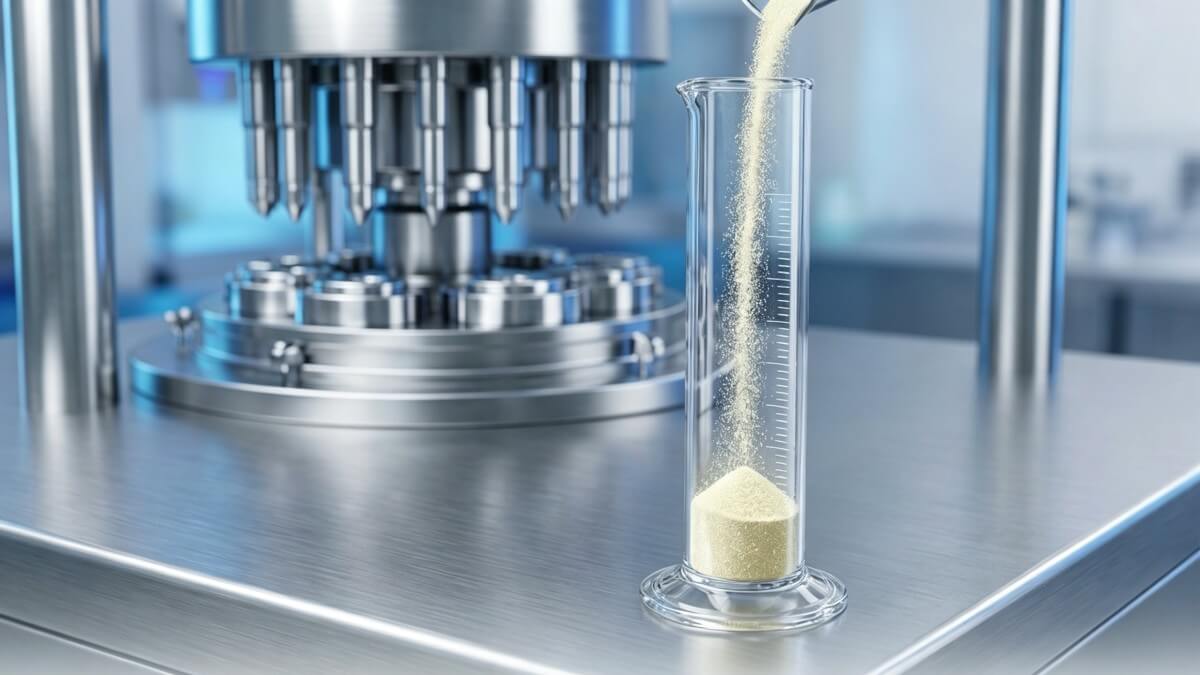
During the first production run of NMNH disodium salt (C11H16N2Na2O8P) tablets, the rotary press often stops within 20 minutes. Powder flow ceases, punch faces become coated with a sticky film, and tablet weight variation (RSD) exceeds 6.0% - well above USP <905> limits. Adding Alpha GPC powder, which deliquesces at 50% RH in under 30 minutes, worsens the problem. This article presents a powder-engineering strategy using a crystalline co-solute that physically isolates both hygroscopic actives from ambient moisture, enabling continuous high-speed compression without sticking or weight drift, while preserving finished dosage form stability.
Why NMNH Disodium Salt Fails in Conventional Blends
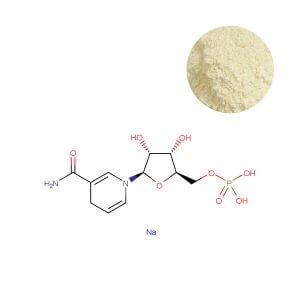
Processing crystalline NMNH disodium salt poses a significant challenge due to its high hygroscopicity. While an exact critical relative humidity (CRH) for this salt is not published, sodium salts of analogous nucleotides typically exhibit CRH between 40% and 50% RH - a range routinely exceeded in GMP production environments (45-65% RH). When moisture absorption surpasses CRH, surface dissolution creates a liquid film bridging particles. This triggers two interrelated failures:
- Adhesion to tooling: the wet film transfers to punch faces and die walls, causing picking, capping, and cleaning stops every 15-30 minutes, cutting OEE by 40-50%.
- Loss of flowability: the angle of repose rises from ~34° (dry) to over 50°, starving the feed frame and causing fill-weight RSD > 6.0%.
Additionally, the salt's 1% aqueous solution shows pH 7.5-8.5, which may accelerate hydrolysis of acid-labile excipients. However, moisture-driven physical instability remains the primary scale-up barrier. Water activity (aw) of the neat salt at 25°C exceeds 0.60 after 1 hour at 50% RH - a level where deliquescence becomes inevitable without a protective barrier.
Fluid-Isolating Co-Solute System: The L-Carnosine Solution
Rather than over-investing in low-humidity suites (≤30% RH), a robust approach uses a high-density, low-hygroscopicity crystalline excipient that physically coats the active particles. This excipient preferentially occupies the active surface, blocking water vapor from reaching the deliquescent core. The scientific basis is established: a comprehensive review on stabilizing highly hygroscopic oral solids identifies co-processing with excipients as a primary method to deflect moisture from the active ingredient (Pharmaceutics, 2022; doi: 10.3390/pharmaceutics14102015). The review confirms that co-processing improves flow and content uniformity during high-speed tableting - precisely the dual need for NMNH formulations.
This co-processing strategy directly translates into a marketable differentiation point: brands that adopt fluid-isolating excipient systems can substantiate label claims such as "stable through production" or "manufactured under advanced moisture-controlled processing" - claims that competing formulations using untreated hygroscopic actives cannot support. The technical barrier to entry becomes a commercial moat.
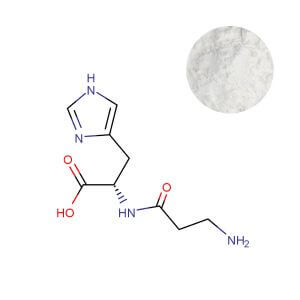
For a ternary combination of NMNH disodium salt with Alpha GPC powder, the optimal co-solute is high-density L-Carnosine powder as a crystalline barrier. Its high crystal density (1.375 g/cm³) and regular packing enable ordered mixing, creating a physical shield on both actives. A 1:3 blend ratio reduces moisture uptake by ~45% under 50% RH for 2 hours (DVS data). L-Carnosine buffers the extreme hygroscopicity of Alpha GPC - which deliquesces within 30 minutes at 50% RH - by acting as a sacrificial moisture sink, preventing rapid liquefaction of Alpha GPC and achieving synergistic physical stabilization that no single excipient can provide.
To implement this fluid-isolating architecture at scale, dry granulation via roller compaction is non-negotiable. Direct compression of raw crystalline NMNH disodium salt with Alpha GPC invariably leads to mass segregation and premature moisture binding. The ternary blend must be processed with the following critical parameters:
- Roll pressure: 4-6 MPa, consistent across the ribbon width.
- Roll gap: 1.5-2.5 mm, monitored with continuous feedback control.
- Ribbon temperature: strictly below 35°C to avoid amorphous reversion.
- Target PSD: 250-500 μm, embedding actives within the L-Carnosine crystalline frame.
From a commercial scale-up perspective, laboratory-scale ordered mixing ratios and DVS-derived moisture uptake data must directly inform capital expenditure decisions - including dehumidification system sizing, blender capacity, and feed frame specifications - before the first production batch is scheduled. Formulation parameters set the equipment requirements, not the reverse.
Critical Quality Attributes of the Ternary Blend
The following table compiles key physicochemical parameters for each component, defining a manufacturable blend:
| Component | Key Parameter & Specification | Role in Deliquescence Control | Blend Acceptance Criterion |
|---|---|---|---|
| Crystalline NMNH disodium salt | Molecular weight ~378.20 g/mol (anhydrous); bulk density 0.4-0.6 g/mL; LOD ≤8% (KF); Form I monohydrate; CRH ~45% | Core active; requires physical isolation | Assay 95-105%; content uniformity RSD ≤3% |
| High-density L-Carnosine powder | Bulk density ≥0.25 g/mL; Hausner ratio 1.23; LOD ≤1.0%; angle of repose 36.5° | Co-solute barrier; reduces water accessibility | Ratio within ±5% relative; homogeneity by NIR |
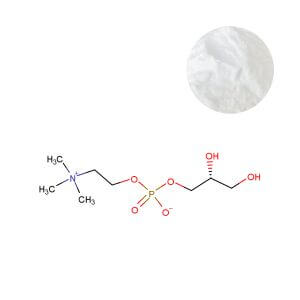
| Alpha GPC powder | 99% purity; deliquesces within 30 min at 50% RH; hygroscopic; KF ≤2% | Secondary active; requires co-solute protection | Assay 98-102%; blend aw ≤0.35 |
Maintaining blend aw ≤0.35 at 25°C is critical. Below this threshold, no free water is available for deliquescence, microbial growth is suppressed, and nucleotide degradation is minimized. The ternary system achieves this through L-Carnosine's surface coverage and its low moisture content (≤1.0% LOD).
Scale-Up Parameters for High-Speed Rotary Press and Capsule Filler
Three process variables are decisive when transitioning from pilot to production:
- Environmental humidity: maintain compression suite at ≤35% RH (absolute humidity ≤6 g/m³) using a desiccant dehumidifier. Processing below the CRH of the most hygroscopic component is the single most effective variable, as confirmed in the Pharmaceutics review. Install a real-time chilled-mirror hygrometer.
- Feeder design and speed: use a forced-feed star wheel at 20-30 rpm to prevent segregation of dense L-Carnosine from lighter actives. Hopper angle 45° with low-frequency vibration to prevent arching.
- Compression force and turret speed: for 10-mm round flat-faced tablets, set main force 8-12 kN and turret speed 40-60 rpm. Monitor punch face temperature with IR sensor; if exceeding 40°C, reduce speed by 10 rpm or apply forced-air cooling.
A 200,000-tablet trial using this ternary blend produced weight variation RSD of 1.8% (well below USP <905> 6.0%) and no sticking after 2 hours at 50 rpm. On a high-speed capsule filler (90,000 capsules/hour) with vacuum-assisted dosing, fill weight RSD remained 2.2% over 4 hours, confirming robust flow.
Quality Auditing for Finished Tablets and Capsules
For purchasing and quality teams, the following specifications must be included:
- Water activity: aw ≤0.35 at 25°C (chilled-mirror, USP <922>).
- Disintegration: ≤5 min in purified water at 37°C for tablets (USP <701>); for capsules, ≤10 min.
- Dissolution: ≥80% of label claim released within 30 min (USP apparatus II, paddle 75 rpm, 900 mL pH 6.8 buffer).
- Accelerated stability: in HDPE bottles with desiccant, assay ≥95% and total degradation products ≤2% after 6 months at 40°C/75% RH. Open-dish studies show the ternary blend picks up only 2.5% moisture vs. 12.8% for neat NMNH salt after 7 days at same conditions.
A blend that fails open-dish moisture testing at 40°C/75% RH will fail accelerated stability - no packaging can compensate for poor excipient selection.
Suppliers must provide COAs covering bulk/tapped density, particle size distribution (laser diffraction), and BET surface area. Kosher, Halal, and Non-GMO Project verification are expected, along with a stability data package including 12 months real-time and 6 months accelerated data.
From Formulation Science to Production Partnership
Scaling NMNH sodium salt with Alpha GPC powder requires a formulation approach that respects the physical constraints of both hygroscopic materials. The fluid-isolating co-solute system, grounded in peer-reviewed co-processing principles, converts a challenging blend into a manufacturable product, eliminating batch rejects and ensuring supply continuity. For R&D directors, obtaining pre-optimized blends with the correct L-Carnosine ratio can shorten development timelines by months. The technical team offers full analytical support, including DVS profiling and stability modeling, to ensure successful first production runs. Contact our formulation specialists to request targeted sample kits for your compression and stability evaluation, or to arrange a one-on-one consultation on production parameters.
Share this article
Found this helpful? Share it with others!
Related Products
Products mentioned in this article
Want to learn more?
Explore our products or contact our team for personalized solutions and expert advice.