
Overcoming Stability Challenges: Innovative SAMe Tosylate Disulfate Formulations for Liver and Joint Health
SAMe is a gold standard for liver and joint health but faces major stability hurdles. This article explores how the Tosylate Disulfate form and smart ingredient synergies enable brands to create premium, shelf-stable supplement formulations.
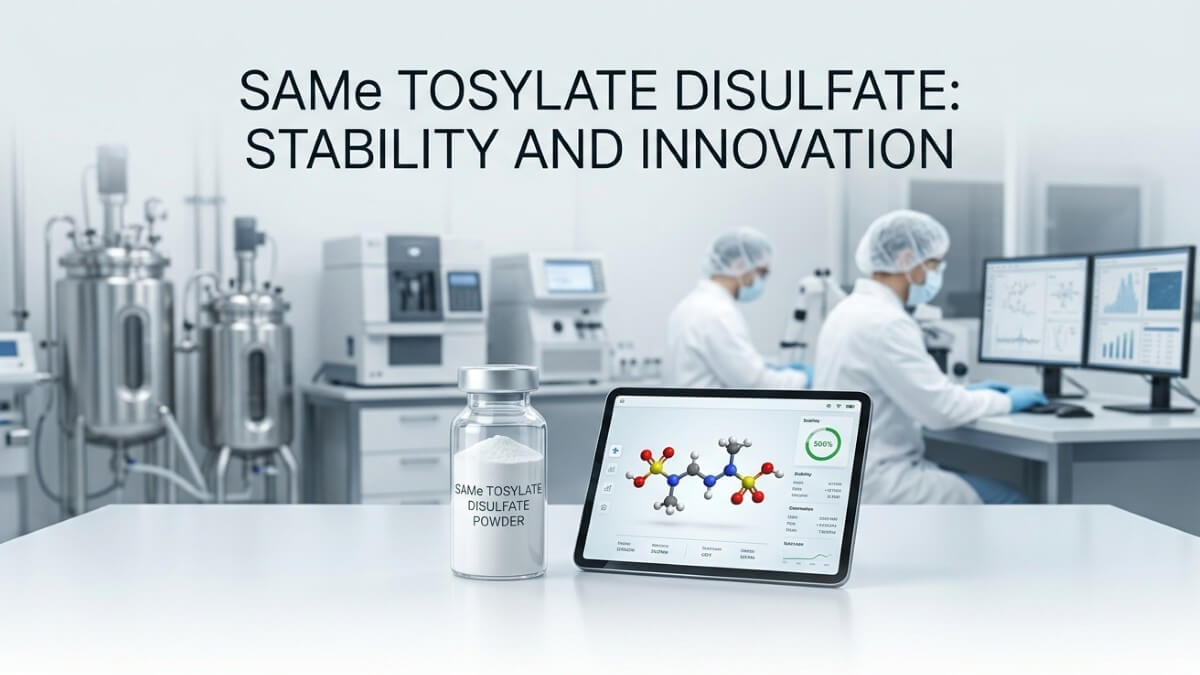
For formulators and R&D leaders, S-adenosylmethionine (SAMe) presents a paradox: it offers clinically backed benefits for liver and joint health, yet its notorious instability has historically made it a difficult ingredient to work with. Hydrolysis, temperature sensitivity, and pH-dependent degradation often lead to significant potency loss before a product reaches the consumer. This article explores how the stabilized salt form SAMe Tosylate Disulfate Powder overcomes these hurdles, and how smart synergistic combinations can unlock premium, science-backed formulations for the hepatoprotective and osteoarthritis markets.
The Stability Bottleneck: Why Traditional SAMe Fails in Formulation
Unstable SAMe (free base) degrades rapidly when exposed to moisture, elevated temperatures, or suboptimal pH. This creates major risks for brands: tablets losing label claim before shelf-life ends, gummies showing discoloration, or powders clumping. Data from chemical databases confirm that SAMe free base requires strict −20°C storage and has a limited solution stability of only three months. Such conditions are impractical for commercial manufacturing and distribution.
What this means for brand owners: Choosing a raw material without verifying its salt form can lead to costly product recalls, consumer complaints, and regulatory scrutiny. The shift toward stabilized SAMe Tosylate Disulfate is not a minor upgrade—it is a fundamental requirement for any serious dietary supplement brand targeting liver or joint health segments.
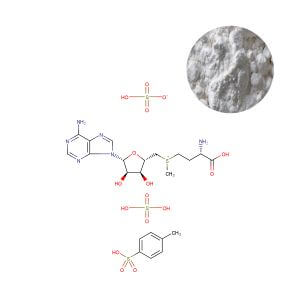
The industry solution lies in salt formation. SAMe Tosylate Disulfate is a mixed sulfate-tosylate salt that exhibits superior thermal and humidity resistance compared to other forms like butanedisulfonate. Its key formulation-friendly parameters include:
- Water solubility: Up to 100 mM in aqueous media, enabling solid and liquid dosage forms.
- Residual moisture: ≤ 2.0% by Karl Fischer, reducing hydrolysis risk.
- Assay range: ≥ 99% (anhydrous basis), supporting consistent labeling.
- Storage stability: 36 months when lyophilized and kept at −20°C; significantly extended at room temperature compared to free base.
For brands sourcing bulk functional ingredients, adopting a stabilized salt form is the first step toward reliable finished products. It allows formulators to focus on efficacy and patient experience rather than fighting chemical decay. The takeaway: In a market where first impressions matter, a stable ingredient is the silent foundation of consumer trust.
Liver Health Synergy: Pairing SAMe with Milk Thistle and Glutathione
The hepatoprotective market is expanding at a CAGR of 12.8% (2025–2032). However, consumer demand has shifted from basic “liver cleansing” to targeted, multi-mechanism support. SAMe’s role as a methyl donor and precursor to glutathione (GSH) is well established. By combining SAMe with complementary ingredients, brands can construct a comprehensive liver matrix.
Why this trend matters: Brands offering single-ingredient liver supplements face increasing commoditization. The real growth opportunity lies in formulated systems that address multiple pathways of liver stress—making ingredient synergy a competitive differentiator, not an add-on.
1. SAMe + Milk Thistle Extract (Silymarin) – Inside-out Protection
While SAMe works intracellularly to restore GSH pools, silymarin (from milk thistle) acts as a membrane stabilizer and antioxidant at the hepatocyte boundary. A 2026 prospective study on 360 NAFLD patients found that six months of silymarin plus lifestyle intervention improved ALT, AST, and GGT by 40%–34%, respectively, and nearly half normalized liver enzymes. When combined, the two ingredients address both oxidative stress and membrane integrity.
For formulators, a fixed-dose combination offers a distinct storytelling angle: “SAMe fuels internal detox pathways, while Milk Thistle Extract (Silymarin) shields the cell wall.” This dual-action narrative resonates with premium liver supplement buyers. Key insight: The most successful liver formulas of the next three years will move beyond “one hero ingredient” to platform-based combinations that mimic physiological repair processes.
2. SAMe + Reduced L-Glutathione – Direct Replenishment of the Master Antioxidant
SAMe is a key precursor in the transsulfuration pathway that generates glutathione. However, interindividual conversion efficiency can vary due to genetics or nutrient status. Directly adding reduced glutathione bypasses this variability, delivering immediate antioxidant support. Several commercial liver health supplements already combine.
Reduced L-glutathione (GSH) requires careful stabilization, often using ascorbic acid and low-moisture packaging to maintain its reduced form. For high-end hepatoprotective SKUs, a blend of stabilized SAMe Tosylate Disulfate and Reduced L-Glutathione (GSH) presents a science-forward strategy that directly addresses the rate-limiting step of endogenous GSH synthesis. What this enables: Brands can target the subset of consumers who do not respond optimally to SAMe alone—creating a premium tier with a clear efficacy story.
Joint Health Innovation: SAMe and Glucosamine Sulfate for Osteoarthritis
Osteoarthritis (OA) affects over 500 million people globally, driving a nutraceutical market worth $12.67 billion (2025). SAMe and glucosamine sulfate have separate clinical histories, but their combination offers a mechanistic rationale that goes beyond simple additive effects.
SAMe contributes methyl groups for the synthesis of proteoglycans, while glucosamine provides the amino sugar backbone. A 2023 pilot double-blind RCT (doi: 10.46497/ArchRheumatol.2023.9994) tested a triple combination of glucosamine sulfate, non-animal chondroitin sulfate, and SAMe (200 mg daily) in knee OA patients. After six months, the high-dose group showed a slight increase in cartilage thickness on ultrasound (p<0.05) and a moderate negative correlation with pain scores (ρ=−0.36). Though pilot in nature, this study provides a human signal for the synergistic potential of SAMe and glucosamine sulfate.
The practical implication: Pairing SAMe with glucosamine sulfate allows formulators to address both short-term pain relief (through SAMe’s anti-inflammatory properties) and long-term structural support. This dual timeline is exactly what OA consumers seek—an immediate sense of improvement plus confidence in joint preservation.
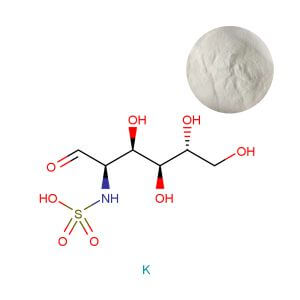
Glucosamine Sulfate 2KCl is the preferred salt form for formulations requiring high stability and low chloride content. For brands developing a comprehensive joint health line, pairing SAMe Tosylate Disulfate with glucosamine sulfate allows both rapid symptomatic relief (supported by SAMe’s anti-inflammatory properties) and long-term cartilage support. The complementary mechanisms are summarized below:
| Ingredient | Primary Mechanism | Clinical Outcome | Stability Consideration |
|---|---|---|---|
| SAMe Tosylate Disulfate | Methyl donor for proteoglycan synthesis; modulates inflammatory cytokines | Pain reduction, morning stiffness improvement (within 1‑2 months) | Low moisture; enteric coating recommended |
| Glucosamine Sulfate | Substrate for glycosaminoglycan production; mild anti-inflammatory | Slows cartilage degradation, improves joint space width (≥6 months) | Hygroscopic; requires desiccant and stable salt form (2KCl) |
Final verdict for joint health formulators: A standalone glucosamine product is no longer a compelling innovation. The combination with stabilized SAMe creates a clinical halo that can justify premium pricing and evidence-based marketing claims.
Formulator’s Checklist: Key Parameters for SAMe-Based Blends
When developing a new dietary supplement containing SAMe, brands should evaluate the following technical aspects to ensure a robust, market-ready product. Use this checklist during supplier qualification and prototype testing.
- pH environment: SAMe degradation accelerates below pH 2.5 and above pH 7.0. Target a finished product pH of 4.0–5.5 (e.g., acid-resistant capsules or enteric-coated tablets).
- Moisture control: Manufacturing relative humidity should be ≤30%. Include desiccants in primary packaging and specify ≤3.0% moisture in the raw material COA.
- Excipient compatibility: Avoid direct contact with reducing sugars (fructose, glucose) and oxidizing minerals (copper, iron). Microcrystalline cellulose and dibasic calcium phosphate are generally safe.
- Dosage forms: Enteric-coated tablets and vegetarian capsules (HPMC) provide better stability than standard gelatin caps under accelerated conditions (40°C/75% RH).
Overarching insight: Technical excellence alone does not sell products—but it prevents failures. The brands that invest in these formulation details early avoid costly late-stage revisions and gain a reputation for quality that translates into retailer and consumer trust.
Reliable suppliers provide full documentation, including HPLC purity (≥98.0%), residual solvent analysis, and stability data under ICH conditions. For brands formulating multi‑ingredient products, co‑micronization or dry granulation can reduce segregation risks.
Conclusion & Next Steps
Stabilized SAMe Tosylate Disulfate unlocks the full potential of this versatile molecule, allowing brands to develop high‑quality liver and joint health supplements without the fear of potency loss. By strategically combining SAMe with milk thistle extract, reduced glutathione, or glucosamine sulfate, formulators can deliver superior value propositions backed by clinical mechanisms.
Your decision point: The market for liver and joint health supplements is growing, but it is also becoming more discerning. Brands that choose the right salt form and synergistic partners today will dominate the premium shelf space tomorrow.
To explore technical data sheets, stability study reports, and custom formulation support for SAMe Tosylate Disulfate, visit our product page or contact our technical team for a consultation on your next product pipeline.
Share this article
Found this helpful? Share it with others!
Related Products
Products mentioned in this article

Want to learn more?
Explore our products or contact our team for personalized solutions and expert advice.