
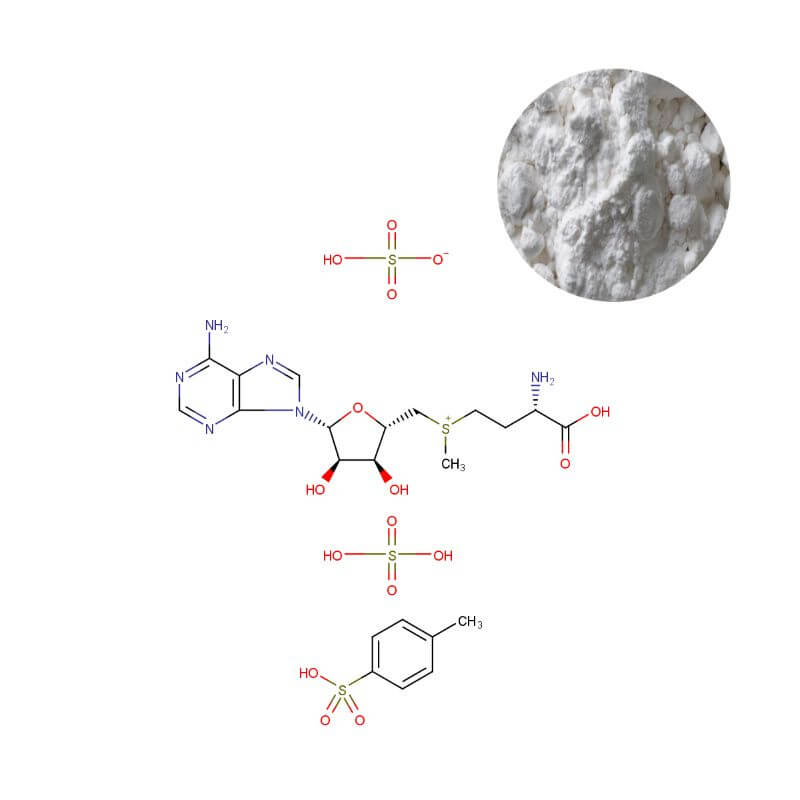
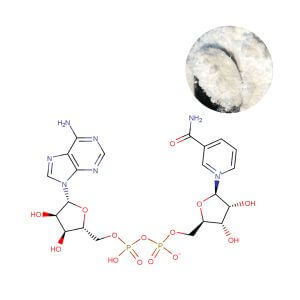
SAMe Tosylate Disulfate Powder
| Product Name | SAMe Tosylate Disulfate Powder |
| CAS Number | 97540-22-2 |
| Appearance | White to off-white crystalline powder |
| Purity | 99.0% min. (by HPLC) |
| Packaging | 1 kg/alu-bag, 5 kg/tin, 25 kg/fiber drum |
| MOQ | 1 kg |
SAMe Tosylate Disulfate Powder (≥99% HPLC): The Methyl Donor for Liver & Cognitive Health Formulations
In the premium supplement segment, formulation effectiveness hinges on ingredient stability, clinical substantiation, and batch-to-batch fidelity. For brands developing hepatoprotective or mood-support products, the choice of S-Adenosyl-L-Methionine (SAMe) often determines label claim credibility. A premium SAMe Tosylate Disulfate Powder typically features ≥99% purity by HPLC, verified via a comprehensive Certificate of Analysis (CoA) that includes S,S-isomer content and SAMe ion assay. This establishes the scientific foundation for high-performance nutraceuticals targeting two of the largest wellness categories: liver health and central nervous system resilience. For brands, securing a consistent ≥99% purity SAMe supply is not merely a raw material decision—it is a strategic move to claim clinical credibility and command premium shelf space in crowded liver and cognitive health aisles.
Triple-Action Mechanism: Methylation, Transsulfuration & Aminopropylation Backed by 2024 Systematic Reviews
SAMe is the second most abundant enzyme cofactor in human cells, acting as the principal methyl donor for DNA, proteins, and neurotransmitters. Beyond methylation, its transsulfuration pathway directly fuels endogenous glutathione synthesis—a critical antioxidant for hepatic detoxification. A 2024 systematic review (doi: 10.3390/nu16213668) analyzed 15 high-quality studies (all rated 4‑5/5) and concluded that SAMe at 1000‑1200 mg/day significantly improves liver parameters with only mild transient GI effects. Concurrently, a companion review (doi: 10.3390/nu16183148) evaluated 36 studies (32 with 4‑5/5 quality) and confirmed that 24 studies demonstrated efficacy for mood, behavior, and sleep outcomes.
From a strategic formulation perspective, this dual systematic evidence allows brands to substantiate two distinct product claims—liver support and cognitive balance—using a single, well-documented ingredient. For procurement teams, this directly translates to reduced R&D risk and broader market adaptability. Rather than building separate supply chains for hepatoprotective and nootropic lines, a compliant, high-purity SAMe powder serves as a unified active core.
Quality Beyond Purity: Why S,S-Isomer & SAMe Ion Content Define Premium Bulk SAMe
While many suppliers advertise “≥98%” or “≥99%” purity, experienced formulators know that SAMe’s therapeutic value depends on two hidden parameters: the S,S-isomer proportion (the natural biologically active form) and the SAMe ion content (the actual active moiety). Key sourcing considerations for certified SAMe include:
- S,S-Isomer ≥70% – Ensures the ingredient retains its native methyl-donor configuration; lower ratios (e.g., 60‑65%) contain inactive or less effective isomers that dilute label claims.
- SAMe Ion Content 50‑54% – Reflects the true active entity within the disulfate tosylate salt matrix; this directly impacts dose equivalence across different suppliers.
- Loss on Drying ≤2.0% – Low moisture protects against degradation, especially critical for hygroscopic ingredients like SAMe.
For brands sourcing bulk SAMe Tosylate Disulfate, the consistency of these two metrics—S,S-isomer and ion content—becomes a critical quality benchmark, routinely documented in a batch‑specific CoA from GMP-focused partners. For procurement teams, this directly translates to avoiding a common industry pitfall: relying solely on total purity figures that mask isomer imbalance, which can lead to up to 33% lower biological activity (as demonstrated in comparative ingredient analyses). A certified CoA that reports both values enables accurate finished product dosage calculation and regulatory confidence. This level of analytical rigor effectively means that brand developers can accurately predict finished product bioequivalence, reducing the risk of under-dosing and consumer complaints.
Added insight: When evaluating suppliers, insist on historical S,S-isomer data across multiple lots. A batch that meets ≥70% today but fluctuates to 62% next quarter creates finished product inconsistencies that erode consumer trust and may trigger label claim deviations under scrutiny.
Formulation Blueprint: Dose, Synergy & Stability Safeguards for SAMe Powders
Integrating SAMe tosylate disulfate into solid dosage forms requires attention to its inherent hygroscopicity and temperature sensitivity. An effective formulation for liver or mood support typically starts with clinical alignment:
| Application | Daily Dose Range (from trials) | Key Synergist | Rationale |
|---|---|---|---|
| Liver Health | 1000‑1200 mg | NAC or Silymarin (Milk Thistle) Extract | Sustains glutathione regeneration; NAC provides cysteine substrate |
| Mood Support | 800‑1600 mg | Active Folate (5-MTHF Calcium) + Vitamin B12 (Methylcobalamin) | Methylated vitamins support the methylation cycle, enhancing SAMe efficiency |
Beyond dosing, stability is the top technical challenge. Practically speaking, SAMe powder degrades rapidly when exposed to moisture or temperatures above 25°C. Therefore, bulk handling should follow these non-negotiable rules:
- Storage: -20°C freezer in original, airtight, light-resistant packaging. Short-term (≤30 days) 2‑8°C is acceptable but not for long-term stock.
- Processing environment: Maintain relative humidity below 40% during blending or encapsulation to prevent particle caking and potency loss.
- Final product format: Enteric-coated tablets or moisture‑proof blister packs dramatically outperform standard HDPE bottles for shelf‑life extension (up to 24 months).
From a strategic formulation perspective, these stability measures are not merely technical details—they directly influence consumer experience and brand reputation. A product that loses 20% of its label claim before opening due to improper packaging creates regulatory exposure and returns. Conversely, brands that invest in cold‑chain logistics and desiccant systems can differentiate with “potency‑guaranteed” positioning. In practice, mastering these stability protocols allows brands to extend product lifecycle by 12–18 months, directly lowering inventory write-offs and boosting customer loyalty.
Practical insight: A frequently overlooked error is using standard desiccant canisters inside non‑foil lined bottles. For SAMe, oxygen ingress matters nearly as much as moisture; nitrogen‑purged packaging with oxygen absorbers can extend shelf life by an additional 6‑12 months compared with silica gel alone.
Supplier Risk Mitigation: A Procurement Checklist for High-Grade SAMe Tosylate Disulfate
As SAMe gains traction in both liver and cognitive health categories, the number of bulk suppliers has grown—but quality variability remains high. To mitigate formulation risk, procurement teams should adopt this objective evaluation checklist when evaluating wholesale SAMe sources:
- Full scope CoA (not just purity): Must include S,S-isomer (≥70%), SAMe ion content (50‑54%), loss on drying (≤2.0%), heavy metals (Pb≤1.0, As≤1.0, Cd≤0.5, Hg≤0.1 mg/kg), and microbial limits (USP <61>/<62>).
- Stability data under recommended storage: Request accelerated stability studies confirming at least 24 months shelf life when stored at -20°C.
- Certifications & traceability: GMP compliance, full chain‑of‑custody documentation, and declared absence of major allergens (gluten, soy, dairy).
- Regulatory support package: For brands entering the US market, ensure the supplier provides information to support NDI notifications (even if not pre‑cleared). For the EU, request Novel Food compliance data.
For procurement teams, this translates directly to lower supply disruption risk and faster time‑to‑market. A verified CoA and stability dossier eliminate the need for expensive retesting and reformulation. Moreover, working with a supplier that routinely provides batch‑specific documentation (available within 24 working hours) allows brands to respond confidently to regulatory audits or customer inquiries. A documented quality history across batches also serves as due diligence evidence, shielding brands from costly reformulation when supply chain disruptions occur.
Total cost perspective: While premium SAMe with documented S,S-isomer ≥70% carries a higher upfront price, it reduces finished product overages, returns, and reformulation cycles. Over a 100 kg annual purchase, the hidden savings often exceed the initial premium by 20‑30%.
Next Steps: Accelerate Your Product Development with Technical Dossier & Free Sample
Building a clinically credible liver or mood support product requires more than just ingredient procurement—it demands a partner who understands formulation challenges. Take the first step by requesting your complimentary sample of SAMe Tosylate Disulfate Powder (≥99% HPLC) along with the full technical dossier, including batch‑specific CoA, stability report, and regulatory guidance. Request your free sample & technical dossier → Our team delivers documentation within 24 working hours, enabling you to validate the ingredient against your quality benchmarks before commitment.
Frequently Asked Questions
Share this product
Related Products
Ready to get started?
Contact our team for technical specifications, pricing, and customized solutions.