
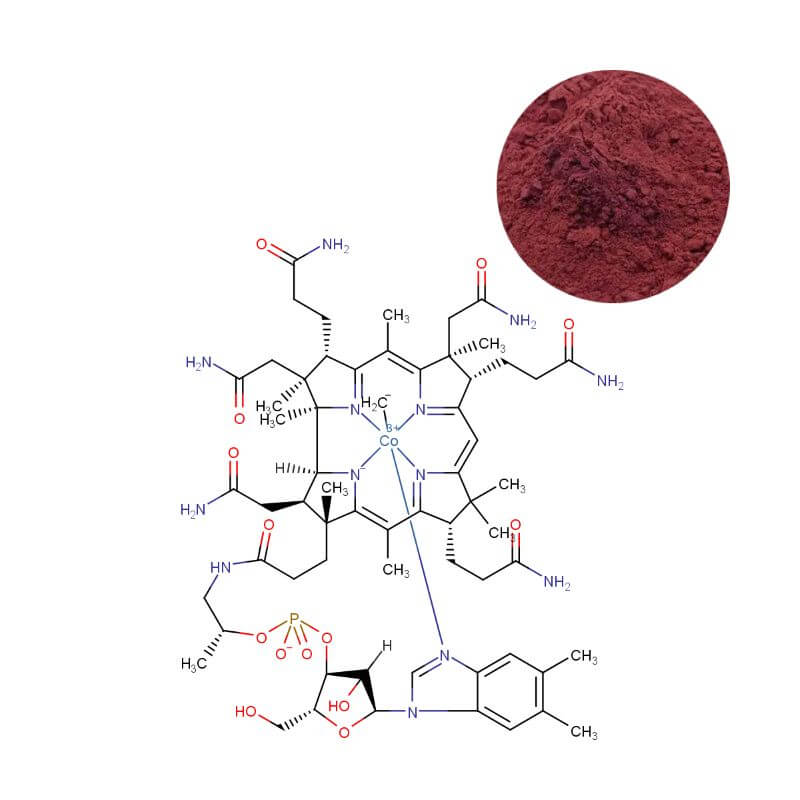
Methylcobalamin (Vitamin B12) Powder
| Product Name | Methylcobalamin Powder |
| CAS Number | 13422-55-4 |
| Appearance | Dark red crystalline powder |
| Purity | 1% Dilution, 99% (by HPLC) |
| Packaging | 1 kg/bag, 5 kg/bag, 25 kg/drum |
| MOQ | 1 kg |
Methylcobalamin Powder: Clinical Trust Architecture for Premium B12 Formulations
Clinical validation of the active coenzyme form has positioned bulk Methylcobalamin Powder as the definitive premium-tier ingredient for neurological and methylation-support formulations. Brands seeking a reliable Methylcobalamin Powder supplier now prioritize verified lot-to-lot COA consistency and audit-ready traceability alongside clinical substantiation. This active B12 form commands a sustainable price premium over cyanocobalamin, backed by differentiated pharmacokinetic data and expanding DTC consumer demand for methylated nutrients. Specification-verified sourcing ensures every batch meets USP monograph requirements for identity, assay, and contaminant limits.
Clinical Evidence Driving Premium Positioning and DTC Claim Substantiation
The premium positioning established through active-form differentiation requires substantiation that withstands regulatory scrutiny and consumer skepticism. Methylcobalamin functions as the direct cofactor for methionine synthase, enabling homocysteine-to-methionine conversion without the decyanation step required by cyanocobalamin. This biochemical distinction delivers measurable clinical differentiation supporting premium pricing strategies.
- Subcutaneous Cmax 24.4% higher than intramuscular delivery with faster absorption onset
- Methionine synthase cofactor activity enables direct methylation pathway support without hepatic conversion
- Neurological function support mechanisms distinct from cyanocobalamin establish differentiated positioning for cognitive health applications
For brand owners, this evidence architecture supports DTC claims such as "neurologically active B12" and "methylation pathway support" that distinguish premium products from commodity cyanocobalamin offerings. Clinical endpoint data from MTHFR polymorphism carriers further supports targeted marketing to the growing consumer segment actively seeking methylated nutrients. Approximately 30-40% of the global population carries the MTHFR C677T heterozygous variant, with reduced enzyme activity supporting demand for pre-methylated B12 forms, defining a high-value target market for methylated B12 formulations. Vitamin B12 Methylcobalamin products command ingredient cost premiums of 2-2.5x over cyanocobalamin, translating into sustainable retail price positioning for premium formulations.
Formulation Synergy and Dosage Innovation for Methylated B-Complex Delivery
Establishing clinical differentiation creates an immediate formulation challenge: preserving methylcobalamin's potency within multi-ingredient delivery systems. The coenzyme's sensitivity to acidic environments and reducing agents demands strategic excipient selection and protective processing technologies.
Methylcobalamin demonstrates optimal stability when combined with methylfolate and pyridoxal-5-phosphate (P5P) in methylated B-complex formulations, creating biochemical synergy across the methylation pathway. Softgel and stick-pack formats accommodate these combinations effectively, while direct-compression tablet systems require careful excipient sequencing to avoid potency loss.
- Ascorbic acid co-formulation accelerates degradation by 70-76% within three months at 1:1 ratios
- Sorbitol incorporation reduces degradation losses from 79% to 12% under acidic conditions
- Maximum photodegradation rates observed at pH 5.0 in ascorbic acid co-formulations, requiring buffering for acidic or alkaline matrices
- Physical isolation via bilayer tablet or separate granulation layers prevents ingredient interaction
Co-formulation with ascorbic acid accelerates photodegradation through a protonation-dependent mechanism, reaching maximum degradation rates at pH 5.0 (Spectrochim. Acta A, 2024; doi: 10.1016/j.saa.2024.124902). For brand owners, these formulation strategies reduce development iteration cycles, shorten time-to-market by 6-10 weeks, and protect premium retail pricing through verified label-claim accuracy across shelf life.
Particle Engineering for Direct-Compression Efficiency and Air-Freight Protection
Formulation strategies that preserve potency in finished dosage forms depend entirely on the physical properties of the incoming raw material. Powder flowability and particle size distribution determine whether methylcobalamin integrates seamlessly into high-speed capsule filling and direct-compression lines or requires costly pre-processing interventions.
| Physical Parameter | Specification | CMO Line Impact |
|---|---|---|
| Particle Size | ≥ 95% through 80 mesh | Uniform blend distribution without segregation |
| Bulk Density | 0.20-0.40 g/mL | Direct compression without granulation |
| Loss on Drying | ≤ 11.5% | Stable crystal hydration for consistent potency |
| Water Solubility | Freely soluble | Compatible with liquid and stick-pack formats |
Crystalline lattice water molecules are essential to molecular stability, with three distinct hydrate forms interconvertible through humidity and temperature exposure (International Journal of Pharmaceutics, 2023; doi: 10.1016/j.ijpharm.2023.123326). Air-freight exposure to low-pressure cargo holds and tarmac temperature fluctuations risks triggering hydrate transitions and caking. Nitrogen-flushed foil packaging with desiccant liners prevents moisture ingress during transit, ensuring direct-to-blender usability upon arrival and eliminating 5-10% potency loss from moisture-mediated degradation.
Global Regulatory Pathways and Label Claim Safety Zones
Reliable powder performance at the CMO line level provides no commercial value if the finished product cannot clear regulatory pathways in target export markets. Methylcobalamin's regulatory identity varies across jurisdictions, creating both opportunities and compliance obligations that affect launch timelines. Selecting a Methylcobalamin Powder supplier with documented regulatory status across multiple markets eliminates the need for parallel supplier qualification across regions.
| Market | Regulatory Status | Label Claim Parameters |
|---|---|---|
| United States | DSHEA dietary ingredient | Structure/function claims permitted |
| European Union | Authorized novel food ingredient | EFSA-compliant claims only |
| Japan | Dual regulatory recognition for vitamin B12 forms | Structure/function claims permitted under food framework |
| India | FSSAI non-prohibited | Nutraceutical use permitted |
In the United States, methylcobalamin requires no NDI notification under DSHEA, permitting immediate market entry. European markets recognize methylcobalamin as an authorized novel food ingredient under EFSA safety assessment, while Regulation (EC) No 1925/2006 governs vitamin addition. Japan's regulatory framework recognizes high-dose methylcobalamin, providing a strong global quality benchmark for this ingredient. India's FSSAI confirmed in February 2025 that no ban exists on methylcobalamin in health supplements. These parallel pathways allow synchronized multi-market launches, avoiding staggered entry delays of 3-6 months that erode competitive advantage.
Total Cost of Ownership Optimization and Supply Chain Resilience
Regulatory clarity enables market entry, but procurement economics determine whether premium positioning delivers sustainable margins. Methylcobalamin Powder wholesale strategies must account for global supply concentration, batch consistency requirements, and inventory carrying costs that together define the true landed cost per finished unit.
- Global methylcobalamin API production estimated at 9.5 metric tons annually with high supplier concentration
- 1% dilution formats eliminate segregation risk and reduce content uniformity testing costs
- Dual-source qualification strategies mitigate single-supplier disruption exposure
- Long-term purchase agreements stabilize pricing against cobalt raw material volatility
Bulk Methylcobalamin Powder sourced through specification-verified channels allows brands to lock in quality parameters while optimizing inventory turnover. The 99% HPLC grade suits high-precision blending operations, while 1% DCP-carrier dilution formats ensure uniform micro-dosing distribution across large-scale blending operations. Dual-source procurement strategies reduce single-supplier disruption exposure and support batch-to-batch uniformity critical for automated high-speed capsule filling lines. Optimized powder specifications reduce annual potency degradation write-offs and deliver measurable per-line efficiency gains. For procurement directors evaluating Methylcobalamin Powder wholesale options, total cost of ownership analysis must incorporate batch release testing, storage compliance, and supply continuity planning alongside unit pricing. Mecobalamin Powder buyers benefit from the same active entity under INN nomenclature, simplifying global procurement documentation, with analytical standards verified against pharmacopeial requirements.
Request Sample Evaluation with Complete Technical Dossier
Technical specification verification and regulatory documentation review should precede commercial-scale procurement commitments. Requesting a sample evaluation package provides R&D teams with authentic material for formulation trials while supplying procurement with the audit documentation needed for supplier qualification. Every sample request includes lot-specific COA, MSDS, allergen statement, GMO-free declaration, and regulatory status summary for target markets. Request evaluation sample of methylcobalamin powder with complete technical data package
Frequently Asked Questions
Share this product
Related Products
Ready to get started?
Contact our team for technical specifications, pricing, and customized solutions.