
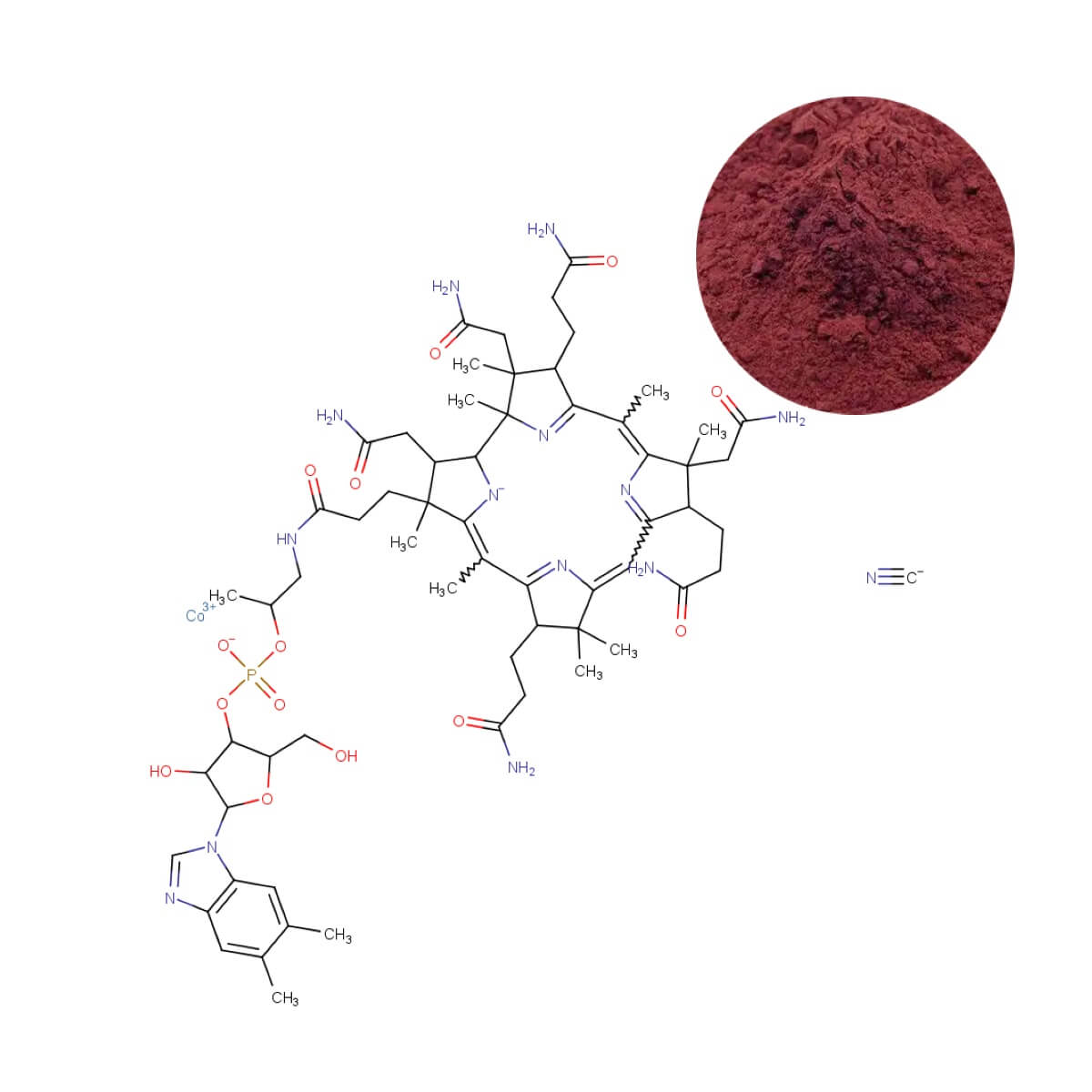
Cyanocobalamin (Vitamin B12) Powder
| Product Name | Cyanocobalamin (Vitamin B12) Powder |
| CAS Number | 68-19-9 |
| Appearance | Dark red crystalline powder |
| Purity | 1% Dilution, 99% (by HPLC) |
| Packaging | 1 kg/bag, 5 kg/drum, 25 kg/drum |
| MOQ | 1 kg |
HPLC-Verified Cyanocobalamin Powder for Cognitive Health Supplements and Gummy Fortification
Oral cyanocobalamin combines clinically documented neurological support with high-stability fermentation-derived material to satisfy both DTC claim requirements and scalable production demands. Bulk cyanocobalamin powder meets this need across 1% dilution and 99% purity grades engineered for micro-dosing accuracy and direct compression efficiency. Established cyanocobalamin supplier ecosystems ensure batch-to-batch consistency, while routine HPLC testing and lot-specific COAs establish the audit-ready traceability that procurement teams require for supply chain compliance across global markets.
Neurological Validation: Translating Clinical Endpoints into Compliant DTC Claims
Clinical defensibility determines whether a cognitive health positioning survives regulatory scrutiny or collapses under substantiation requirements. Cyanocobalamin functions as a cofactor for methylmalonyl-CoA mutase and methionine synthase, supporting myelin synthesis and neurotransmitter metabolism through methylation-dependent epigenetic regulation of the CCL11 gene as observed in a study on long COVID-associated visuoconstructive deficit, though extrapolation to general cognitive health populations requires further investigation. Oral absorption reaches peak plasma concentration at approximately 6.83 hours with a biological half-life of approximately 6 days.
- Serum B12 deficiency threshold below 200 pg/mL correlates with elevated cognitive impairment risk in aging populations
- A 2024 meta-analysis of RCTs in general populations found no significant cognitive memory enhancement, underscoring the regulatory distinction between deficiency correction claims and cognitive improvement claims
Brands positioning cyanocobalamin for cognitive support must anchor messaging in "supports normal neurological function" rather than "improves cognition," a distinction that regulatory review boards actively enforce. A cyanocobalamin wholesale strategy that incorporates both the 99% pure grade for clinical substantiation and the 1% dilution grade for consumer-friendly dosing enables brands to capture premium pricing in the cognitive health segment without crossing drug-level claim boundaries.
Dosage Innovation: Stabilizing Cyanocobalamin in Gummies, Capsules, and RTD Beverages
Clinical positioning establishes the claim; the delivery format determines whether that claim survives shelf-life reality. Cyanocobalamin degrades measurably in high-moisture matrices when co-formulated with vitamin B1 and B3, a degradation pathway that gummy manufacturers must account for when establishing stability-driven overage strategies. USP content acceptance criteria apply to chewable gels, independent of any overage added during production.
| Dosage Form | Grade Selection | Stability Consideration | Commercial Implication |
|---|---|---|---|
| Pectin gummies | 1% dilution on mannitol | Overage strategy determined by stability data; verify against final matrix and packaging conditions | Label claim protection with controlled COGS |
| Direct compression tablets | 99% pure crystalline | ≥95% through 80 mesh supports uniform blending | May reduce secondary granulation with proper blending, lowering TTM |
| RTD beverages | 1% dilution pre-dissolved | pH 4-6 stability window | Enables transparent liquid format at scale |
Per Wang et al. (2019, Food Chemistry), beta-lactoglobulin and alpha-lactalbumin complexes improve both thermal and photostability of adenosylcobalamin and cyanocobalamin by 10% to 30%, creating formulation pathways for premium sublingual and functional beverage applications. For brands pursuing cyanocobalamin wholesale procurement, the 1% dilution grade reduces minimum weighing errors in micro-dosing while the 99% pure grade enables flexible overage calculations, together shortening formulation development cycles and reducing costly stability testing iterations before commercial launch.
Global Regulatory Pathways: GRAS Identity, EFSA Claims, and Label Safety Zones
Formulation stability addresses the manufacturing question; regulatory identity determines which markets the finished product can legally enter. Cyanocobalamin holds GRAS status in the United States under 21 CFR 184.1945 for direct human food ingredient use, with FDA explicitly designating "vitamin B12" as synonymous with cyanocobalamin when unqualified.
- US market structure/function claims permitted: "Supports nervous system health" and "Helps maintain normal cognitive function"
- EU approved health claims under EFSA: "Vitamin B12 contributes to normal functioning of the nervous system" and "Vitamin B12 contributes to normal psychological function"
- FDA daily reference value for vitamin B12 established at 2.4 mcg per 21 CFR 101.9
- No NDI notification required for cyanocobalamin in the US, eliminating 12-18 month market entry delays
- EU Novel Food Regulation does not apply; vitamin B12 authorized under Regulation (EC) No 1925/2006
The regulatory asymmetry between US and EU claim frameworks creates a strategic opportunity for brand owners. US structure/function claims allow broader consumer-facing language while EU approved claims require precise wording that mirrors EFSA's scientific opinion. A cyanocobalamin supplier that provides both region-specific compliance dossiers and lot-specific COAs enables brands to launch in multiple jurisdictions while reducing legal review expenses and accelerating international market entry.
Particle Engineering: From 80-Mesh Specification to Air-Freight Stability and CMO Line Efficiency
Regulatory clearance opens market access; powder physics determines whether the product survives the journey from drum to dosage form without quality loss. Cyanocobalamin's ≥95% through 80 mesh particle size distribution directly influences blend uniformity in direct compression and capsule filling operations, where PSD variation between lots can cause segregation and color inconsistency in finished tablets.
| Physical Parameter | Specification | CMO Line Impact | Commercial Translation |
|---|---|---|---|
| Bulk density | 0.35-0.55 g/mL (1% dilution) | Consistent die fill in high-speed encapsulation | Reduced weight variation, fewer rejected capsules |
| Water activity | ≤0.35 aw | Prevents caking during storage and transport | Extended warehouse shelf life, lower inventory write-offs |
| Moisture content | 99% pure: ≤12.0%; 1% dilution: ≤5.0% | Prevents sticking during direct compression | Higher production yield, less downtime for cleaning |
| Appearance | 99% pure: Dark red crystalline; 1% dilution: Pink to red free-flowing powder | Visual QC indicator for light exposure | Rapid batch release, reduced analytical testing costs |
Air freight exposes powder to low-pressure cargo holds and tarmac temperature extremes that accelerate moisture migration in hygroscopic dilution grades. Aluminum foil inner liners with desiccant packets and light-blocking outer drums prevent caking and potency loss during international transit. For brand owners, this protective packaging delivers reduced rejection rates at receiving inspection and fewer production interruptions from out-of-spec raw material, protecting both launch timelines and margin.
Total Cost of Ownership: Batch Consistency, Supply Resilience, and Margin Expansion
Physical protection secures the product in transit; financial architecture determines whether the procurement decision generates sustainable margin expansion. China accounts for an estimated 70-80% of global fermentation-derived cobalamin capacity, creating both pricing efficiency and concentration risk that procurement directors must balance against inventory carrying costs and potential stockout scenarios.
- 99% pure grade may support direct compression with appropriate glidant pre-blending, potentially reducing secondary granulation requirements
- 1% dilution grade reduces minimum weighing errors in micro-dosing, lowering batch rejection rates in gummy and capsule production
- Batch-to-batch COA consistency enables just-in-time inventory models, reducing working capital tied to safety stock
- Single-source qualification with dual-grade supply reduces vendor management overhead and incoming QC costs
Fermentation capacity is capital-intensive, and cobalt procurement volatility introduces cost uncertainty that passes through to raw material pricing. A cyanocobalamin wholesale strategy that secures both 99% pure and 1% dilution grades from a qualified cyanocobalamin supplier with documented batch consistency protects against formulation disruptions when market conditions shift.
Accelerating R&D Validation with Audit-Ready Samples and Compliance Dossiers
Technical specification review reaches its decision point when R&D needs physical material to verify blend uniformity, and procurement needs documentation to qualify the vendor. Sample requests routed through this channel receive synchronized delivery of 10-20g evaluation quantities alongside lot-specific COA, MSDS, allergen statement, non-GMO declaration, and regulatory compliance summary. This dual-track fulfillment reduces the sequential back-and-forth that typically extends supplier qualification by weeks. R&D teams can proceed directly to formulation trials while procurement completes vendor audit requirements in parallel. Obtain evaluation-grade Cyanocobalamin powder with complete technical documentation package.
Frequently Asked Questions
Share this product
Related Products
Ready to get started?
Contact our team for technical specifications, pricing, and customized solutions.