
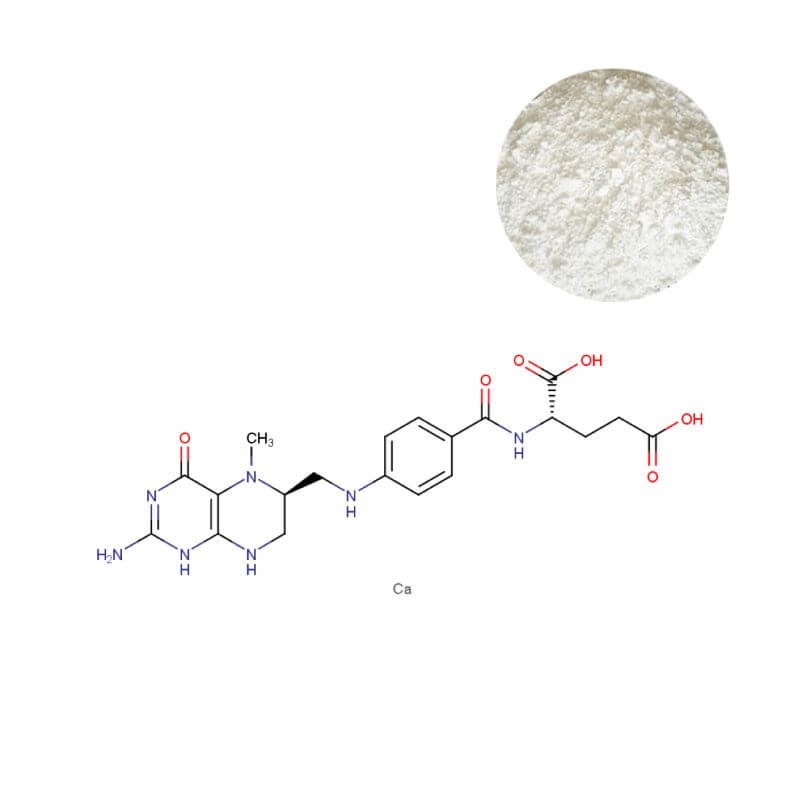
L-5-MTHF Calcium (Active Folate)
| Product Name | L-5-MTHF Calcium (Active Folate) |
| CAS Number | 151533-22-1 |
| Appearance | White to off-white fine powder |
| Purity | 98.0% min. (by HPLC, Anhydrous Basis) |
| Packaging | 1 kg/bag, 5 kg/tin, 25 kg/drum |
| MOQ | 1 kg |
L-5-MTHF Calcium (98% Active Folate): The Direct‑Action Folate for Prenatal, Cognitive & Cardiovascular Formulas
Formulating a truly differentiated folate supplement faces the metabolic bottleneck of folic acid. Many consumers—especially those with MTHFR polymorphisms—cannot efficiently convert synthetic folic acid into its bioactive form. L‑5‑MTHF Calcium (active folate) bypasses this limitation entirely. With a minimum purity of 98% (anhydrous basis, HPLC) and a well‑defined specific rotation range of +38.0° to +45.0°, this calcium salt offers a ready‑to‑use, stable source of the body’s predominant circulating folate. For brands, bulk L‑5‑MTHF Calcium provides a clean alternative to standard folic acid—supporting maternal and cardiovascular health claims while simplifying stability. This purity level is a strategic differentiator, enabling premium product positioning with science‑backed efficacy claims that justify higher margins and reduce reliance on consumer‑specific metabolism.
Why Active Folate Matters: Metabolic Bottlenecks and Direct Bioactivity
The clinical distinction between folic acid and L‑5‑MTHF Calcium lies in their metabolic fate. Synthetic folic acid requires multi‑step reduction by DHFR and MTHFR to become biologically active. In contrast, L‑5‑MTHF is the body’s principal circulating folate and the only form that crosses the blood‑brain barrier. A 2023 review in the Journal of Translational Internal Medicine (doi: 10.2478/jtim-2023-0087) clearly states that 5‑MTHF “directly participates in one‑carbon metabolism” without enzymatic activation. From a strategic perspective, this means your product delivers predictable folate response across a broader consumer base, including those with reduced MTHFR activity.
Beyond DNA synthesis and methylation, L‑5‑MTHF helps maintain healthy homocysteine levels—a key marker for cardiovascular wellness. The same review highlights a synergistic mechanism: calcitriol (vitamin D3) upregulates the reduced folate carrier (RFC) and cystathionine β‑synthase, enhancing folate bioavailability and homocysteine clearance. This insight enables combined vitamin D3 and active folate formulations, setting your product apart from conventional multivitamins. For procurement teams, the takeaway is clear: sourcing a bulk L‑5‑MTHF Calcium with verified optical purity ensures your finished product can make these science‑backed claims without metabolic guesswork. From a brand equity standpoint, this eliminates consumer complaints linked to individual metabolic variability, directly improving repeat purchase rates and reducing return risk.
Quality Benchmarks: What Defines a Premium L‑5‑MTHF Calcium Supplier
The difference between generic and high‑grade active folate lies in verifiable specifications. A reliable L‑5‑MTHF Calcium supplier provides a comprehensive COA that goes beyond simple purity. Key sourcing considerations include:
- Assay (≥98.0% on anhydrous basis, HPLC) – ensures batch‑to‑batch bioactivity consistency.
- Specific rotation (+38.0° to +45.0° at c=1.5, water, 25°C) – critical for distinguishing genuine L‑isomer from inactive D‑forms.
- Water content (6.0% – 17.0% by Karl Fischer) – directly linked to stability; values outside this range risk degradation or crystal form alteration.
- D‑Isomer ≤1.0% – guarantees high enantiomeric purity, essential for predictable pharmacokinetics.
Heavy metal limits (Pb ≤1.0, As ≤1.0, Cd ≤0.5, Hg ≤0.1 mg/kg) and microbial compliance are baseline expectations. For procurement teams, this directly translates to lower regulatory risk and faster market access in both the US and EU. Moreover, the patented C‑crystalline form (common among reputable suppliers) provides superior long‑term stability compared to amorphous material, enabling a 24‑month shelf life under standard storage conditions. It's worth noting that a certified L‑5‑MTHF Calcium with full traceability from synthesis to finished packaging is not a luxury—it’s a risk‑mitigation essential. This traceability directly reduces the cost of quality failure; one recalled batch due to impurity or inconsistency can wipe out years of margin gains, making upfront specification verification a high‑ROI decision.
| Quality Attribute | Industry Benchmark (98% Grade) | Why It Matters for Your Brand |
|---|---|---|
| HPLC Purity (anhydrous) | ≥98.0% | Ensures batch‑to‑batch dosing accuracy for finished labels |
| Specific Rotation | +38.0° to +45.0° | Verifies authentic L‑5‑MTHF; avoids inactive isomers |
| Water Content (KF) | 6.0% – 17.0% | Directly impacts chemical stability and crystal integrity |
| Residual Solvents | Complies with USP <467> | Meets global pharmacopoeia safety thresholds |
Formulation in Practice: Stability, Synergy and Delivery Solutions
Formulation requires managing sensitivity to moisture, light, and oxidation. While the C‑crystalline form is robust, best practices dictate dry blending or low‑humidity granulation (≤45% RH) for tablet production. Avoid high‑shear wet granulation without appropriate stabilizers. For powder blends and stick packs, ensure packaging provides an excellent oxygen and moisture barrier—aluminium foil laminates are strongly recommended. A 2024 clinical study in Molecular Nutrition & Food Research (doi: 10.1002/mnfr.202400444) investigated 172 childbearing‑age women receiving either 400 µg or 800 µg of (6S)‑5‑MTHF calcium salt mixed with folic acid (1:1). After 8 weeks, serum (6S)‑5‑MTHF levels rose from 19.1 nmol/L to 73.9 nmol/L in the 800 µg group (p<0.001), with 95.5% of total serum folate being the active form. From a strategic formulation perspective, this provides two actionable insights: an 800 µg daily dose yields superior serum levels without increasing unmetabolized folic acid; and pure active folate offers cleaner pharmacokinetics for premium lines.
Typical synergy partners include:
- Methylcobalamin (Active Vitamin B12) – both act in the methionine synthase cycle, supporting methylation and neurological health.
- Vitamin D3 – calcitriol upregulates folate transport proteins, enhancing overall efficacy.
- Choline or Betaine – complementary methyl donors for comprehensive one‑carbon support.
For capsule or softgel applications, use excipients with low water activity (e.g., microcrystalline cellulose). Avoid direct contact with strong acids or alkaline salts. Chelation with divalent minerals is minimal at normal supplement pH, but separation in two‑part capsules can further guarantee long‑term stability.
Mitigating Risk: The Checklist for Sourcing Reliable Active Folate
Choosing a bulk L‑5‑MTHF Calcium distributor or exporter requires more than a low price per kilogram. A robust supplier qualification framework should include the following objective checkpoints:
- Full COA per batch – includes assay, water content, specific rotation, D‑isomer, heavy metals, residual solvents, and microbial limits, all tested by ISO/IEC 17025‑accredited methods.
- GMP compliance and food safety certifications – ISO 22000, FSSC 22000, or equivalent. Halal and Kosher certificates add global market access.
- Stability data for 24 months – under ICH conditions, demonstrating that the 98% purity and water content remain within specification.
- Traceability from synthesis to finished packaging – including origin of starting materials and absence of common allergens (gluten, soy, dairy).
- Regulatory dossier support – NDI and GRAS status for the US, Novel Food inclusion for the EU, and technical files for other regions.
For procurement teams, this directly translates to de‑risked supply chains and faster time‑to‑market. A supplier that provides batch‑specific COA within 24 working hours and offers a free 10‑20 g sample for in‑house validation demonstrates operational maturity. Investing in such a partner reduces hidden costs—failed stability batches, regulatory rejections, or reformulation delays—far outweighing upfront price differences. Ultimately, buy L‑5‑MTHF Calcium from a source that treats quality documentation as a non‑negotiable standard. Through a Total Cost of Ownership lens, the premium for verified, batch‑consistent material is negligible compared to the expense of reformulation, compliance delays, or a product recall. This shifts the decision from unit price to long‑term supply security and brand protection.
Next Steps: Accelerate Product Development with Verified Active Folate
You now have a clear roadmap: from the metabolic superiority of L‑5‑MTHF over folic acid, to critical quality benchmarks, and practical formulation tactics that protect stability and enable innovative synergies. The final step is to validate these specifications with your own bench tests. Request your complimentary sample & complete technical dossier—including a batch‑specific COA, stability summary, and regulatory references. This allows you to evaluate powder flow, blend uniformity, and compatibility with your unique formula architecture before committing to bulk orders.
Frequently Asked Questions
Share this product
Related Products
Ready to get started?
Contact our team for technical specifications, pricing, and customized solutions.