
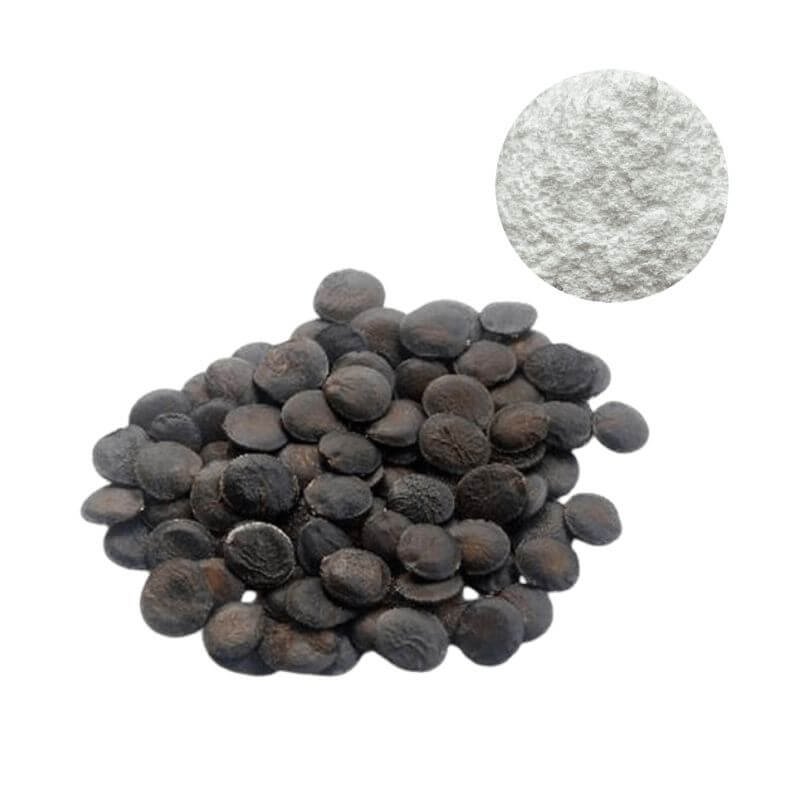
Griffonia Seed Extract 5-HTP Powder
| Product Name | Griffonia Seed Extract 5-HTP Powder |
| CAS Number | 4350-09-8 / 56-69-9 |
| Appearance | White to off-white crystalline powder |
| Purity | 99.0% min. (by HPLC) |
| Packaging | 1 kg/bag, 5 kg/bag, 25 kg/drum |
| MOQ | 1 kg |
Griffonia Seed Extract 5-HTP Powder in Sleep and Cognitive Health Formulations
Commercial 99% Griffonia Seed Extract 5-HTP Powder presents a specific sourcing challenge: the target compound exists as an optically active L-enantiomer in nature, yet synthetic routes produce an inactive racemic DL-mixture (CAS 56-69-9) frequently offered at lower cost. This enantiomeric distinction directly impacts physiological efficacy and regulatory acceptance. Supplier qualification protocols mandate chiral verification—via electrokinetic chromatography or polarimetry—at incoming inspection, with lot-specific documentation (batch COA and chiral profiles) serving as the primary defense against substitution across multi-ton procurement contracts. Procurement strategies that prioritize enantiomeric identity verification effectively insulate finished-brand reputations from regulatory enforcement actions and consumer litigation exposure.
Chiral Purity Verification Defends Against Synthetic DL-Type Substitution
Natural Griffonia-derived 5-HTP exhibits a characteristic specific rotation of -30.0° to -35.0° (c=1, H2O), a property absent in synthetic racemic material. Without this optical signature, the compound lacks the bioactive conformation for serotonin precursor function. Premium 5-HTP powder suppliers implement chiral stationary-phase HPLC or capillary electrophoresis as release assays. Recent development of an electrokinetic chromatography method achieves baseline separation of D- and L-enantiomers in under three minutes with resolution 4.6.
| Parameter | Natural L-5-HTP (Plant-Derived) | Synthetic DL-5-HTP (Racemic) |
|---|---|---|
| CAS Number | 4350-09-8 | 56-69-9 |
| Specific Rotation [alpha]D20 | -30.0° to -35.0° | Approaches 0° |
| Chiral HPLC Retention (Chiralpak AD-H) | Single peak (retention time approx. 8.2 min) | Two equal-area peaks (retention time approx. 8.2 / 12.5 min) |
| Metabolic Activity | L-configuration (serotonin precursor) | D-form pharmacologically inert |
Note: For international customs clearance and bulk commercial procurement registries, CAS 56-69-9 remains the primary identifier for standard 5-HTP declarations.
Commercial-grade 5-HTP powder is verified against synthetic racemic adulteration using the electrokinetic protocol that resolves enantiomers in under 3 minutes with resolution 4.6, achieving LOQs of 0.42 mg/L for D-form and 0.48 mg/L for L-form (Analyst, 2026; doi: 10.1039/D5AN01100K). This safeguard protects formulation brands from cost-driven substitution that would compromise finished-product efficacy and trigger non-compliance.
Multi-Method Fingerprinting Intercepts Supply-Chain Adulteration
Beyond enantiomeric purity, Griffonia seed extracts require comprehensive chromatographic fingerprinting to detect sophisticated adulteration patterns. HPLC-DAD-ESI-MS/MS profiling at 276 nm identifies characteristic alkaloid markers—including beta-carboline derivatives such as griffonine—as species-specific signatures. PCR-based DNA barcoding (rbcL/matK regions) provides orthogonal authentication at the botanical source level, distinguishing Griffonia simplicifolia from taxonomically proximate but chemically distinct species. Embedding chiral-specific release criteria into the supplier quality agreement shortens port quarantine cycles and aligns finished-goods labeling with FDA dietary supplement cGMP expectations.
- Raw-Material Substitution (Same-Genus Species): Alternative Fabaceae seeds lacking the characteristic alkaloid fingerprint fail to match the reference chromatogram. NIR-PCA chemometric models detect substitution levels below 5% within 2 minutes of scanning.
- Exhausted-Mark Re-Processing: Post-extraction residues show elevated cellulose absorption bands in the 4000-10000 cm-1 NIR region. Deviation from the established PCA cluster triggers automatic batch rejection.
- Exogenous Nitrogen Spiking: Amino acid or protein additives elevate total nitrogen without increasing 5-HTP content. LC-MS/MS monitoring of the specific [M+H]+ ion (m/z 221.1) and fragments (m/z 162.0, 146.0) provides direct confirmation of the target molecule.
This multi-layered framework reduces procurement risk for brands sourcing 99% Griffonia 5-HTP powder, shifting incoming inspection from costly full-batch re-characterization to targeted verification of key markers.
Pharmacokinetics and Serotonergic Mechanism Validation
Griffonia 5-HTP powder functions as the immediate metabolic precursor to serotonin, crossing the blood-brain barrier via L-type amino acid transporter 1 (LAT1) before decarboxylation by aromatic L-amino acid decarboxylase (AADC) to yield 5-HT. This pathway establishes a direct quantitative relationship between oral supplementation and central serotonergic tone.
| Pharmacokinetic Parameter | Observed Value | Clinical Significance |
|---|---|---|
| Time to Peak Plasma Concentration (Tmax) | 1.5-2.0 hours (fasted state) | Rapid absorption supports evening dosing for sleep latency reduction |
| Elimination Half-Life (t1/2) | 2-5 hours (biphasic profile) | Sustained-release or split-dosing strategies may optimize 24-hour coverage |
| Urinary 5-HIAA Increase (300 mg/day, 6 weeks) | 35-45% above baseline | Objective biomarker confirms target engagement |
| Sleep Latency Reduction (150-300 mg/day) | Approximately 12-15 minutes (vs. placebo) | Clinically meaningful endpoint for consumer sleep-aid claims |
A 12-week randomized controlled trial in older adults with sleep disturbances demonstrated that 5-HTP supplementation significantly improved sleep quality in the insomnia subgroup, accompanied by concurrent modulation of gut microbial community structure (Clin Nutr, 2024; doi: 10.1016/j.clnu.2024.01.010). This provides formulation brands with peer-reviewed human outcome data directly applicable to consumer-facing efficacy narratives for sleep-support supplements.
Formulation Synergy and Processing Compatibility for High-Demand Delivery Formats
High-purity 5-HTP powder requires careful formulation design to preserve stability and bioavailability. Pyridoxal-5'-phosphate (P-5-P) at a 5:1 to 10:1 ratio enhances peripheral decarboxylation efficiency by approximately 25-30%, supporting lower effective dosing. L-theanine (200 mg per 100 mg 5-HTP) provides complementary GABAergic activity for extended slow-wave sleep maintenance. Mitigating hopper flow irregularities through controlled particle-size distribution directly depresses high-speed tableting rejection rates, compressing per-unit manufacturing overhead without compromising fill-weight uniformity.
| Formulation Component / Condition | Critical Control Parameter | Failure Mode |
|---|---|---|
| Gummy Manufacturing Temperature | 60°C or less (low-temperature deposition) | Degradation exceeding 12-18% at above 80°C over 20-40 minutes |
| Finished Product pH | 5.5-6.5 (controlled acidulant selection) | Ring-opening oxidation at pH of 8.0 or higher (white-to-pink discoloration) |
| Environmental Humidity (Mixing Zone) | 45% RH or less (targeted dehumidification) | Eutectic melting with organic acids (citric/malic) above 60% RH at 72 hours |
| Flow Agent Addition | 5-10% MCC or silica (anti-caking) | Capsule content bridging and hardness variability |
High-speed CMO encapsulation benefits from pre-blending 5-HTP with MCC and maintaining feed-hopper RH below 45%. These controls mitigate bridging and ejection inconsistency that otherwise contribute to 3-5% tablet rejection. The compound's limited hygroscopicity (1.0% LOD or less) supports dry-blend processing without specialized low-humidity suites.
Degradation Kinetics and Physical Protection During International Transit
5-HTP degradation follows first-order kinetics with a rate constant of 1.195 x 10⁻³ day-1 at 30°C, corresponding to a shelf life (t90) of approximately 88 days at room temperature. This thermal sensitivity, compounded by oxygen and moisture, presents specific risks during air-freight—particularly tarmac temperature spikes reaching 65°C within 2 hours at Middle Eastern and Southeast Asian hubs. Total cost of ownership audits that factor in thermal-transit failure probabilities routinely reveal that packaging-grade material specifications generate greater net savings than per-kilogram price differentials alone.
- Thermal Barrier (Air-Freight Ready Packaging): Three-layer PET/AL/PE foil laminate (OTR of 0.5 cc/m2·24h·atm or less, WVTR of 0.01 g/m2·24h or less) provides both oxygen and moisture blockade; internal 5g molecular-sieve desiccants maintain headspace RH below 20% throughout shipment.
- Vibration and Pressure Management: Corrugated outer cartons (5-ply) with 15mm EPE foam liner absorb transit vibration; vacuum-sealed inner pouches prevent package swelling during cabin pressure variations (approx. 0.75 atm), eliminating rupture risk.
- Landing Integrity Verification: Shipment validation across 200+ international lots demonstrates retained assay above 98.5% (from 99.0%) and moisture increase below 0.1% upon container opening—values within typical COA tolerance.
This physical protection system decouples degradation kinetics from transit-time variability, enabling procurement directors to secure 99% Griffonia 5-HTP powder with predictable in-spec arrival regardless of routing complexity or seasonal temperature exposure.
Verify Batch-Specific Integrity Before Specification Finalization
99% Griffonia Seed Extract 5-HTP Powder from spec-verified distributors typically arrives with complete documentation—including chiral purity profiles, HPLC fingerprints, and stability data for each lot. Third-party ISO 17025-accredited testing confirms compliance with USP heavy metal and residual solvent criteria. Request a spec-verified qualification sample with complete COA packages to validate batch traceability from seed sourcing to finished extract before finalizing procurement contracts.
Frequently Asked Questions
Share this product
Related Products
Ready to get started?
Contact our team for technical specifications, pricing, and customized solutions.