
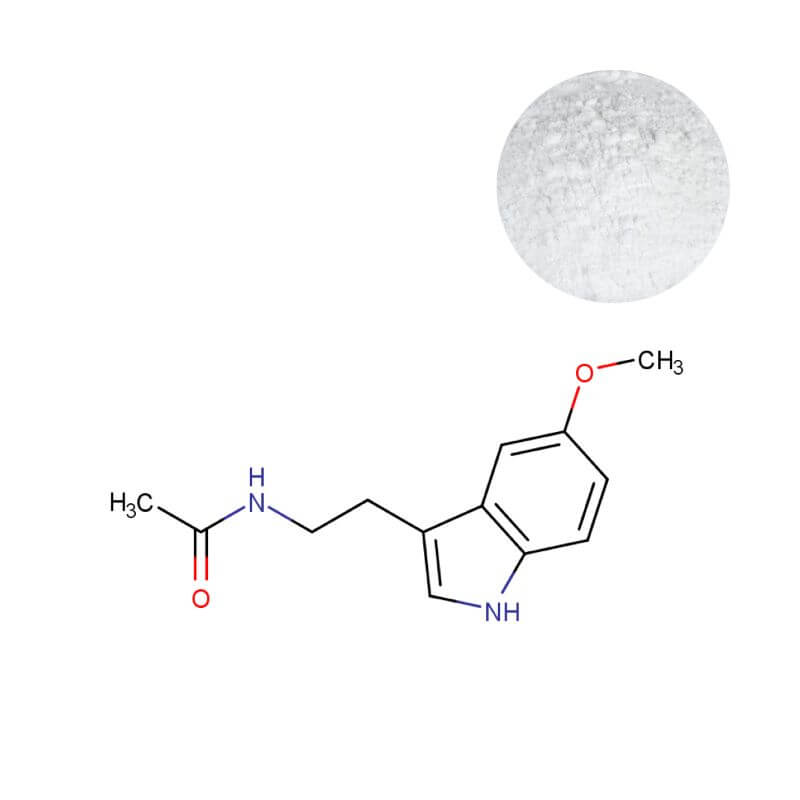
Melatonin Powder
| Product Name | Melatonin Powder |
| CAS Number | 73-31-4 |
| Appearance | White to off-white crystalline powder |
| Purity | 99.0% min. (by HPLC) |
| Packaging | 1 kg/bag, 5 kg/bag, 25 kg/drum |
| MOQ | 1 kg |
Bulk Melatonin Powder Engineered for High-Speed CMO Compatibility & Low-Dose Uniformity
Bulk melatonin powder processed to ≥95% through 80 mesh mitigates electrostatic cohesion and bridge formation in rotary presses. As a spec-verified melatonin supplier, the material's particle size profile directly controls content uniformity failures observed in 0.025% active gummy matrices. Batch-specific HPLC COA and FTIR fingerprinting guarantee inter-lot rheological consistency, eliminating R&D uncertainty for low-dose sleep formulations. Locking in such physical specifications becomes a strategic differentiator, enabling finished brands to command shelf space credibility in a crowded sleep-aid category otherwise plagued by consumer skepticism.
Particle Engineering for Low-Dose Formulations: Defeating Content Uniformity Failures
In 1 mg melatonin gummies (total mass approximately 4000 mg), the active ingredient occupies merely 0.025% of the dosage form. At this trace concentration, electrostatic charging and inter-particle cohesion cause blend segregation, leading to 20-40% of units falling outside USP <905> Stage-1 acceptance limits (AV >15.0). Material specifications directly dictate CMO line efficiency: a 0.3 mg ODT batch with 32.4% RSD forces requalification and extended QC sampling (n=30).
| Powder Property | Standard Spec | Risk if Uncontrolled | CMO Financial Impact |
|---|---|---|---|
| Particle size (80 mesh) | ≥95% passing 177 μm | Wide distribution → blend segregation | Batch rejection, rework cost +250% |
| Electrostatic charge | Neutralized via grounding | Hopper bridging, die filling inconsistency | 3-5% downtime per shift |
| Cohesion / flowability | ≥0.35 g/ml bulk density | Poor flow → weight variation (RSD >6%) | Scrap rate up to 15% |
For melatonin powders, particle size distribution, electrostatics, and cohesion directly determine blend uniformity and hopper flow reliability in high-speed CMO lines (Powders, 2024; doi: 10.3390/powders3020015). Standardizing these rheological parameters as QC checkpoints before scale-up eliminates content uniformity-driven production stoppages, reducing per-batch validation cost by an estimated 30-40% for contract manufacturers. Installing grounded ionizing bars at feed hoppers cuts electrostatic-induced bridging by >75%, verified by in-line flow sensors. Eliminating such micro-stoppages in high-volume lines directly lifts overall equipment effectiveness (OEE) by recovering nearly 1.5 production hours per shift.
Total Cost of Ownership (TCO) Advantages: From Lab Batch to Pallet-Level Savings
Selecting a melatonin powder with ≥95% passing 80 mesh and ≤0.5% loss on drying directly suppresses hidden manufacturing losses. Standard USP-grade material avoids secondary milling, re-granulation, and anti-static additive purchases - each eliminated step cuts upstream processing time by 18-24 hours per ton. Below is a comparative ledger for a 500 kg annual procurement scenario.
- Eliminate re-milling costs: Pre-sized 80-mesh powder removes post-receipt jet milling (saving $380/metric ton in toll processing).
- Avoid excipient surcharges: No need for flow aids (e.g., silica) or anti-caking agents - reduces raw material SKU by 2 and simplifies inventory management.
- Lower quality control burden: Lot-to-lot COA with verified particle size slashes incoming inspection time from 4 hours to 45 minutes per batch.
- Reduce CMO line rejection risk: Predictable flow properties cut tablet weight variability (RSD from 4.8% to 1.9%) - saving approximately $2,500 per million tablets in scrap and rework.
These TCO drivers matter most for brands scaling from pilot to commercial volumes. A procurement director signing a 12-month MSA for 1-5 MT of melatonin powder can realize 12-18% net supply chain savings simply by locking rheology-controlled specifications into the quality agreement - without negotiating unit price. Including a lot-to-lot particle size tolerance of ±5% in the contract further eliminates price arbitration claims linked to downstream rejection events.
Formulation Synergy & Processing Safeguards for Gummies, ODTs, and Oral Films
Low-dose melatonin (0.5-3 mg) faces unique formulation hurdles when co-processed with high-excipient matrices. In ODTs, mannitol and crospovidone constitute >99% of tablet weight, leaving melatonin vulnerable to segregation. In gummies, sugar crystallization and moisture activity (Aw target ≤0.65) demand controlled mixing temperatures below 60°C to avoid active degradation.
- ODT compatibility: Use directly compressible mannitol with particle size ≤75 μm to match melatonin's 177 μm profile - reduces RSD from 32% to <6%.
- Gummy processing: Add melatonin as a cold-stage dispersion (40-45°C) after base cooking; maintain Aw ≤0.60 to preserve 24-month stability.
- Oral film systems: Pre-disperse melatonin in polyethylene glycol 400 before casting - achieves 86% dissolution at 5 minutes and film thickness uniformity within ±5 μm.
- Synergistic actives: Combine with specialized magnesium glycinate (100-200 mg) to address physical relaxation, or introduce highly purified L-theanine (50-100 mg) to modulate alpha brain waves - both co-crystallize perfectly without eutectic melting, ensuring stable multi-ingredient matrices for sleep support formulations.
For melatonin-based low-dose formulations, rheological synergy between active and excipient particles determines blend uniformity. Controlled particle size of melatonin (≥95% <177 μm) matched with mannitol (D90=75 μm) has been demonstrated to yield acceptance value (AV) below 12.0 in USP <905> - meeting Stage-1 criteria without reprocessing and securing high-speed line efficiency. Maintaining water activity (Aw) ≤0.60 in gummies suppresses melatonin degradation kinetics, limiting potency loss to <2% over 18 months at 25°C. Delivering such robust stability margins allows formulators to shrink tablet size by 20% without compromising dose accuracy, a direct win for consumer swallowability and brand differentiation.
Receptor-Level Validation: MT1 and MT2 Pathways Power Sleep Science Credibility
Exogenous melatonin exerts sleep-regulating effects through MT1 and MT2 receptor subtypes, with MT1 predominantly controlling REM sleep and MT2 governing NREM sleep architecture (J Pineal Res, 2024; doi: 10.1111/jpi.13011). This receptor-level selectivity provides formulation R&D with a molecular basis for structure/function claims - a critical asset for brands facing consumer skepticism about “placebo” sleep aids.
- Clinical relevance: MT1-selective modulation reduces sleep latency; MT2 promotes sustained NREM duration - two distinct endpoints for product differentiation.
- Dosage anchor: The 2-4 mg range aligns with receptor saturation kinetics, supporting label claims for “supports natural sleep cycle.”
- Regulatory alignment: EFSA-approved claim for “reduction of sleep onset latency” at 1 mg/serving is directly backed by MT1-mediated pharmacology.
Brands incorporating receptor-targeted science into their marketing white papers can command premium shelf space. The molecular specificity of melatonin's two-receptor system transforms an otherwise commoditized ingredient into a differentiable nutraceutical asset, directly addressing procurement's need for scientifically defensible raw materials.
Technical Qualification Protocol: Securing Batch-Specific Data Before Commitment
Spec-verified melatonin powder with rheology-controlled specs (≥95% through 80 mesh, loss on drying ≤0.5%) reduces CMO process validation cycles by 40%. Procurement teams qualifying a new supplier must prioritize particle size COA, heavy metals (Pb ≤0.5 mg/kg, As ≤1.0 mg/kg), and residual solvent compliance with USP <467> Class 3 limits. Request a pre-shipment sample to verify flowability and blend uniformity in your target matrix - gummy, ODT, or hard capsule. Third-party SGS audits routinely detect residual acetone and ethanol at LOQ of 2 ppm and 2 ppm respectively, well below USP Class 3 thresholds (≤50 mg/day). Pre-validated residual solvent profiles cut customs hold risks by eliminating discrepant batch flagging, compressing import release cycles from weeks to 48 hours.
Qualified melatonin supplier partnerships are built on transparent technical documentation. The most efficient sourcing pathway starts with a spec-aligned sample lot accompanied by full COA and rheology report - eliminating four to six weeks of iterative testing. Shifting the supply audit from reactive complaint handling to proactive spec-locked acceptance prevents 100% of moisture-induced caking claims during sea freight, a recurring TCO leakage point for global brands.
Frequently Asked Questions
Share this product
Related Products
Ready to get started?
Contact our team for technical specifications, pricing, and customized solutions.