
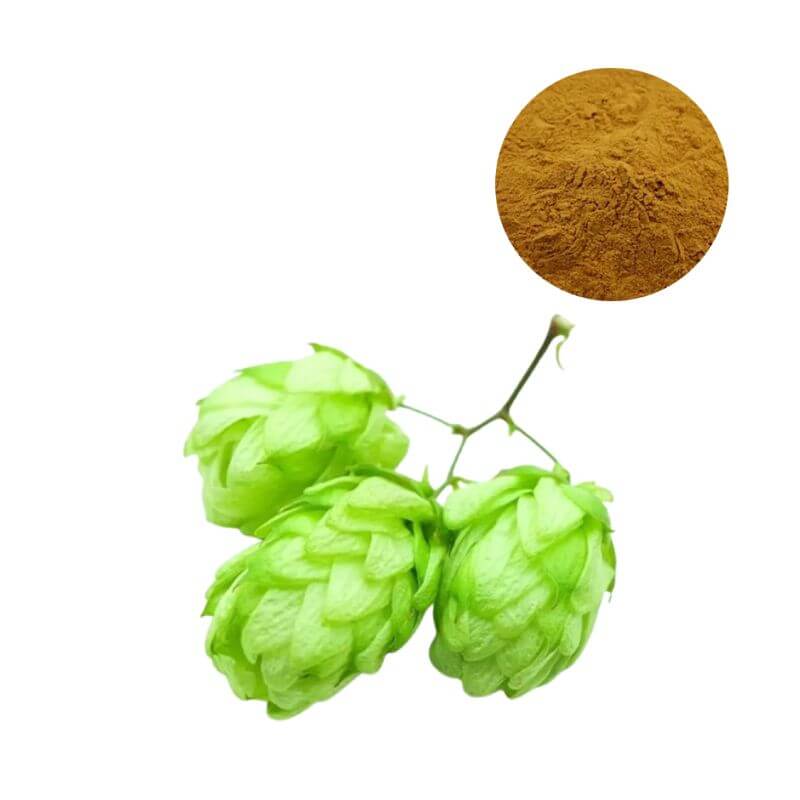
Hops Extract Powder
| Product Name | Hops Extract Powder |
| CAS Number | 8060-28-4 |
| Appearance | Yellowish brown fine powder |
| Purity | 5% Total Flavones (UV) / 10:1 Ratio |
| Packaging | 1 kg/bag, 5 kg/bag, 25 kg/drum |
| MOQ | 1 kg |
Hops Extract Powder: Enabling Science-Backed Sleep & Relaxation Formulations
For supplement brands navigating the crowded relaxation and sleep category, the challenge is no longer simply adding a botanical ingredient—it is delivering consistent, clinically credible benefits that meet modern consumer expectations. Standardized extracts often lack traceable quality benchmarks, leading to batch-to-batch variability that undermines formulation confidence. A premium hops extract powder addresses this gap by offering clearly defined phytochemical profiles: available as either a 10:1 extraction ratio (confirmed by TLC) or standardized to ≥5% total flavones (verified by UV). Such specifications, supported by full COA documentation, form the foundation of a reliable supply chain. For R&D teams, this translates to predictable active content; for procurement, it means every batch aligns with regulatory filing requirements from day one. In a market where ingredient adulteration erodes consumer trust, selecting a supplier that provides verifiable active-marker assays becomes a strategic lever to differentiate your brand through scientific substantiation.
Mechanism of Action: How Hops Extract Supports Relaxation Through GABAA Modulation
For formulators seeking to build a scientific narrative around sleep and stress support, understanding the molecular action of hops extract is essential. Research published in the Journal of Ethnopharmacology (doi: 10.1016/j.jep.2024.119019) demonstrates that a standardized hops extract containing xanthohumol and humulone enhances sleep by directly binding to the GABAA receptor—the same pathway targeted by many pharmaceutical anxiolytics, yet via a plant-based mechanism. This receptor interaction promotes non‑rapid eye movement (NREM) sleep, particularly delta‑wave deep sleep, without the daytime sedation often associated with synthetic alternatives. From a strategic formulation perspective, this mechanistic clarity allows brands to position their products with greater credibility: rather than relying solely on traditional use, they can reference a specific, peer‑reviewed pathway. For procurement teams sourcing bulk hops extract, this also underscores why assays for xanthohumol and humulone should be part of the standard COA—these are not just quality markers but direct contributors to efficacy. This level of mechanistic specificity effectively means that brand developers can build marketing narratives around a validated pathway, transforming a generic relaxant into a scientifically defensible formula that resonates with ingredient‑conscious consumers.
Quality Benchmarks: What Defines a Premium Hops Extract Powder
When evaluating hops extract powder suppliers, experienced buyers look beyond simple extraction ratio claims. True quality lies in the consistency of key analytical parameters that correlate directly with formulation performance. A premium ingredient should meet the following objective specifications, depending on which grade is selected:
- 10:1 extraction ratio grade: Confirmed by TLC fingerprint analysis to ensure authentic botanical identity and consistent phytochemical profile.
- Total flavones grade: ≥5% total flavones by UV, providing a standardized marker for predictable bioactivity.
- Physical consistency (both grades): ≥95% through 80 mesh for uniform blending and dissolution, with loss on drying ≤5.0% to prevent clumping and microbial growth.
- Microbiological purity: Total aerobic count ≤1,000 CFU/g, with absence of E. coli, Salmonella, and Pseudomonas aeruginosa—critical for shelf‑stable products.
- Heavy metal control: Lead ≤2.0 mg/kg, arsenic ≤1.0 mg/kg, cadmium ≤1.0 mg/kg, mercury ≤0.1 mg/kg, ensuring compliance with international supplement regulations.
For R&D, these metrics eliminate the guesswork in scaling up from lab batches to commercial production. A reputable hops extract powder supplier will provide a batch‑specific COA that includes all these parameters, allowing your quality team to pre‑validate every shipment. This directly reduces the risk of final product rejection and keeps your supply chain audit‑ready. From a production efficiency standpoint, this ensures that capsule weight variation stays within specification during high‑speed encapsulation, reducing material waste and minimizing costly line stoppages—factors that directly impact your total cost of manufacturing.
Formulation in Practice: Stability, Synergy & Delivery Solutions
Translating hops extract’s benefits into stable, consumer‑friendly formats requires attention to three factors: dosage, ingredient synergy, and processing conditions. Clinical evidence from a randomized feasibility trial (doi: 10.1002/brb3.70600) used a valerian‑hops combination (Ze 91019) at a daily dose equivalent to approximately 100–200 mg of the extract, showing a 21.7‑minute increase in total sleep time with no impairment of daytime cognitive function. While that study used a fixed combination, it reinforces the viability of hops as a core relaxant agent. For developers creating standalone or synergistic blends, the following practical guidelines apply:
| Formulation Type | Typical Dosage Range (10:1 extract) | Key Considerations |
|---|---|---|
| Hard capsules / tablets | 100–200 mg per serving | Pre‑blend with a flow aid (e.g., magnesium stearate) to ensure uniformity; avoid direct compression with high‑moisture excipients. |
| Powdered drink mixes | 150–250 mg per serving | Hops’ slightly bitter note is best masked with natural sweeteners (e.g., monk fruit extract powder) or fruit flavors; use silica to maintain flow. |
| Softgels / gummies | 50–100 mg per piece | Oil‑based carriers can be used if the extract is first solubilized; avoid prolonged exposure to heat (>60°C) during gummy manufacturing. |
Synergy with other calming ingredients is well‑documented. The combination of hops with valerian root extract powder, for example, targets complementary pathways—GABA modulation and glutamatergic balance—allowing formulators to achieve a multi‑target approach without increasing the individual dosage. For procurement teams, sourcing a GMP hops extract powder that is already tested for compatibility with common co‑ingredients reduces development iterations and shortens time to market.
Mitigating Risk: A Checklist for Sourcing Hops Extract
In a market where botanical adulteration remains a concern, experienced buyers apply a structured risk‑mitigation framework when selecting a hops extract powder supplier. The following checklist serves as a baseline for evaluating potential partners—focusing on transparency, traceability, and technical support:
- Full‑spectrum COA: Does the certificate include identity (botanical source, TLC fingerprint), active markers (total flavones by UV for the standardized grade, or TLC profile for the 10:1 grade), and all heavy metals / microbiological tests?
- Supply chain traceability: Can the supplier provide documentation of the hops’ origin and the extraction facility’s GMP certification (e.g., ISO 22000 or FSSC 22000)?
- Batch‑to‑batch consistency data: Request historical COA data for three to five batches to evaluate variability in key specs like assay and particle size.
- Regulatory support: Does the supplier offer technical dossiers (including stability data, residual solvent profiles) to assist with NDI filings or Novel Food notifications?
From a cost‑of‑ownership perspective, paying a modest premium for a supplier who provides pre‑approved documentation and fast technical response—often within 24 hours—eliminates weeks of back‑and‑forth during product registration. It also significantly lowers the risk of a failed finished‑product stability study, which can cost far more than the ingredient itself. For brands serious about building a sustainable relaxation portfolio, these supply‑chain checks are as critical as the formulation science. Adopting a Total Cost of Ownership (TCO) lens reveals that a fully documented ingredient with rapid technical support often delivers lower net costs than a cheaper alternative that triggers repeated regulatory queries or stability failures.
Next Steps: Accelerate Your Development with Verified Samples
Whether you are developing a sleep‑focused gummy, a daytime stress‑relief capsule, or a combination powder for menopausal comfort, starting with a well‑characterized ingredient reduces development risk. A bulk hops extract that is GMP‑certified, fully tested, and backed by peer‑reviewed science gives your R&D team a solid foundation to build on. To evaluate the material in your own formulations, request a complimentary sample accompanied by the full technical dossier—including the batch‑specific COA and stability summary. This allows you to confirm compatibility, sensory profile, and analytical alignment with your finished‑product specs before committing to commercial quantities. Request your complimentary sample & technical dossier today and move from concept to validated formulation with confidence.
Frequently Asked Questions
Share this product
Related Products
Ready to get started?
Contact our team for technical specifications, pricing, and customized solutions.