
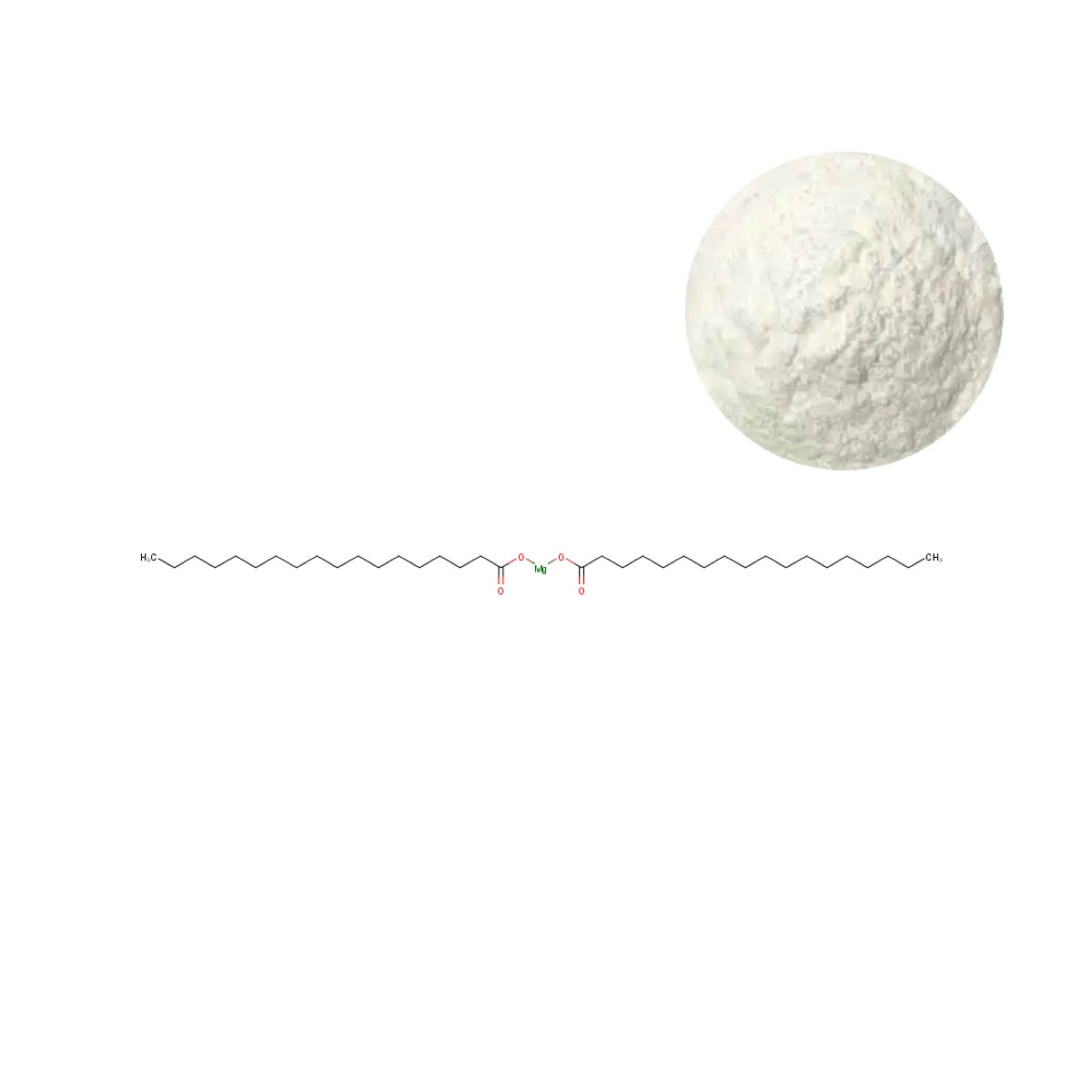
Magnesium Stearate Powder
| Product Name | Magnesium Stearate Powder (Vegetable Source) |
| CAS Number | 557-04-0 |
| Appearance | Fine white to off-white powder |
| Purity | MgO content 6.8% - 8.3% (Standard Specification) |
| Packaging | 25 kg/drum |
| MOQ | 25 kg |
Magnesium Stearate Powder: Optimizing Tablet Performance & Supply Chain Reliability for Nutraceutical Formulations
For nutraceutical brands, the choice of excipient is often where formulation success is determined—or compromised. Magnesium stearate, the most widely used lubricant in solid dosage forms, is frequently treated as a commodity. Yet its impact on tablet ejection force, disintegration time, and long-term stability is profound. Minor variations in fatty acid profile or particle morphology can lead to batch failures, rejected tablets, or unexpected dissolution shifts—each translating into costly delays and lost market opportunities. A premium-grade magnesium stearate, characterized by a controlled fatty acid composition (typically with stearic acid ≥40% and stearic + palmitic acids ≥90%) and a consistent particle size (≥99% through 200 mesh), transforms this excipient from a risk factor into a predictable processing aid. This article provides an evidence‑based framework for evaluating, formulating with, and sourcing high‑quality magnesium stearate, enabling brands to de‑risk development and achieve reproducible tablet performance—from pilot batches to full-scale commercial production.
Beyond Purity: Why Fatty Acid Composition Defines Premium Magnesium Stearate
While a Certificate of Analysis (COA) routinely reports assay values (e.g., MgO content 6.8–8.3%), the true performance differentiator lies in the fatty acid distribution—specifically the ratio of stearic to palmitic acid. Recent systematic work published in AAPS PharmSciTech (doi: 10.1208/s12249-024-02980-x) demonstrates that magnesium stearate with a lower stearic acid content results in significantly prolonged tablet disintegration and slower drug release. Conversely, material with a higher stearic proportion exhibits superior lubrication efficiency—i.e., a greater reduction in ejection force—without compromising dissolution. This trade‑off is critical: selecting a grade solely by bulk density or particle size while ignoring the fatty acid profile risks either over‑lubrication (delayed disintegration) or under‑lubrication (sticking, capping).
From a quality perspective, the widely adopted industry benchmark—stearic acid ≥40.0% and stearic + palmitic ≥90.0%—is not arbitrary. It reflects a balance that minimizes batch‑to‑batch variability in both lubricity and hydrophobic film formation. For brands sourcing bulk magnesium stearate, requesting a detailed fatty acid analysis (by GC) alongside the standard COA is therefore not merely a technical formality; it is a step toward ensuring that every drum performs identically in high‑speed tablet presses. This translates directly into fewer scale‑up surprises and a more predictable route to market. Moreover, from a regulatory standpoint, having a supplier that routinely provides this data simplifies the compilation of quality modules for NDI notifications or novel food applications in markets like the US and EU, where excipient characterization is increasingly scrutinized.
Formulation Strategies to Avoid Over‑Lubrication and Ensure Bioavailability
The primary technical challenge with magnesium stearate is over‑lubrication: excessive mixing or an ill‑chosen concentration coats the active particles with a hydrophobic layer, delaying dissolution and potentially reducing bioavailability. The effective formulation requires a dual focus on concentration and blending time.
- Concentration range: Typically 0.25% to 1.0% of the tablet weight. While concentrations as low as 0.25% may suffice for free‑flowing blends, formulations containing hygroscopic or poorly flowing actives often need up to 1.0%. Exceeding 1.5% is rarely beneficial and markedly increases disintegration time.
- Blending time: Mixing should be just long enough to achieve uniform distribution—usually 2–5 minutes in a V‑blender or 1–3 minutes in a high‑shear mixer. Prolonged blending exponentially increases the hydrophobic coating, as confirmed by the 2024 study: longer mixing times reduced tablet tensile strength and slowed drug release, regardless of the stearate grade.
- Source selection: A pivotal comparison of bovine‑ and vegetable‑derived magnesium stearate (doi: 10.1002/jps.21381) revealed that, while both sources share similar particle size distributions, vegetable‑derived material often exhibits lower ejection force in dry‑granulated tablets—i.e., better lubrication efficiency—owing to differences in fatty acid composition and surface energy. For brands targeting vegan or allergen‑free claims, plant‑based magnesium stearate from palm or rapeseed oil is now the industry default, and its performance advantages are supported by peer‑reviewed data.
Practically speaking, a pre‑formulation study that tests two concentration levels (e.g., 0.5% and 1.0%) with a fixed blending time can quickly identify the optimum for a given active. Documenting these parameters also provides regulatory support for the final manufacturing process. For brands aiming to differentiate in crowded categories—such as sports nutrition or geriatric supplements where fast disintegration is valued—fine‑tuning the lubrication step to minimize hydrophobic coating can be a subtle but impactful product attribute, supporting claims like “fast release” without additional active ingredient costs.
Total Cost of Ownership: How Supplier Consistency Protects Your Bottom Line
When evaluating bulk magnesium stearate quotes, the unit price per kilogram is only the starting point. The true cost of ownership includes hidden expenses from batch‑to‑batch variability: rejected tablets, process interruptions, and additional quality control testing. A supplier that cannot guarantee a consistent fatty acid profile—e.g., stearic acid content fluctuating by more than ±2%—forces the formulator to re‑optimize the lubrication step for every new batch, a time‑consuming and costly exercise. In contrast, a reliable magnesium stearate distributor or exporter who routinely publishes full COAs including fatty acid distribution, loss on drying, and particle size (by laser diffraction) enables customers to lock in a reproducible processing window, reducing the need for redundant in‑house testing.
Moreover, the physical properties of magnesium stearate—such as its specific surface area and hydrate form (anhydrous, monohydrate, dihydrate)—are influenced by production parameters like precipitation pH and drying temperature. These subtle differences alter its lubricant efficiency and moisture sensitivity. Suppliers who control these variables deliver not only consistent performance but also longer documented shelf life for the finished product. This consistency ultimately reduces the risk of dissolution failures during stability studies and extends the product’s commercial shelf life, minimizing returns and chargebacks—a direct bottom‑line benefit for any brand.
The Sourcing Checklist: What to Verify for Reliable Magnesium Stearate Supply
Given the criticality of this excipient, a disciplined supplier evaluation should include the following objective checks. For procurement and quality teams, this checklist serves as a practical tool to benchmark potential partners and ensure that every drum of magnesium stearate meets the specifications required for reproducible tablet manufacturing.
| Verification Item | Why It Matters |
|---|---|
| Plant‑based origin statement | Confirms suitability for vegan, kosher, halal certifications and avoids BSE/TSE concerns. |
| Fatty acid composition (by GC) | Ensures stearic acid ≥40% and stearic+palmitic ≥90%, the predictors of consistent lubricity. |
| Particle size (≥99% through 200 mesh) | Affects flow and blend uniformity; coarser grades may segregate during handling. |
| Loss on drying (≤6.0%) | Indicates hydrate stability; high moisture can promote hydrolysis of sensitive actives (e.g., aspirin). |
| Heavy metals (Pb ≤2, As ≤3, Cd ≤1, Hg ≤0.1 mg/kg) | Meets global pharmacopoeial limits (USP, EP, FCC) and protects consumer safety. |
| Microbiological compliance (total aerobic count ≤1000 CFU/g, absence of pathogens) | Prevents microbial contamination in finished products, especially in dietary supplements. |
| Regulatory documentation (GRAS, EFSA re‑evaluation compliance) | Facilitates global market entry and simplifies NDI notifications or novel food applications. |
By applying this checklist, brands can partner with suppliers who treat magnesium stearate as a performance ingredient rather than a mere filler—a distinction that directly impacts production efficiency and end‑product quality.
Next Steps: Securing Your Production‑Ready Magnesium Stearate
A well‑characterized magnesium stearate, backed by fatty acid analysis and batch‑to‑batch consistency, eliminates the guesswork from tablet formulation. It allows your R&D team to focus on active ingredient innovation, confident that the excipient will perform predictably every time. Requesting a sample and the full technical dossier—including a representative COA and stability data—enables your team to verify, under your own laboratory conditions, that the supplier’s specifications translate into the desired processing performance. This evidence‑based approach eliminates guesswork, reduces internal testing costs, and supports a faster, more confident sourcing decision—whether you are a manufacturer, contract developer, or brand owner. Request Your Complimentary Sample & Technical Dossier.
Frequently Asked Questions
Share this product
Related Products

Ready to get started?
Contact our team for technical specifications, pricing, and customized solutions.