Valerian Root Extract Powder
Valerian Root Extract Powder (CAS 8057-49-6), a Valeriana officinalis L. root extract standardized to 0.3% or 0.8% valerenic acids by HPLC for capsules.
| CAS Number | 8057-49-6 |
| Valerenic Acids | 0.3%, 0.8% (HPLC) |
| Source | Valeriana officinalis L. Root |
| Packaging | 1 kg / aluminum foil bag; 25 kg / fiber drum |
| MOQ | 1 kg |
| Samples | Free sample available |
| Documents | COA, TDS on request; more upon inquiry |
Valerian Root Extract Powder: Extract Grade, Not Ground Root
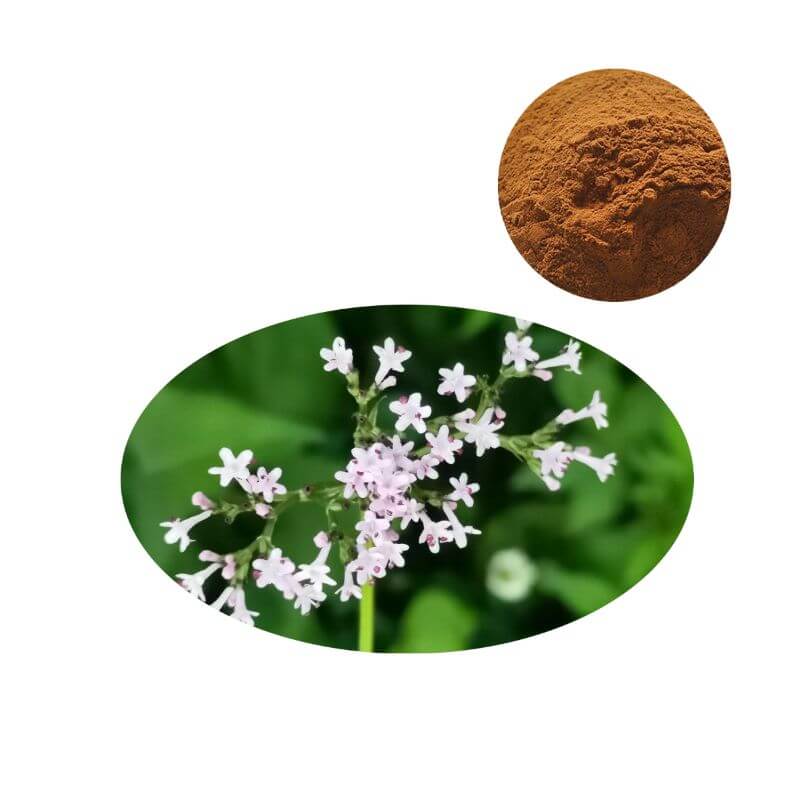
Valerian Root Extract Powder (CAS 8057-49-6) is a botanical extract standardized to valerenic acids and milled to 95% through 80 mesh. It is supplied as a brown powder with the root's characteristic odor. It is not ground valerian root. The extract concentrates the root's marker compounds, so the two forms cannot be swapped when calculating marker content per kilogram. Commercial grades are defined by valerenic acid content measured by HPLC. The grades offered here are 0.3% and 0.8%. Three points usually decide whether two quotes describe the same ingredient: which grade the formulation calls for, whether the marker value is reported on a dry basis, and which Valeriana species the material comes from.
Where Valerian Root Extract Comes From
Valerian root extract is a plant-derived material produced from the dried root of Valeriana officinalis L. Commercial supply is plant-derived. Not every plant sold under the valerian name carries useful levels of valerenic acids. Within the genus, V. officinalis and its close relatives are the sources with meaningful marker concentrations, while species other than V. officinalis analyzed in published comparisons carry trace amounts or none. A 2023 study of Polish-grown V. officinalis found that cultivated tetraploid forms reached higher valerenic acid levels than wild diploid populations, and that the coefficient of variation for valerenic acid content ranged from 18% to 55% across cultivated forms. (Molecules, 2023; doi: 10.3390/molecules29010112) Supply depends on the crop, with cultivation in Europe and China and marker content shifting with growing year, location and genotype. For buyers, species identity and a batch-specific HPLC value carry more weight than origin claims. A wholesale Valerian Root Extract Powder offer is only comparable once the species is named and the marker is reported by HPLC.
Choosing Between 0.3% and 0.8% Valerenic Acids
Two HPLC-standardized grades are supplied, and the choice turns on how much powder the finished dosage form can carry.
| Grade | Valerenic Acids | Test Method | Particle Size |
|---|---|---|---|
| Standard | ≥ 0.3% | HPLC | ≥ 95% through 80 mesh |
| High-potency | ≥ 0.8% | HPLC | ≥ 95% through 80 mesh |
Both grades express marker content as valerenic acids by HPLC. The percentage is a minimum, so the dry-basis or as-is basis needs to be stated before two offers are compared directly. Reaching the same valerenic acid mass takes roughly 2.67 times more powder at 0.3% than at 0.8% (0.8 ÷ 0.3). In a hard capsule or tablet with a fixed fill weight, that ratio decides whether a grade fits the format at all. In a gummy or stick pack, it changes how much bulking agent the formula needs. Particle size is identical across both grades, so the selection is driven by marker concentration rather than physical handling. Cost-sensitive blends that treat valerian as one component often start at 0.3%, while formulas where valerian is the principal botanical tend toward 0.8%. A bulk Valerian Root Extract Powder quote across grades should state the marker basis and particle size alongside the percentage. Batch-specific COAs and 20-50 g samples of either grade are available for evaluation.
How the Powder Performs in Capsules, Tablets and Gummies
The 80-mesh powder is typically used in hard capsules and direct-compression tablets, subject to formulation trials; particle size alone does not confirm flow or fill-weight consistency. Dried valerian extract is hygroscopic, and published work on direct compression shows that the carrier-free dry extract is very hygroscopic (Class IV) and begins to deliquesce at 40% relative humidity. Adding colloidal silicon dioxide shifted the same extract to Class III and produced a powder with flow and compactability suitable for direct compression. Those findings describe a specific extract and carrier system, not a property measured on every commercial lot. For gummies and ready-to-mix powders, the fine powder can be dispersed in a gelatin or pectin base but can pick up moisture during cooking and drying, so humidity control and a glidant are common process measures. The brown color and characteristic odor carry through to clear capsules, gummies and unflavored drink mixes. Whether the chosen grade is a wholesale Valerian Root Extract Powder 0.8% or a 0.3% material, the handling constraints are the same; what changes is the powder mass the formula must accommodate. A Valerian Root Extract Powder supplier working with both grades can supply batch COAs and 20-50 g samples for format trials.
Batch 20260204: What the COA Shows
Batch 20260204 is a 0.3% grade lot, manufactured on 4 February 2026 and tested on 11 February 2026. It returned a valerenic acid result of 0.36% against a minimum of 0.3%. Moisture and ash were both inside their limits.
| Test Item | COA Limit | Batch Result |
|---|---|---|
| Valerenic Acids (HPLC) | ≥ 0.3% | 0.36% |
| Loss on Drying | ≤ 7.0% | 3.4% |
| Ash | ≤ 5.0% | 3.2% |
| Particle Size | 95% pass 80 mesh | Complies |
| Lead (Pb) | ≤ 1.0 mg/kg | Complies |
| Arsenic (As) | ≤ 2.0 mg/kg | Complies |
| Mercury (Hg) | ≤ 1.0 mg/kg | Complies |
| Cadmium (Cd) | ≤ 0.5 mg/kg | Complies |
| Total Plate Count | n=5, c=2, m≤1,000, M≤104 CFU/g | All <10 CFU/g |
| Mould & Yeast | ≤ 100 CFU/g | <10 CFU/g |
| Coliforms | n=5, c=2, m≤10, M≤102 MPN/g | All <10 MPN/g |
| Salmonella | Negative | Not detected |
| Staphylococcus aureus | Negative | Not detected |
Valerenic acids at 0.36% sit above the 0.3% floor. A buyer calculating marker input from the label minimum works from the 0.3% value; a buyer working to an exact target should use the measured 0.36%. Loss on drying at 3.4% and ash at 3.2% are both inside their respective limits. The microbiological results are reported under a two-class sampling plan, and all five total plate count portions returned below 10 CFU/g, well under the m value of 1,000 CFU/g. Coliforms were below 10 MPN/g in every portion, and Salmonella and Staphylococcus aureus were not detected. The batch number ties the document to the shipment, and the complete batch COA is available on request.
Regulatory Listing Status in the US, Canada and Australia
The extract appears in three national ingredient lists under the Valeriana officinalis name or CAS 8057-49-6, each under a different category.
| Market | List / Instrument | Entry | Recorded Status |
|---|---|---|---|
| United States | FDA Substances Added to Food; 21 CFR 172.510; FEMA 3099 | VALERIAN ROOT, EXTRACT (VALERIANA OFFICINALIS L.), CAS 8057-49-6 | Flavoring agent or adjuvant |
| Canada | NHPID monograph, 26 July 2024 | Valeriana officinalis, root | Non-standardized and standardized extracts, oral route |
| Australia | Therapeutic Goods (Permissible Ingredients) Determination (No. 2) 2026 | Valeriana officinalis | Permitted in listed medicines; oral products carry a liver warning statement |
In the United States, the extract is listed in FDA's Substances Added to Food database under 21 CFR 172.510 with FEMA number 3099. The recorded technical effect is flavoring agent or adjuvant; the database entry describes a flavor use, not a dietary supplement authorization. Health Canada's NHPID carries a Valeriana officinalis root entry covering non-standardized dry extracts, tinctures, fluid extracts and infusions for oral use, with the monograph dated 26 July 2024. The monograph also covers standardized extracts with specified marker ranges and extract-ratio requirements. The NHPID listing is an ingredient monograph used in product licensing. Australia's Therapeutic Goods (Permissible Ingredients) Determination (No. 2) 2026 lists Valeriana officinalis as permitted in listed medicines. The TGA statement that in rare cases valerian may harm the liver, with advice to stop use and seek medical advice if signs such as yellowing skin or eyes appear, applies to medicines listed in the ARTG on or after 1 March 2023 or released for supply on or after 1 March 2024. (TGA, 2026) These listings describe different regulatory categories rather than a single authorization: a flavoring substance in the US, a natural health product ingredient monograph in Canada, and a permitted listed-medicine ingredient with a warning requirement in Australia.
Frequently Asked Questions
Related Products
Request a Quote for Valerian Root Extract Powder
Tell us your required quantity and application. Our team will help you evaluate product specifications, pricing, samples, and supply options.