
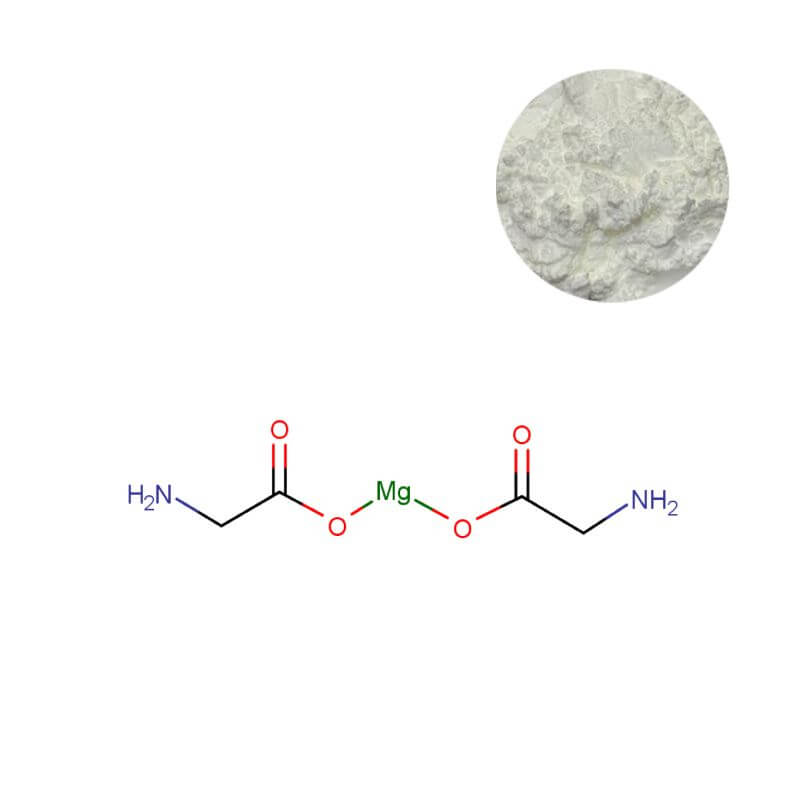
Magnesium Glycinate Powder
| Product Name | Magnesium Glycinate (Bisglycinate) Powder |
| CAS Number | 14783-68-7 |
| Appearance | Off-white to white free-flowing powder |
| Chelated Spec | Mg 13.5% - 14.5% (ICP-OES) | Assay ≥ 98.0% |
| Buffered Spec | Mg 18.0% - 20.0% (ICP-OES) |
| Packaging | 1 kg/bag, 5 kg/bag, 25 kg/drum |
| MOQ | 1 kg |
Magnesium Glycinate (Bisglycinate) Powder (≥98%): Clinically Supported Mineral for Sleep, Stress & Muscle Recovery Formulas
For bulk Magnesium Glycinate buyers, the challenge is no longer just "adding magnesium" to a formula—it's selecting a form that delivers absorption, gastrointestinal comfort, and clinically relevant outcomes. For brands formulating premium sleep aids or stress management powders, the choice of magnesium source directly impacts consumer compliance. A non-laxative, high-bioavailability form is now market standard. Premium Magnesium Glycinate (Bisglycinate) Powder, standardized to ≥98% purity with ≤2.0% free glycine, addresses precisely these demands. Unlike oxide or citrate, this chelated mineral leverages an active peptide transport pathway, enabling brands to formulate high-compliance sleep support, stress management, and sports recovery products. For procurement teams, the real value lies in batch-to-batch consistency, documented by a comprehensive COA from GMP-certified partners. In an increasingly crowded relaxation category, ≥98% purity with tight free-glycine control becomes the scientific moat that justifies premium pricing and prevents commodity-level margin erosion.
Mechanism & Clinical Evidence: Why Bisglycinate Outperforms Conventional Magnesium Salts
Magnesium Glycinate's superiority stems from its dual-component structure. Magnesium acts as a natural NMDA receptor antagonist and helps regulate the HPA axis, while the glycine moiety functions as an inhibitory neurotransmitter, promoting calmness. This chelated form is absorbed via the PEPT1 transporter, bypassing the competitive ionic channels used by calcium, zinc, and iron. Practically speaking, this translates to significantly higher intracellular magnesium delivery without the laxative effect common to oxide or citrate.
A 2025 randomized, double-blind, placebo-controlled trial (n=155, 250 mg elemental magnesium/day for 4 weeks) directly evaluated Magnesium Bisglycinate in adults reporting poor sleep. The active group showed a reduction of 3.9 points on the Insomnia Severity Index (ISI) versus 2.3 points in the placebo group (p=0.049) (Nat Sci Sleep, 2025; doi: 10.2147/NSS.S524348). Notably, the trial's exploratory analysis identified participants with lower baseline dietary magnesium intake as the subgroup showing the most pronounced benefit. This insight allows brands to target their messaging toward consumers most likely to experience tangible results. From a strategic formulation perspective, this study provides the first high-quality RCT directly supporting a sleep-health claim for Magnesium Bisglycinate. For brand owners, this means moving beyond generic magnesium marketing to build a clinically defensible narrative—a key differentiator in the crowded relaxation and sleep category. This level of clinical specificity means R&D teams can confidently file structure-function claims with the FDA, shortening the legal review phase and accelerating time-to-shelf by several months.
Quality Benchmarks: What Defines a Premium Magnesium Glycinate Supplier
When sourcing bulk Magnesium Glycinate, three quality indicators matter more than a simple "≥98%" purity claim: free glycine content, heavy metal limits, and residual solvent compliance. Premium ingredients typically feature free glycine ≤2.0% (by HPLC), ensuring the chelate is complete and no excess free amino acid remains. Why is free glycine so critical? Excess glycine can alter taste profiles and, more importantly, indicates incomplete chelation—meaning some magnesium may still be in a less bioavailable form. Key sourcing considerations include:
- Heavy metal control: Lead ≤1.0 mg/kg, Arsenic ≤1.0 mg/kg, Cadmium ≤0.5 mg/kg, Mercury ≤0.1 mg/kg (verified by ICP-MS).
- Microbiological safety: Total plate count ≤1,000 CFU/g, absence of E. coli and Salmonella.
- Residual solvents: Compliance with USP <467>.
For procurement teams evaluating a Magnesium Glycinate wholesale partner, this translates to lower regulatory risk (FDA-recognized dietary ingredient under 21 CFR, EU Directive 2002/46/EC Annex II), fewer finished product stability surprises, and liability protection. A reliable Magnesium Glycinate supplier provides a batch-specific COA with all these parameters. Without such documentation, brands expose themselves to formulation failures or customs holds. From a production efficiency standpoint, tight free-glycine control eliminates the need for extra taste-masking steps in powder blends, directly reducing manufacturing cycle time and ingredient waste.
| Quality Parameter | Industry Benchmark | Why It Matters for Your Formula |
|---|---|---|
| Assay (as chelate) | ≥98.0% (by HPLC/Titration) | Ensures consistent active dose per serving; prevents under-dosing. |
| Loss on Drying | ≤5.0% | Low moisture prevents clumping and microbial growth during storage. |
| Particle size | ≥95% through 80 mesh | Enables uniform blending in powder mixes and smooth capsule filling. |
| Fully Chelated Mg Content | 13.5%-14.5% (by ICP-OES) | Verifies chelation integrity. |
Formulation in Practice: Stability, Synergy & Dosage Guidelines
Magnesium Glycinate Powder offers excellent thermal stability (melting point >360°C) and is soluble in water, making it ideal for capsules, tablets, stick packs, and ready-to-mix drinks. However, its slight hygroscopicity demands attention during manufacturing. An effective formulation requires low-humidity environments (<50% RH) and moisture-barrier packaging (e.g., foil sachets or desiccants inside HDPE bottles). From a strategic formulation perspective, controlling ambient humidity during blending is often more critical than the primary packaging itself—a practical insight that reduces caking complaints.
For ready-to-mix drink powders, particle size (≥95% through 80 mesh) ensures rapid dissolution without grittiness. A common industry oversight is failing to pre-blend Magnesium Glycinate with a free-flowing agent like silicon dioxide—this simple step prevents agglomeration during high-speed packaging. Common daily dosages range from 200-400 mg elemental magnesium (equivalent to 1,500-3,000 mg of Magnesium Glycinate powder, depending on the 13.5%-14.5% magnesium content). For synergistic formulas, consider pairing with:
- Vitamin B6 (as P5P): Enhances cellular magnesium uptake and supports neurotransmitter balance.
- Taurine or L-theanine: Amplifies the calming effect via GABAergic pathways.
- Vitamin D3: Co-factors for bone and metabolic health.
For procurement teams, this directly translates to formulation flexibility. Unlike oxide, which often requires high excipient loads to mask taste or mitigate laxative effects, Magnesium Glycinate's neutral flavor and high tolerance enable clean-label, low-pill-count products that resonate with discerning consumers.
Mitigating Risk: A Sourcing Checklist for Bulk Magnesium Glycinate
Selecting a Magnesium Glycinate supplier involves more than price per kilogram. To ensure supply chain resilience and quality consistency, brands should adopt a systematic evaluation framework. Key considerations include:
- Traceability: Does the supplier provide a batch-specific COA with HPLC, ICP-MS, and USP methods? Can they offer a fully traceable chain from raw magnesium source to finished powder?
- Regulatory support: Are they prepared to supply technical dossiers for FDA NDI notifications (though not required for this FDA-recognized ingredient) or EFSA compliance? Premium suppliers deliver these documents within 24 working hours.
- Auditable quality systems: Look for GMP, ISO 9001, Kosher, Halal, and non-GMO certifications as baseline.
Furthermore, a responsive supplier provides technical documentation within 24 working hours—a critical factor when your regulatory filing deadline is approaching. This responsiveness reduces project delays and hidden engineering costs. From a strategic formulation perspective, a low-cost supplier may hide costs through inconsistent purity (e.g., free glycine exceeding 2.0%) or poor heavy metal control, leading to failed finished product tests or consumer complaints. For procurement teams, this directly translates to total cost of ownership: investing in a certified, transparent partner reduces batch rejection rates, accelerates time-to-market, and protects your brand's reputation. Adopting a total cost of ownership lens means recognizing that a 5% price premium on raw material eliminates the risk of a $50,000 finished batch recall—a direct contribution to your P&L.
Next Steps: Accelerate Your Development with Technical Confidence
As a bulk supplier, your roadmap is clear: the evidence (2025), specs (free glycine, heavy metals, particle size), tips, and sourcing checklist. The most efficient next step is to test these specs with your own R&D team using a sample and a complete technical dossier. Request your complimentary sample and batch-specific COA today—see firsthand how consistent particle size, low heavy metals, and a fully traceable supply chain can streamline your product launch.
Frequently Asked Questions
Share this product
Related Products
Ready to get started?
Contact our team for technical specifications, pricing, and customized solutions.