
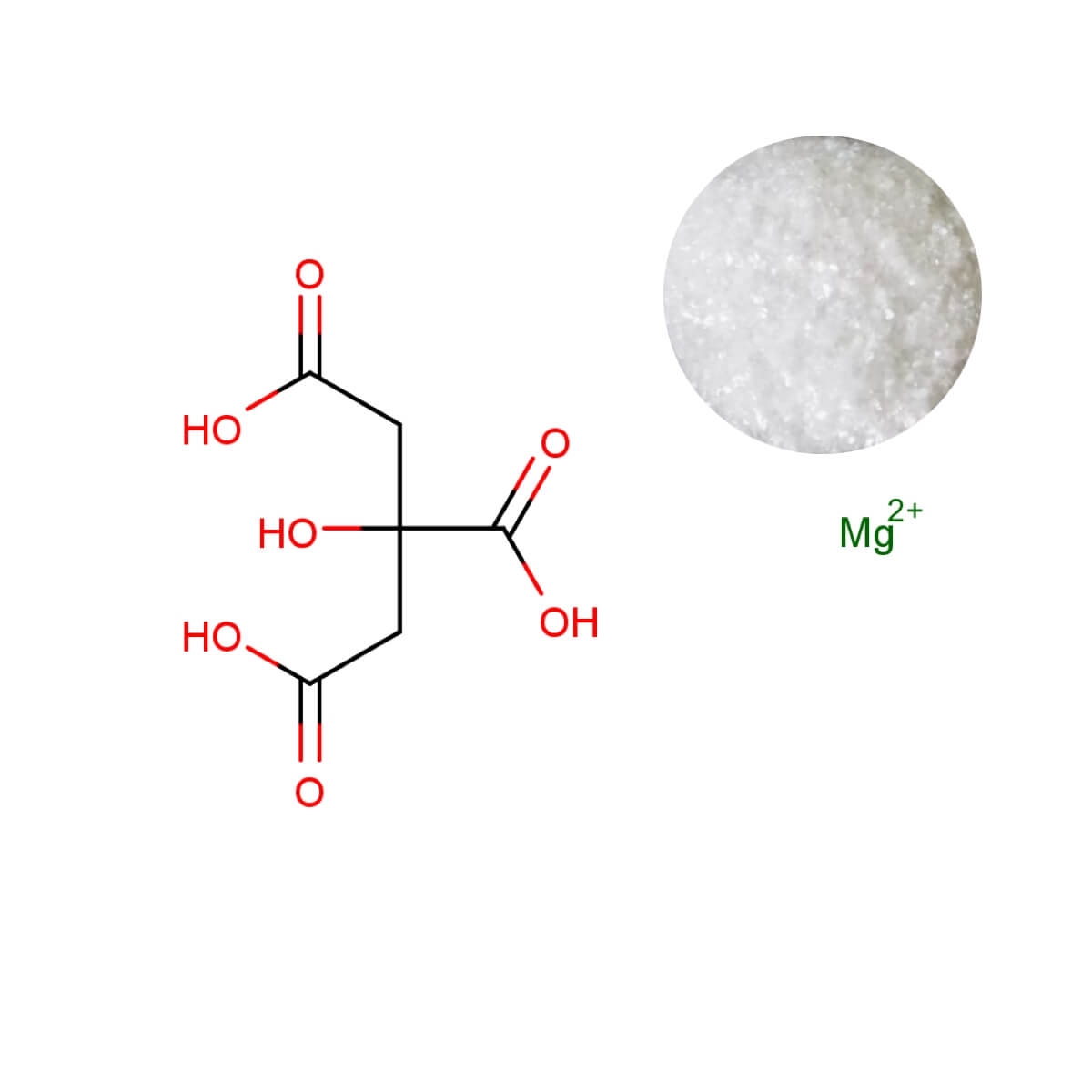
Magnesium Citrate Powder
| Product Name | Magnesium Citrate Powder |
| CAS Number | 3344-18-1 |
| Appearance | White to off-white fine powder |
| Purity | Mg 14.5–16.4% (by Complexometric Titration) |
| Packaging | 1kg/bag, 5kg/bag, 25kg/drum |
| MOQ | 25 kg |
Time-Defined Release Magnesium Citrate Powder: Clinical Dosing, Gummy Formats, Premium Claims
Shelf space in the magnesium category now rewards time-defined release profiles, and bulk magnesium citrate powder anchors that commercial shift. Spec-verified magnesium citrate powder supplier networks translate time-specific plasma responses from crossover trials into defensible dosing narratives for gummies, stick packs, and capsules. Every lot ships with element-specific COA data and audit-ready traceability, closing the R&D-to-procurement risk control loop. Label arithmetic stays transparent, so buyers reconcile every 500 mg capsule against the batch COA.
Clinical Release Kinetics That Defend Premium Magnesium Claims
Scrutinize any magnesium label and the plasma-curve evidence either holds or collapses. A 2024 randomized crossover trial in forty participants recorded significant plasma magnesium elevation at 4 hours after oral magnesium citrate, while glycinate showed no significant rise at any tested time point. That 4-hour differential only becomes an asset through compliant structure/function language grounded in exact elemental dosing that maps back to the compound mass actually weighed at the hopper.
| Label Claim | Anhydrous (locked product form, approx. 16% Mg) | Nonahydrate (market reference, approx. 11.5% Mg) |
|---|---|---|
| 200 mg elemental magnesium | approx. 1,250 mg compound | approx. 1,739 mg compound |
| 400 mg elemental magnesium | approx. 2,500 mg compound | approx. 3,478 mg compound |
| Assay window on COA | Mg 14.5-16.4% by complexometric titration, reported per lot | |
Positioning magnesium citrate powder Mg 14.5-16.4% as the 4-hour response form supports time-defined absorption claims without overstating onset speed, protecting premium retail pricing against commodity capsules. Wholesale magnesium citrate powder buyers receiving assay, moisture, and form identity on one COA reconcile label arithmetic in minutes. Verification speed is margin protection: fewer reformulation loops, fewer artwork revisions, and a substantiation file that holds when challenged.
Gummy and Stick-Pack Architectures Where Hydration Chemistry Decides Feasibility
Speed claims set the promise; the dosage form decides whether that promise survives twelve months on shelf. Gummy matrices carry 10-20% water by weight, and an anhydrous mineral phase actively pulls moisture toward itself, hardening texture within weeks. Vitamin K2 as MK-7 degrades faster in alkaline microenvironments, which a citrate surface can locally create at the particle interface.
- Route the mineral phase into a low-water-activity inner layer to stop matrix hardening.
- Microencapsulate cholecalciferol and MK-7 against light, heat, and alkaline drift.
- Assign nonahydrate forms to dry-blend capsules and stick packs where moisture exposure stays minimal.
- Co-mill with magnesium glycinate to smooth mouthfeel while lowering total citrate load per serving.
Choosing nonahydrate for first-wave SKUs and anhydrous for compact high-load tablets splits the portfolio along risk lines, reaching retail eight to twelve weeks earlier while reserving the denser form for premium line extensions. Nonahydrate is referenced here as a market comparator; the locked specification is the anhydrous form. magnesium citrate powder raw material sourced with documented particle size and moisture windows removes a full stability re-validation cycle per format change. Formulators pairing this mineral with vitamin D3 cholecalciferol and vitamin K2 MK-7 gain a bone-health architecture that single-ingredient capsules cannot replicate.
Powder Rheology, Press-Line Throughput and Air-Freight Integrity
Elegant formulations collapse when powder refuses to flow. Anhydrous magnesium citrate sits at 0.36-0.51 g/cm³ in the locked direct-compression specification (broader commercial references span 0.30-0.70 g/cm³), a mid-low range that starves high-speed press dies, while its critical relative humidity near 65% at 25 °C places any unconditioned hopper inside the absorption zone.
At 75% relative humidity the powder reportedly takes up 12-18% of its own weight within 48 hours, converting free-flowing granules into bridge-forming mass; batch-specific values should be confirmed against supplier COA and stability data. Tarmac temperature cycling then triggers micro-condensation inside foil liners, so a compliant shipment can arrive agglomerated and unusable without re-milling.
Bulk magnesium citrate powder ordered with bulk density and particle distribution eliminates secondary granulation, protecting eight to twelve weeks of launch timing and cutting tablet-weight variation and reject rates. Foil-lined, nitrogen-flushed packaging turns rejection risk into predictable landed cost. magnesium citrate powder supplier documentation covering moisture uptake and barrier specification reads as landed-yield insurance, because one rejected lot costs more than a year of barrier film.
Regulatory Identity Splits Across US and EU Frameworks
Physical protection solves arrival; it does not solve classification. The same lot carries different legal identities on each side of the Atlantic, and a mis-stated hydrate can stall clearance long after the pallet has landed and the launch calendar has been published.
EU Regulation 2024/346 authorizes anhydrous trimagnesium dicitrate as E345(i), a stabilizer and anticaking agent restricted to solid food supplements at a maximum of 100,000 mg/kg. The nonahydrate is not covered by that authorization. Authorization does not by itself certify specification compliance; E345(i) sets its own assay window and lead limit, which the batch COA must separately demonstrate. In the United States, magnesium qualifies as a dietary ingredient category under DSHEA; whether a specific citrate form is pre-DSHEA or requires an NDI notification depends on its marketing history, where no E-number applies.
- Confirm the COA states Anhydrous or Nonahydrate alongside CAS 3344-18-1 or 153531-96-5.
- File EU technical-use justification separately from mineral-source positioning for hydrated forms.
- Cap supplemental elemental magnesium near the 250 mg per day ceiling for readily dissociable salts.
- Replace high-dose relaxation language with approved function wording before asset localization begins.
EFSA sets 250 mg per day of supplemental elemental magnesium for readily dissociable salts, a ceiling driven by osmotic laxative response rather than toxicity. Brands building claims inside that boundary avoid post-entry reformulation, and dual-phase designs combining fast citrate with sustained-release magnesium glycinate deliver layered sensation without breaching the limit. Wholesale magnesium citrate powder purchased with form identity locked to the regulatory filing prevents the costliest compliance failure: a correctly manufactured lot rejected for being the wrong hydrate.
Total Cost of Ownership Across Anhydrous and Hydrated Forms
Compliance clears the path to market; unit economics decide how long a brand stays there. Comparing forms on price per kilogram inverts the real answer, because elemental payload, freight volume, and line yield move in opposite directions and rarely in the buyer's favor by default.
At roughly $5,000 per tonne and 16% elemental magnesium, the anhydrous form lands near $31.25 per kilogram of elemental magnesium. The nonahydrate at roughly $3,000 per tonne and 12% elemental magnesium lands near $25.00 per kilogram. The hydrated form is cheaper per milligram of deliverable mineral, which contradicts the instinct that higher element content automatically wins.
- Compute cost per kilogram of elemental magnesium, never cost per kilogram of compound.
- Credit the anhydrous form for roughly 25% lower freight mass at equal payload.
- Charge the anhydrous form for humidity control, barrier packaging, and slower line qualification.
- Hold dual-form safety stock because China accounts for roughly 76% of recorded nonahydrate export transactions across tracked customs jurisdictions, a concentration no single buyer controls.
Two forms in inventory cost less than one stockout. Magnesium citrate powder raw material held in both forms enables SKU-level formulation shifts when a tariff line moves, protecting margin. Bulk magnesium citrate powder contracted against elemental payload rather than compound weight removes margin leakage from paying for water of crystallization the label never mentions.
De-Risk Formulation Before the First Production Run
Specification review rarely fails on headline assay; it fails on form identity, moisture behavior, and elemental arithmetic that surface at pilot scale. A sample request returns the full technical package: assay by complexometric titration, heavy metals by ICP-MS, residual solvents to USP <467>, and form-specific regulatory positioning. R&D validates release against the intended matrix while procurement confirms landed yield before a purchase order. Request pilot samples of magnesium citrate powder with compliance dossier and compare both forms against one brief.
Frequently Asked Questions
Related Products
Request a Quote for Magnesium Citrate Powder
Tell us your required quantity and application. Our team will help you evaluate product specifications, pricing, samples, and supply options.