
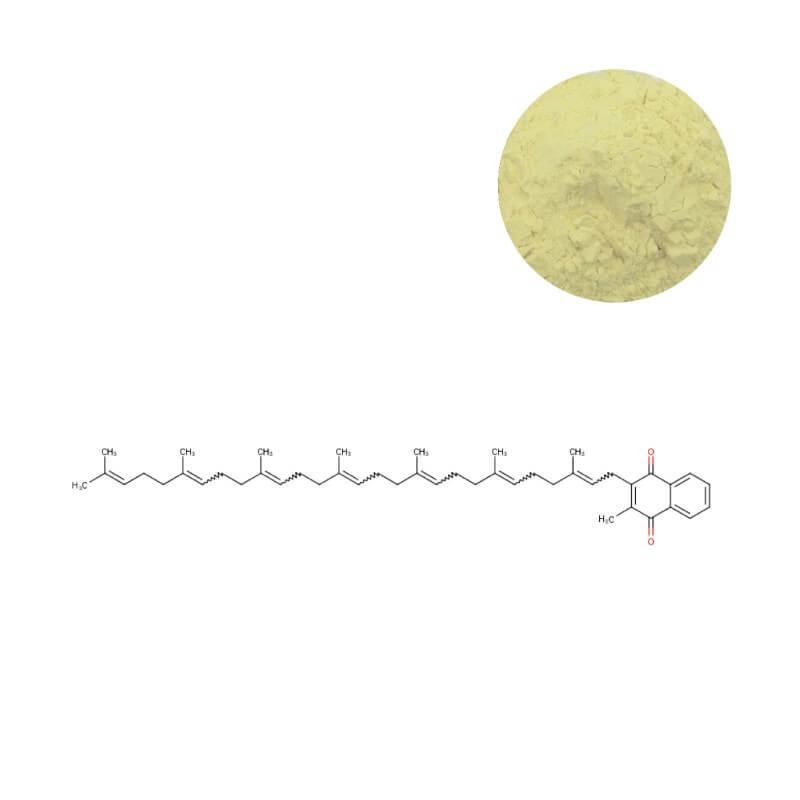
Vitamin K2 MK-7 Powder
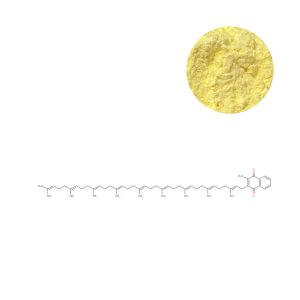
| Product Name | Vitamin K2 MK-7 Powder (Fermented) |
| CAS Number | 2124-57-4 |
| Appearance | Off-white to yellowish fine powder |
| Purity | 0.2%, 1.0% (Diluted) / 98.0% min. (by HPLC) |
| Packaging | 1 kg/bag, 5 kg/bag, 25 kg/drum |
| MOQ | 1 kg |
Fermented Vitamin K2 MK-7 Powder - High-Purity Grade for Cardiovascular & Bone Health Formulations
The low-hygroscopicity profile of bulk Vitamin K2 MK-7 Powder directly eliminates column-binding and caking during high-speed encapsulation, while its verified all-trans isomer ratio ensures predictable carboxylation efficiency across multi-component blends. Batch-to-batch consistency is verified via HPLC fingerprinting and all-trans confirmation - ensuring each CMO-bound shipment arrives within the verified performance baseline. Strategic particle engineering thus becomes the decisive differentiator that elevates a brand's finished product from commodity-grade to clinically credible, margin-protected positioning in an increasingly saturated bone-and-artery category.
Powder Flow Dynamics and High-Speed CMO Line Adaptability - Anti-Static & Aerostatic Packaging Protocol
Fermented MK-7 powders, particularly at 0.2% and 1.0% carrier-based dilutions, exhibit moderate electrostatic agglomeration when processed below RH 30%. This physical trait directly impacts rotary tablet press performance: unmodified powder grades often cause feed-frame bridging and die-fill variability, translating into frequent line stoppages and elevated reject rates.
- Electrostatic agglomeration & feeder bridging: Untreated MK-7 blends have been documented to reduce the interval between cleaning cycles from 4 hours to 1.5 hours on high-speed capsule fillers (Bosch GKF-class), with reject rates climbing from 0.8% to 3.7%.
- Aerostatic packaging for air-freight integrity: The combination of low-cabin pressure (0.6 atm at cruising altitude) and tarmac temperature spikes (>55°C during summer ground holds) exposes the powder to a cumulative thermal span of up to 80°C (from cold-chain loading at -20°C to tarmac solar gain exceeding 55°C), challenging seal integrity and accelerating isomerization. Triple-layered vacuum aluminum bags with OTR < 0.5 cc/m2 · 24h · atm and built-in molecular sieve desiccants prevent moisture ingress and active degradation.
This engineering translates into procurement value: reduced cleaning and fewer rejects lower manufacturing costs per bottle. For JIT inventory, the Oclean Nutra spec ensures arrival flowability matches the origin COA - eliminating re-validation runs. For production managers, this translates into measurable gains: fewer line changeovers, reduced scrap rates, and the ability to run high-speed encapsulation at full rated capacity without compromising fill-weight uniformity.
Global Regulatory Infrastructure and Compliance Trails for Market Access
Navigating cross-border claims requires precise alignment with each jurisdiction's approved framework. The following table summarizes current regulatory statuses and permitted daily intake thresholds for Vitamin K2 MK-7 across key markets.
| Market / Agency | Regulatory Status | Permitted Daily Intake / Claim Scope |
|---|---|---|
| USA (FDA GRAS) | GRN No. 641 (active) | No specified UL; typical use 45-300 μg/day |
| EU (EFSA Novel Food) | Authorized (EU 2017/2470, 2025 consolidation) | ≤ 200 μg/day; bone health claim only |
| Japan (FFI) | Functional Food ingredient | Multiple registered SKUs; vascular-age and joint-comfort claims |
- US FDA compliance path: The GRAS status enables structure-function claims without pre-market NDA, but cardiovascular-disease-risk reduction claims remain prohibited under DSHEA.
- EU EFSA bone health only: While the bone health claim is approved, cardiovascular assertions are explicitly disallowed - a critical distinction for labeling strategy.
- Australian TGA & FSANZ: Permitted as a vitamin K source in FSMP and complementary medicines, with upper limits aligned with EU standards.
The US-EU regulatory divergence (flexible vs. 200 μg ceiling) creates dual-dossier needs. A pre-compiled compliance matrix reduces R&D validation time and accelerates NDI or Novel Food re-notification.
Chromatographic Fingerprinting and All-Trans Isomer Verification for Adulteration Guard
MK-7's biological activity is determined not solely by total content but by the proportion of the all-trans isomer. Industry HPLC protocols (C30 column, 270 nm detection) separate all-trans MK-7 (retention time ~22.5-24.5 min) from cis-MK-7 (~21.0-21.8 min) and MK-6 impurities (~10 min). Without this level of chromatographic scrutiny, low-purity or isomer-enriched blends can pass conventional content assays while delivering inferior carboxylation efficacy.
- cis-MK-7 limit: Commercial-grade spec ≤ 2.0% (USP standard), while EU Novel Food permits up to 6.0% - making the tighter spec a distinct competitive differentiator.
- Adulteration interception: Substituting high-purity fermented MK-7 with synthetic material can be identified by carbon-14 isotopic abundance (pMC ≥ 95% for natural fermentation vs. near-zero for petrochemical routes). HPLC fingerprinting plus AMS verification provides an auditable evidence chain.
This rigor protects brand owners from adulteration costs - $2,500-$5,000 per US container detention, plus production delays. Providing a complete HPLC fingerprint trace for each batch gives QA/QC directors a defensible package that shortens release cycles and eliminates arbitration delays. Adopting this fingerprinting protocol directly accelerates customs release cycles by pre-empting laboratory disputes, while simultaneously providing a clean audit trail that satisfies both FDA FSVP and EU supply-chain due diligence expectations.
Clinical Kinetics and Carboxylation Efficacy - MK-7 Pharmacokinetics and Endpoint Data
The geranylgeranyl side chain of MK-7 facilitates integration into LDL particles, yielding a serum half-life of approximately 68-72 hours - enabling once-daily dosing at microgram levels. The two validated Gla-protein targets, MGP (vascular) and osteocalcin (bone), translate this pharmacokinetic advantage into measurable clinical outcomes (J Hypertens, 2025; doi: 10.1097/01.hjh.0001115396.35887.92).
| Clinical Parameter | MK-7 (90 μg/day) Data | Comparative Reference |
|---|---|---|
| Serum T1/2 | ~72 hours | MK-4: 1-2 hours |
| dp-ucMGP reduction (8 weeks) | 30%-50% decrease | Functional K-deficiency marker |
| CAC progression (2-year RCT) | 18-29 Agatston units/year reduction (p=0.03) | Mild-to-moderate CAD cohort |
This clinical profile addresses consumer skepticism that plagues supplement categories. For PMs, referencing the 2-year RCT outcome - CAC progression slowed irrespective of BP status - provides a compliant yet compelling narrative differentiating MK-7 from generic bone-support products.
Formulation Synergy, Processing Stability, and Finished-Concept Innovation
The combination of MK-7 with crystalline vitamin D3 powder and calcium creates a closed-loop calcium-metabolism pathway. However, the lipophilic nature of MK-7 (LogP ≈10.5) requires careful emulsification when incorporated into aqueous gummy matrices or solid-dose blends containing mineral salts. High-purity MK-7 has been shown to maintain superior stability under accelerated conditions (6 months at 40°C / 75% RH), reducing the risk of nominal vs. actual content deviations (Molecules, 2019; doi: 10.3390/molecules24050829).
- Softgel vs. gummy processing: Softgels (55% market share) are the most stable format for oil-soluble MK-7/D3 blends. For sugar-free gummies, post-deposition coating is recommended to avoid thermal isomerization during high-temperature pouring (≥ 65°C).
- Microencapsulation for dry blends: Pre-dissolving MK-7 in MCT oil and spray-coating with modified starch (core droplet size D90 ≤ 5 μm) minimizes separation and oxidation in multi-mineral premixes.
- Finished concept: a two-per-day, plant-based gummy delivering 45 μg MK-7 plus chelated magnesium glycinate powder, positioned for the 45-60-year-old wellness consumer seeking daily vascular and skeletal support.
For brand owners, the purity-driven stability demonstrated in formulation studies translates directly into reduced batch-rejection rates. By selecting high-purity (>98% all-trans) MK-7 over lower-grade alternatives, procurement teams secure a 12-month ambient stability window that eliminates the need for cold-chain warehousing and minimizes write-offs due to potency drift.
Technical Verification, Dossier Dispatch, and Continuity Risk Management
Batch-specific COA, compliance dossiers, and LC-MS fingerprints accompany each lot. Global fermentation capacity (75%-80% in China) faces environmental policy shifts, extending lead times for orders above 3 tons to 60-90 days. Securing spec-verified material now avoids line stoppages, hedges spot volatility, and prevents costly airfreight replacements - a TCO safeguard.
Procurement and R&D teams are invited to request a fully documented qualification sample package, including complete HPLC fingerprint charts and stability data aligned with EU Novel Food specifications. Secure a spec-verified Vitamin K2 MK-7 qualification sample with full COA documentation to initiate supplier onboarding and protect production continuity across your finished-goods portfolio.
Frequently Asked Questions
Share this product
Related Products
Ready to get started?
Contact our team for technical specifications, pricing, and customized solutions.