
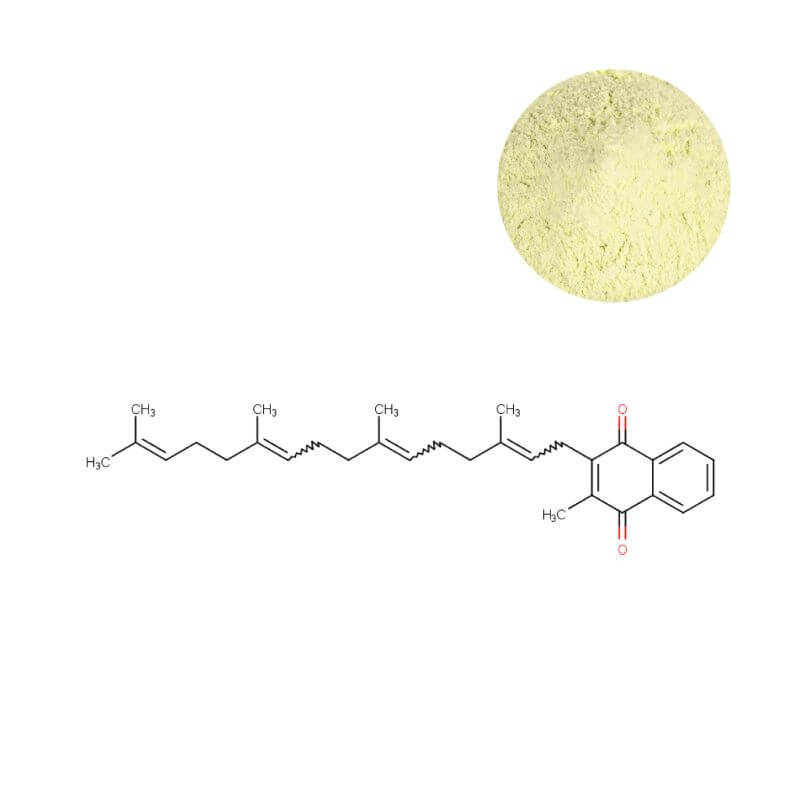
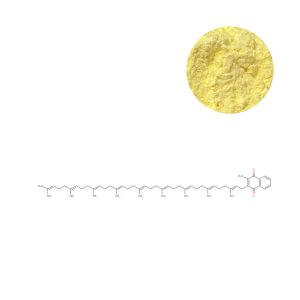
Vitamin K2 MK-4 Powder
| Product Name | Vitamin K2 MK-4 Powder (Menaquinone-4) |
| CAS Number | 863-61-6 |
| Appearance | White to Pale Yellow Powder |
| Purity | 98.0% min. / 1.0% or 1.3% (Diluted) (by HPLC) |
| Packaging | 1 kg/bag, 5 kg/bag, 25 kg/drum |
| MOQ | 1 kg |
Bulk Vitamin K2 MK-4 Powder: Engineering Flow and Stability for CMO Lines
Bulk Vitamin K2 MK-4 Powder typically experiences hopper bridging and punch sticking during rotary pressing due to low bulk density (0.2-0.4 g/mL) and electrostatic charging above 5 nC/g, forcing line stops every 15-20 minutes. A spec-verified bulk Vitamin K2 MK-4 Powder supplier addresses these physical liabilities through controlled particle engineering and real-time flow monitoring under USP <1174> protocols. Comprehensive lot-to-lot verification ensures consistent discharge uniformity across multi-tonne procurement cycles, providing the audit trail required for seamless CMO integration and long-term supply agreements. Managing particle-level electrostatic behavior, not just certificate specs, gives premium brands the operational edge in a commoditized supply landscape.
Static Control and Flow Engineering as CMO Productivity Multipliers
Unmodified MK-4 crystals develop surface charges exceeding 5-10 nC/g during pneumatic transfer, creating aggregates that block feed frames and produce weight variation defects in 3-5% of output. These disruptions typically reduce effective throughput by 20-30% and accelerate punch wear, directly increasing tooling replacement frequency and operator intervention costs.
- Anti-static glidant integration at 0.5-1.0%: Colloidal silicon dioxide reduces triboelectric charge by 60-70%, minimizing punch adhesion while preserving dissolution kinetics across all carrier systems.
- Controlled milling to 80-mesh specification: A tight particle size distribution (≥95% through 80 mesh) stabilizes bulk density and prevents segregation in multi-nutrient premixes containing diverse particle morphologies.
- Continuous avalanche angle monitoring (USP <1174>): In-line measurement provides immediate feedback for hopper vibration adjustments, pre-empting flow interruptions before defective tablets accumulate in rejection bins.
Specifying these flow-engineering parameters in the material specification eliminates the hidden costs of frequent tooling replacement, operator overtime, and scrapped batches. The recovery of 15-20% of lost press time per shift translates into a measurable total cost of ownership advantage for high-volume contract manufacturers, aligning physical powder performance directly with financial outcomes. Static adhesion-driven wear demands punch reconditioning every 8-12 hours, adding 40-60 minutes of maintenance per shift and 0.012-0.018 USD per thousand tablets in tooling costs.
Lipid Carrier Engineering for Aqueous Dispersion Integrity
The lipophilic MK-4 molecule (log P > 9.0) resists direct dissolution in aqueous systems, requiring high-shear microfluidisation with modified food starch or MCT to achieve a mean droplet size (D90) ≤ 200 nm. Processing temperature during high-shear homogenisation must remain below 45°C to prevent thermal isomerisation, with typical energy input ranging 300-500 kWh per metric tonne of emulsion batch to achieve the required droplet disruption force. Without this control, emulsions exhibit oil separation and turbidity above 50 NTU within 3-6 months of ambient storage.
| Carrier Platform | D90 Target (nm) | Shelf Stability (25°C, 24 mo.) | Critical Processing Control |
|---|---|---|---|
| MCT oil + modified starch | 180-200 | No creaming; turbidity < 50 NTU | Homogenisation ≥ 800 bar |
| Sunflower lecithin + glycerol | 150-180 | Clear dispersion; no oil separation | pH maintained 5.0-7.5; avoid freeze-thaw |
Exposure to freeze-thaw cycles or high-electrolyte premixes disrupts the emulsifier interface, causing coalescence and visible sediment formation. Adopting a validated carrier system with documented stress-tolerance data eliminates the risk of finished-product rejection and costly re-engineering efforts. Routine verification of droplet size distribution and zeta potential (≥30 mV) provides early failure alerts, enabling corrective action before production scale-up and protecting brand reputation in competitive liquid supplement segments. Droplet size verification via DLS or laser diffraction (USP <729>) ensures batch-to-batch consistency, with polydispersity index below 0.2 for monodisperse emulsions. Securing consistent droplet size distribution directly reduces reformulation cycles and eliminates scale-up failures, compressing development timelines by an estimated 2-3 weeks per launch.
Carboxylation Biology: MK-4 as Vascular and Skeletal Modulator
Menaquinone-4 functions as the obligatory cofactor for γ-glutamyl carboxylase (GGCX), converting inactive matrix Gla protein (MGP) and osteocalcin into their calcium-binding carboxylated forms. This post-translational modification represents the only endogenous system that inhibits arterial calcification and directs calcium into bone matrix, supporting cardiovascular and bone health applications.
- MGP carboxylation for vascular protection: Activated MGP binds free calcium phosphate with high affinity, preventing hydroxyapatite crystal deposition in arterial vessel walls and maintaining elastic integrity.
- Osteocalcin activation for bone mineralisation: Carboxylated osteocalcin anchors calcium ions to the bone matrix, enhancing hydroxyapatite crystal growth and skeletal density maintenance.
- Ferroptosis suppression via NRF2/GCLM axis: Recent in vivo studies confirm MK-4 attenuates abdominal aortic aneurysm progression through upregulation of glutathione biosynthesis and lipid peroxide neutralization.
This dual-target mechanism distinguishes MK-4 from MK-7 for formulations requiring rapid tissue exposure, as MK-4 achieves a Tmax of 2-4 hours in aortic tissue, whereas MK-7 requires 48-72 hours to reach comparable arterial levels, supporting distinct formulation strategies for acute versus sustained vascular protection. R&D teams can confidently support structure-function claims around vascular elasticity and bone mineral density when formulating with a fully characterised MK-4 source that demonstrates consistent carboxylation activity across batches, validated by orthogonal analytical methods including HPLC and mass spectrometry. Achieving batch-to-batch carboxylation consistency through validated HPLC protocols shortens customs release windows and secures multi-regulatory acceptance without additional in-market retesting.
Excipient Compatibility and Synergist Co-Formulation Intelligence
Effective MK-4 formulations typically pair the vitamin with Vitamin D3 (to enhance calcium absorption) and magnesium (to support carboxylase enzyme activity) while avoiding degradation from pro-oxidant minerals and UV exposure. Systematic compatibility screening using FTIR spectroscopy demonstrates that menatetrenone exhibits no peak shifts, no new absorptions, and no spectral alterations with all tested formulation excipients (Drug Res (Stuttg), 2024; doi: 10.1055/a-2361-2895), granting formulators broad freedom in selecting fillers, binders, and lipid carriers.
- Oxidative stabilisation with mixed tocopherols: Inclusion of 1000-2000 ppm chain-terminating antioxidants, combined with nitrogen blanketing (dissolved O2 < 2 ppm), restricts quinone ring degradation to ≤ 5% over 24 months at 25°C.
- Mineral separation strategy for multi-vitamin systems: Direct compounding with iron or copper accelerates cis-isomerisation; layered tablet designs or coated beadlets effectively isolate these reactive interactions without compromising dissolution.
- Carrier oil selection for D3-K2 co-formulation: The lipid matrix must maintain both actives' solubility profiles without cross-interference; medium-chain triglycerides provide optimal dissolution characteristics for both molecules.
Applying this compatibility knowledge directly shortens formulation development cycles by eliminating unnecessary trial-and-error screening of unsafe excipients. Procurement managers benefit from reduced supplier complexity and consistent dissolution across formats, ensuring intended bioactivity without stability surprises over the 24-month shelf life. The combination of mixed tocopherols with ascorbyl palmitate as a secondary antioxidant demonstrates synergistic protection, reducing MK-4 degradation by an additional 30-35% compared to tocopherols alone under accelerated stability conditions (40°C/75%RH, 6 months).
Audit-Ready Documentation and Sample Qualification Pathway
Consistent powder flow characteristics, verified colloidal dispersion stability, and universal excipient compatibility make this MK-4 grade a reliable foundation for cardiovascular and bone-health supplement lines. For multinational procurement directors, verifying physical stability data upstream eliminates downstream cargo rejection risks and avoids costly 30-day hold periods at destination ports. Complete technical dossiers, stability protocols, and lot-specific COA packages are available to streamline supplier qualification and regulatory filing. Request spec-verified Vitamin K2 MK-4 Powder samples.
Frequently Asked Questions
Share this product
Related Products
Ready to get started?
Contact our team for technical specifications, pricing, and customized solutions.