
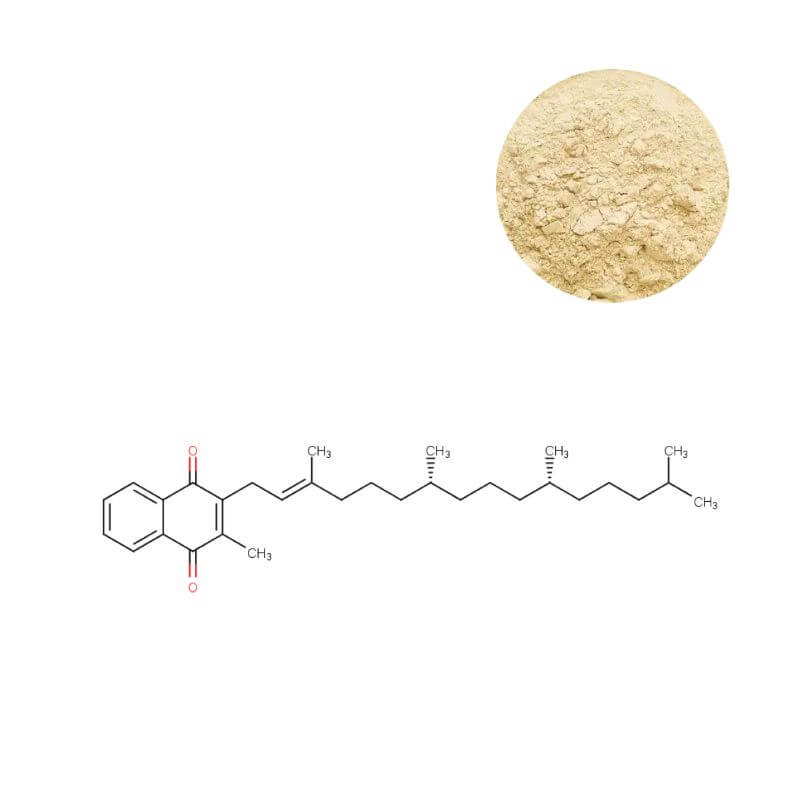
Vitamin K1 Phylloquinone
| Product Name | Vitamin K1 (Phylloquinone) |
| CAS Number | 84-80-0 |
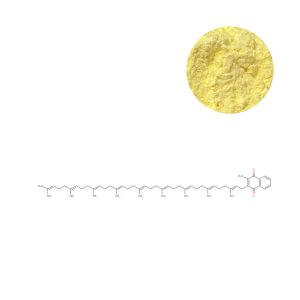
| Appearance | Fine yellow powder (for 1%/5%) or viscous golden-yellow oil (for 98%) |
| Purity | 1% min., 5% min., or 98% min. (by HPLC) |
| Packaging | 1 kg/aluminum bag, 5 kg/tin, 25 kg/fiber drum |
| MOQ | 1 kg |
Vitamin K1 (Phylloquinone) 98% Oil & CWD Powder: Enabling Stable, Science‑Backed Bone & Cardiovascular Health Formulations
For supplement brands targeting aging consumers or post‑menopausal women, differentiating a bone health or vascular support product increasingly hinges on ingredient quality and clinical substantiation. Vitamin K1 (phylloquinone) – the predominant dietary form of vitamin K – offers a well‑established safety profile and a clear regulatory pathway. However, not all commercial grades deliver the same stability or batch‑to‑batch consistency. Premium 98% oil and cold‑water dispersible (CWD) powders (1% / 5% loadings) are engineered to overcome light sensitivity and formulation incompatibility, ensuring that the final product’s label claim matches real‑life potency. For brands, this directly enables a science‑backed premium positioning while avoiding costly overages or batch rejection – a decisive competitive edge in the bone health category.
Quality Benchmarks for Bulk Vitamin K1: What Defines a Premium Ingredient?
When sourcing bulk Vitamin K1, a certificate of analysis (COA) is mandatory, but not all COAs are equal. Key quality indicators extend beyond simple purity percentages. For a certified Vitamin K1 supplier, the following parameters are non‑negotiable:
- Isomeric purity – High‑grade phylloquinone contains minimal cis‑isomers, which have lower biological activity. HPLC profiles should show ≥98% trans‑isomer.
- Residual solvents & heavy metals – Compliant with USP <467> and USP <232> limits (Pb ≤2.0 mg/kg, inorganic As ≤1.0 mg/kg).
- Light & oxidative stability – Verified via accelerated stability studies. Premium oil is packaged under inert gas in amber glass; CWD powders use oxygen‑barrier foil.
The European Food Safety Authority’s dietary reference values for vitamin K (doi: 10.2903/j.efsa.2017.4780) set an adequate intake of 70 µg/day for adults, based on phylloquinone’s role in coagulation. From a strategic formulation perspective, this official benchmark allows brands to confidently substantiate “supports normal blood clotting” claims while designing products that also address bone metabolism – a secondary but increasingly valued function. For procurement teams, this directly translates to selecting a Vitamin K1 distributor that provides full chromatographic data and real‑time stability tracking, reducing the risk of label claim failures after months on shelf. From a product lifecycle perspective, such traceability cuts R&D validation time by weeks and ensures consistent consumer trust through every production cycle.
Market Trends: Positioning Phylloquinone for Bone & Cardiovascular Differentiation
Consumer awareness of vitamin K’s role beyond clotting has grown rapidly, especially in bone and arterial health. While most supplements still pair vitamin D and calcium, adding phylloquinone creates a more complete “calcium guidance system.” A recent randomised placebo‑controlled trial in post‑menopausal osteoporotic women (doi: 10.1007/s11657-023-01288-w) found that 1 mg/day of vitamin K1 significantly improved hip geometry parameters (intertrochanteric endocortical diameter p=0.04; femoral neck cross‑sectional area p=0.03) even without changes in BMD. Practically speaking, this suggests that phylloquinone’s effect on bone quality – rather than merely bone density – can be a distinct selling point.
| Application | Preferred Form | Typical Inclusion Level (per serving) | Key Benefit for Brands |
|---|---|---|---|
| Softgels (oil‑based) | 98% oil | 100 – 500 µg | High stability, easy formulation, no taste masking needed |
| Tablets / stick packs | 1% or 5% CWD powder | 200 – 1000 µg | Cold water dispersible, homogeneous dry blending |
| Multivitamin gummies | 1% CWD powder | 50 – 200 µg | Low dose flexibility, no oil leakage |
For brands developing Vitamin K1 for bone health formulations, combining it with Vitamin D3 (Cholecalciferol) (10 µg) and calcium (500‑1000 mg) remains the most evidence‑backed synergy. However, a more innovative path is to pair phylloquinone with Magnesium Glycinate or zinc – both co‑factors in bone matrix synthesis. This positioning allows a finished product to move beyond “calcium absorption” toward “full skeletal support.” It is worth noting that using a GMP Vitamin K1 powder (CWD) eliminates the need for emulsifiers in dry blends, a hidden cost saver that many R&D teams overlook.
Supply Chain Resilience & Total Cost of Ownership for Vitamin K1 Oil and Powder
Phylloquinone is highly sensitive to light and, to a lesser extent, oxygen. This physical property directly impacts total cost of ownership (TCO) – not just the price per kilogram. A cheaper oil grade packaged in translucent HDPE may degrade 15‑20% faster under warehouse lighting, forcing shorter shelf life or higher overage. Premium bulk Vitamin K1 oil is always supplied in amber glass or opaque multilayer bags with nitrogen flushing. Similarly, CWD powders require low‑water‑activity packaging to prevent hydrolysis of the carrier matrix.
Key sourcing considerations include:
- Lead time & safety stock – Reputable Vitamin K1 exporters maintain at least three months of buffer inventory for oil and six months for powder, mitigating raw material shortages.
- Third‑party testing frequency – Best‑in‑class partners provide HPLC‑verified COA for every batch, plus annual full‑panel testing (residual solvents, heavy metals, microbial).
- Cold chain vs. ambient storage – Oil requires 2‑8°C; powder can be kept at 15‑25°C if dry. Mixing both in one shipment often increases logistics costs – a detail often missed during RFQ.
For procurement teams, this directly translates to evaluating a Vitamin K1 supplier not only on unit price but also on packaging specification, storage protocol, and willingness to provide accelerated stability data. An upfront investment in quality supply reduces hidden costs related to batch rejection, reformulation, or brand reputation damage. Practically, this lowers total cost of ownership by preventing stability‑driven label claim failures – a hidden risk that erodes margins more than raw material price differences.
Mitigating Risk: A Checklist for Sourcing Phylloquinone as a Supplement Ingredient
When buying Vitamin K1 for a new product launch, a systematic risk‑mitigation framework protects your development timeline and market compliance. Below is a practical checklist used by experienced formulators when evaluating a Vitamin K1 distributor or direct partner:
- Full disclosure of isomer profile – Not just total purity but % trans‑phylloquinone (should be >98%).
- Batch‑specific heavy metals (ICP‑MS) – Pay special attention to lead and inorganic arsenic; USP limits are often stricter than generic food standards.
- Microbial enumeration for CWD powder – Total plate count ≤1,000 CFU/g, absence of E. coli and Salmonella.
- Residual solvent analysis – Especially for oil grades where ethanol or hexane may be used in extraction or synthesis.
- Stability commitment – The supplier should guarantee ≥95% potency for 24 months under recommended storage conditions.
For procurement, applying this checklist is the most effective due diligence to avoid catastrophic batch holds at customs – a risk that can cost 10 times the material value. From a compliance standpoint, ensuring that each shipment is accompanied by a fully traceable COA referencing USP or GB standards eliminates most regulatory surprises. For brands targeting EU or US markets, the fact that phylloquinone is not a novel food (pre‑1997 use) and has GRAS status (FDA GRN 000592) simplifies the notification process. However, relying on a certified Vitamin K1 partner that proactively provides technical dossiers (including stability, safety, and allergen statements) cuts weeks from the R&D phase.
Next Steps: De‑risk Your Formulation with a Complimentary Sample & Technical Dossier
Accelerating your bone health or cardiovascular supplement project starts with verifying raw material performance in your actual production environment. We provide a free, 10‑20g sample of Vitamin K1 (Phylloquinone) – either 98% oil or 5% CWD powder – along with a batch‑specific COA and a stability summary. Request your complimentary sample & technical dossier to confirm dispersibility, assay accuracy, and compatibility with your existing excipients before committing to production volumes.
Frequently Asked Questions
Share this product
Related Products
Ready to get started?
Contact our team for technical specifications, pricing, and customized solutions.