
The Bone Health “Triangle”: Why Your Vitamin D3 & K2 Formula Needs Dimagnesium Malate
The era of standalone Vitamin D3 is ending. This article explores the biochemical synergy of the D3-K2-Magnesium triangle, clinical evidence for Dimagnesium Malate, and technical strategies to help brands build high-potency bone health systems.
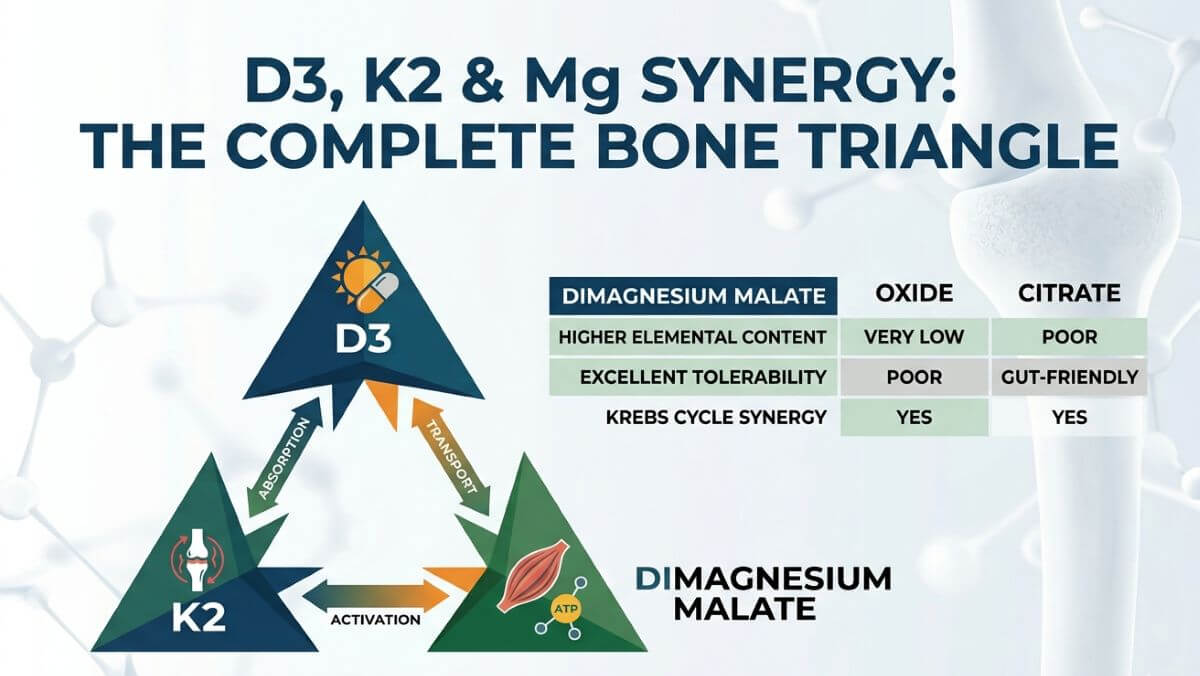
For years, the bone health category has been driven by two pillars: vitamin D3 for calcium absorption and vitamin K2 for calcium direction. Yet a growing body of evidence points to a missing third vertex—magnesium. Without adequate magnesium, the D3‑K2 axis cannot reach its full potential, leaving efficacy gaps that sophisticated formulators can now close. This article unpacks the biochemical synergy behind D3, K2 and magnesium, and explains why dimagnesium malate offers a superior magnesium source for next‑generation bone health products.
The Market Pull: From Single Ingredients to Integrated Systems
The global bone and joint health supplement market is projected to grow from USD 15.0 billion in 2025 to USD 34.0 billion by 2035, with a CAGR of 9.5% for bone density products alone (GII Research, 2025). Within this expansion, consumer demand is shifting away from isolated vitamin D3 toward multi‑target formulations that address absorption, direction and enzymatic activation simultaneously. According to a 2024 consumer study across North America and Europe (n=841), 74% of health‑conscious adults said a “vital trio” of D3, K2 and magnesium addressed an unmet need, and over half were willing to pay a premium for such a combination.
What this means for brands: The market has moved beyond asking “does it contain D3?” to “does the D3 work effectively inside the body?”. For brands still relying on standalone vitamin D3 products, the window of differentiation is narrowing. Those that adopt the three‑component system now can claim a science‑backed advantage before the segment becomes crowded.
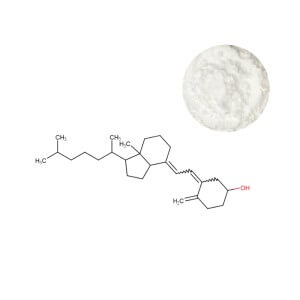
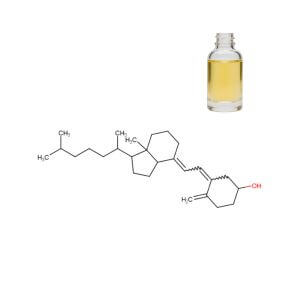
For brands sourcing bulk vitamin D3, the opportunity lies in moving beyond commodity‑grade single ingredients toward science‑backed systems. A reliable starting point is Vitamin D3 Cholecalciferol Powder, which provides high concentration and consistent potency for dry blends. The same logic applies to liquid‑based products: oil‑soluble D3 remains highly bioavailable, but its efficacy still depends on the presence of K2 and magnesium.
The Biochemistry of the Bone Triangle: Why Magnesium Is the Unlock Key
The classic model of bone metabolism focuses on calcium intake. However, the body cannot use calcium effectively unless three conditions are met:
- Sufficient vitamin D3 to stimulate intestinal calcium absorption and upregulate calcium‑binding proteins.
- Active vitamin K2 (MK‑7) to carboxylate osteocalcin, enabling the protein to bind calcium and deposit it into the bone matrix.
- Adequate magnesium to activate the γ‑carboxylase enzyme (which converts osteocalcin to its active form) and to support the enzymatic conversion of 25‑hydroxyvitamin D to its active 1,25‑dihydroxy form.
Magnesium deficiency—affecting an estimated 40‑60% of European and US populations (NHANES data)—directly impairs both vitamin D activation and K2‑dependent carboxylation. A 2024 review published in Nutrients explicitly describes a “crosstalk” between magnesium, vitamin K and vitamin D metabolism, highlighting that magnesium serves as an essential cofactor for the γ‑carboxylase enzyme (doi: 10.3390/nu16060834). Without magnesium, even high doses of D3 and K2 cannot deliver the expected bone health benefits.
The core insight: Adding magnesium is not a “nice to have” – it is the biological precondition for D3 and K2 to function as intended. A D3+K2 formula without adequate magnesium is like a high‑performance engine running on low‑grade fuel: it may look impressive on paper, but real‑world efficacy will be compromised.
Choosing the Right Magnesium Source: Why Dimagnesium Malate Stands Out
Not all magnesium salts perform equally in a finished supplement. Formulators must balance element content, solubility, gastrointestinal tolerability and positioning claims. The table below compares three common magnesium forms used in bone health blends.
| Magnesium Form | Elemental Mg Content | Key Characteristics | Best for… |
|---|---|---|---|
| Magnesium Citrate | ~16% | Well‑absorbed; mild laxative effect | Budget‑conscious general wellness products |
| Magnesium Bisglycinate | ~10‑14% | High tolerability; chelated for absorption | Sleep & stress formulas |
| Dimagnesium Malate | ~19‑20% | High elemental content; enters Krebs cycle for cellular energy; excellent GI tolerability (91% tolerability in clinical trial) | Premium bone, muscle & energy blends |
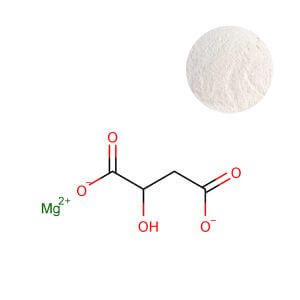
Dimagnesium Malate Powder offers a distinct advantage over citrate or bisglycinate for bone health triangles: its malate moiety participates in the Krebs cycle, supporting ATP production and reducing fatigue—an additional benefit that aligns with active aging and sports nutrition cross‑over segments. Clinical data from a Jigsaw Health study (published in the Journal of the American College of Nutrition) showed that 500 mg of dimagnesium malate daily increased red blood cell magnesium by 6% at 30 days and 30% at 90 days, while improving magnesium deficiency symptoms by 63% at 90 days. Gastrointestinal tolerability was reported as “good” or “very good” by 91% of participants.
Why this matters for R&D: Choosing dimagnesium malate allows brands to make two distinct consumer claims simultaneously – bone health support and energy metabolism – a dual positioning that commands higher retail margins. In contrast, citrate or bisglycinate would force a single‑benefit narrative. For brands aiming at the premium active‑aging demographic, dimagnesium malate is the clear differentiator.
From a formulation perspective, dimagnesium malate has a neutral taste profile, good flowability and is compatible with both powder blends and oil‑based systems when encapsulated. Its higher elemental magnesium content (≥19.0% by assay) means less total fill weight per dose, allowing smaller capsules or more compact tablets.
Formulating the Complete Triangle: D3 + K2 + Dimagnesium Malate
Market data tells us why the triangle is urgent. Biochemistry explains how it works. But the real test for brand teams is how to make it stable, scalable, and compliant. Below are key technical parameters that R&D leaders should consider when designing a premium bone health SKU.
1. Recommended Daily Dosage Ranges (Adult)
- Vitamin D3: 800‑2000 IU (20‑50 mcg) – adjust for target label claim
- Vitamin K2 (MK‑7): 90‑180 mcg – all‑trans MK‑7 form preferred (≥99.7% purity)
- Dimagnesium Malate: 200‑400 mg elemental magnesium (equivalent to ~1000‑2000 mg dimagnesium malate)
2. Stability & Compatibility Considerations
- Vitamin K2 (MK‑7) is sensitive to moisture and direct contact with mineral salts. Use microencapsulated K2 (e.g., K2VITAL DELTA technology) or separate the ingredients into two‑layer tablets or two‑compartment sachets when possible.
- Dimagnesium malate has a pH of 6.0‑7.5 (2% solution), making it neutral and unlikely to degrade D3 or K2 under normal dry‑blend conditions.
- For oil‑based softgels, using Vitamin D3 Oil is ideal; pair it with K2 oil suspension and add magnesium as a separate tablet or powder‑filled capsule to avoid direct contact.
3. Quality Specifications for Sourcing
- Vitamin D3 Cholecalciferol Powder: ≥100,000 IU/g, GMP‑manufactured, with full COA (HPLC assay, residual solvents, heavy metals ≤10 ppm).
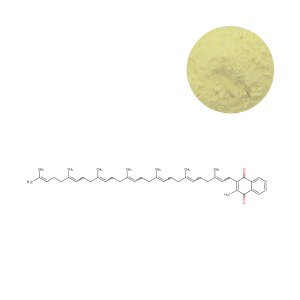
- Vitamin K2 MK‑7 Powder: ≥1,500 mcg/g all‑trans MK‑7, fermented from Bacillus subtilis natto, non‑GMO, with stability data at 40°C/75% RH for 24 months.
- Dimagnesium Malate Powder: assay ≥98.0% (on dried basis), magnesium content 19‑20%, malic acid 69‑71%, lead ≤0.5 ppm, arsenic ≤1.0 ppm.
Takeaway for procurement: A single‑source supplier for all three components reduces qualification time and ensures batch‑to‑batch compatibility. When sourcing these ingredients, request stability data for the combined blend – not just individual certificates of analysis. For dry blends, Vitamin D3 Cholecalciferol Powder can be combined directly with Vitamin K2 MK‑7 Powder and dimagnesium malate, provided that humidity is controlled (≤35% RH) and desiccants are added.
Claim Strategy and Consumer Communication: Turning Science into Shelf Appeal
Even the most advanced formulation will fail if consumers cannot understand its advantage. The D3‑K2‑magnesium triangle allows brands to move beyond generic “supports bone health” claims to more differentiated messaging, such as:
- “Activates calcium transport and deposition”
- “Supports normal muscle function and bone mineralization” (magnesium EFSA‑approved claim)
- “Contributes to the reduction of tiredness and fatigue” (magnesium)
- “With active MK‑7 vitamin K2 for optimal calcium direction”
Because dimagnesium malate provides both magnesium and malate, brands can also target the active aging or sports recovery segment with claims like “supports energy metabolism and bone strength.” This dual positioning increases shelf appeal and justifies a premium price point (typically 30‑50% higher than standard D3‑only products).
The strategic insight: In a crowded bone health aisle, the winner will not be the brand with the most ingredients, but the one that tells the clearest story about why each ingredient matters. The “triangle” narrative – D3 for absorption, K2 for direction, magnesium for activation – is simple enough for consumers to remember and scientific enough for professionals to trust.
Conclusion: Building the Next‑Generation Bone Formula
The era of single‑ingredient bone health supplements is ending. Today’s discerning consumers and clinicians look for evidence‑based systems that address the full physiology of calcium metabolism. By formulating with vitamin D3, vitamin K2 (MK‑7) and dimagnesium malate, brands can deliver a true “bone triangle” that maximizes calcium absorption, direction and enzymatic activation.
Final takeaway: Adding magnesium is not an upgrade – it is a completion. Without it, the D3‑K2 system is only half‑engineered. With dimagnesium malate, brands close the loop and offer a genuinely differentiated solution that commands premium positioning.
Ready to develop your premium bone health SKU? Explore our technical datasheets and sample request options for Vitamin D3 Cholecalciferol Powder, Vitamin D3 Oil, Vitamin K2 MK‑7 Powder and Dimagnesium Malate Powder. Contact our technical team →
Share this article
Found this helpful? Share it with others!
Related Products
Products mentioned in this article
Want to learn more?
Explore our products or contact our team for personalized solutions and expert advice.