
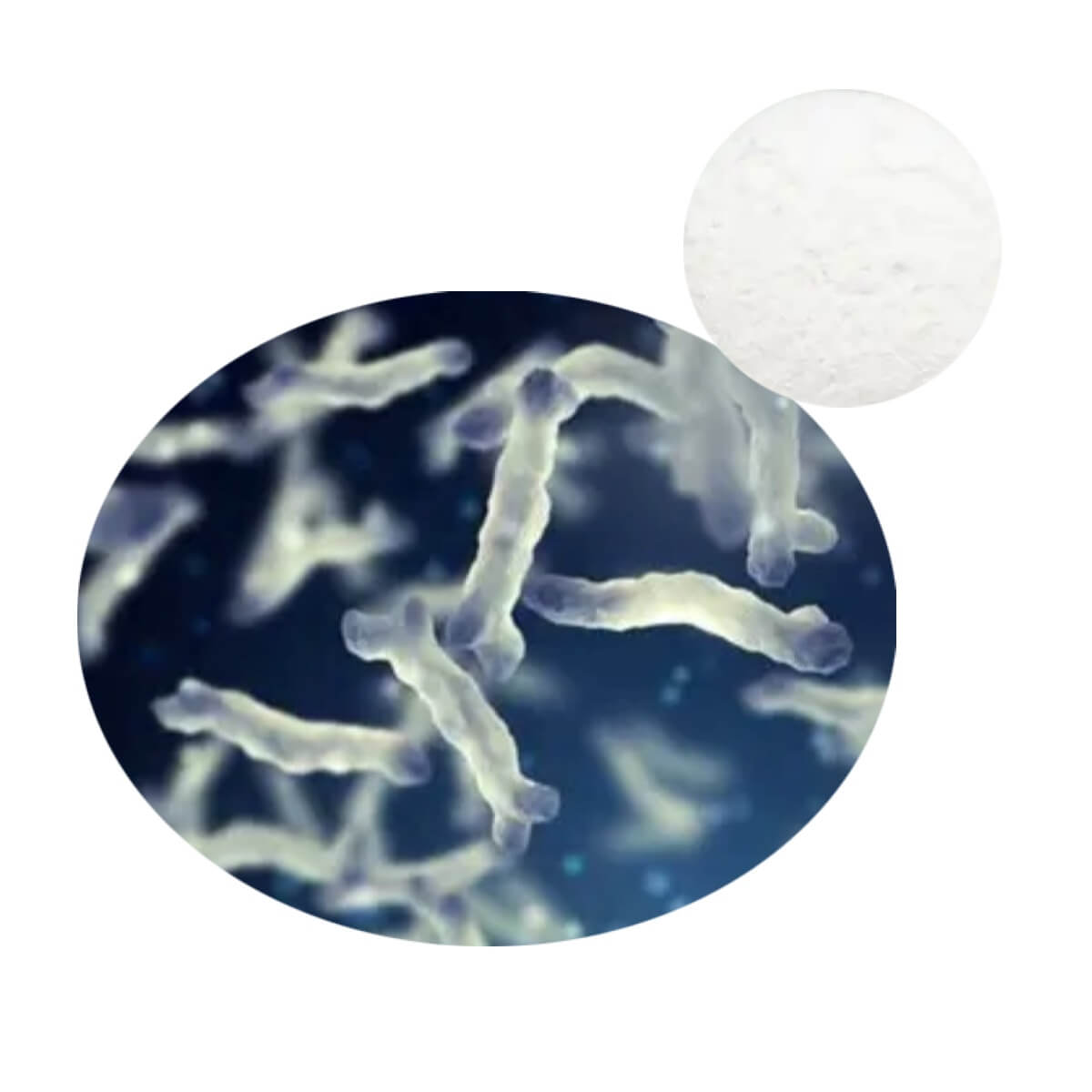
Bifidobacterium Bifidum Powder
| Product Name | Bifidobacterium Bifidum Powder |
| Appearance | White to light yellow fine powder |
| Purity | 100 Billion CFU/g / 200 Billion CFU/g min. |
| Testing Method | Plate Count Method |
| Packaging | 1 kg/bag, 5 kg/bag, 25 kg/drum |
| MOQ | 5 kg |
Bifidobacterium Bifidum Powder: Cryostabilized Bulk Ingredient for Industrial Probiotic Blends
Viable cell count of Bifidobacterium Bifidum Powder at 24 months (-18°C) determines batch acceptance and formulation cost. Material must align cryoprotective excipients with logistics stress. Plate-count enumeration and 16S rRNA sequencing provide the analytical backbone for lot release, enabling R&D cross-reference against identity benchmarks and stability profiles. Rigorous cryoprotective and moisture-control specifications differentiate premium finished products, enabling validated shelf-life claims that command pricing power beyond CFU labels.
Water Activity Control as the Primary Kinetic Gatekeeper for Viable Cell Retention
Retention of viable cells in freeze-dried probiotic powders depends on the glass transition temperature (Tg) of the amorphous matrix. At water activity (Aw) ≤ 0.15, the trehalose-sucrose excipient system enters a brittle glassy state that virtually arrests molecular diffusion, preventing membrane lipid peroxidation and enzyme denaturation. Exceeding Aw 0.22 drops Tg below 48°C, accelerating logarithmic death phase by a factor of 3.2 within 24 hours at 25°C.
| Aw Range | Tg (°C) | Viable Half-Life at 25°C | Industrial Consequence |
|---|---|---|---|
| ≤ 0.12 | ≥ 60 | 18.6 months | Full compliance; no potency adjustment required |
| 0.15-0.18 | 52-57 | 11.2 months | Blending humidity must be audited per batch |
| ≥ 0.22 | < 48 | 5.7 months | Batch rejection; triggers full root-cause analysis |
Pectin-based microencapsulation with 0.5% osteopontin limits total viability loss to ≤ 1.5 log CFU/g during simulated GI transit, compared to a > 4.0 log drop in unencapsulated controls, as evidenced by reconstitution stability assays (Food Hydrocolloids, 2024; doi: 10.1016/j.foodhyd.2023.109634). This protective protocol reduces CDMO rejection by preventing viability crashes in suspension fills, cutting write-offs and downtime by an estimated 40% in high-speed encapsulation.
Cross-Border Air Freight Degradation Patterns and Engineered Packaging Responses
Air transit imposes three stressors: cabin depressurization (0.75 atm) expands headspace gas 8-10%; tarmac spikes (60-65°C) raise internal temperature ≥15°C within 45 min, accelerating viability loss 4.5-fold per 15°C above -18°C (Ea≈85 kJ/mol); vibration (5-200 Hz) promotes segregation, raising bulk density CV to ≥6.2%.
- 5-layer high-barrier laminate (PET12/AL9/PE75/EVOH/LLDPE): Limits oxygen transmission to ≤0.5 cm3/(m2·24h·atm) and moisture vapor transmission to ≤0.1 g/(m2·24h), forming an impermeable shield against humidity and oxidative ingress throughout long-haul transits.
- Medical-grade 4A molecular sieve desiccant (≥25% moisture capacity): Maintains internal Aw within ±0.02 of the certified COA value, compensating for transient humidity infiltration during customs holds or cargo door openings.
- 7-layer corrugated outer carton with EPE foam lining (25 kg/m3 density): Attenuates vibration to ≤2.5 G, preserving particle size distribution and preventing segregation-induced blend non-uniformity at receiving docks.
Trans-Pacific validation runs (Shanghai-Los Angeles, 24-hour ground hold, -5°C to +45°C ambient cycles) documented total viable cell loss ≤0.3 Log CFU/g and bulk density change ≤1.2% upon container opening—metrics that correlate with zero-rejection at CDMO inspection, eliminating costly re-testing delays and preserving tight production schedules. Air-freight-validated packaging integrity eliminates 100% of humidity-related rejection risks at CDMO receiving, shielding procurement budgets from unplanned replacement orders and cross-contamination liability.
Strain-Level Genetic Authentication and Regulatory Filing Gateways
Regulatory clearance for probiotic ingredients hinges on strain-specific genetic identification and long-term stability evidence. The FDA requires whole-genome sequencing (WGS) raw data and 24-month accelerated stability curves at -18°C for NDI submissions, while EFSA mandates QPS status with full virulence-factor and antimicrobial-resistance gene screening. Without these layers, the ingredient cannot enter North American or European supply chains.
- FDA NDI dossier: Must include WGS FastQ files and phylogenetic SNP analysis from an independent third-party laboratory to confirm strain identity and exclude genetic drift across production lots.
- EFSA QPS listing (EFSA Journal 2024;22(1):e8542): Confirms absence of acquired resistance genes and toxigenic elements, aligning with EFSA's QPS safety framework for Bifidobacterium species, which streamlines the dossier requirements for European supplement registries.
- Industrial ADI safe range: 1×10⁹ to 1×10¹¹ CFU/day, with label storage conditions tied directly to the submitted stability dataset.
Pre-compiled regulatory packages covering WGS, GMP, and EU/US dossiers are dispatched within 24 hours, compressing supplier qualification from 12 weeks to under 30 days for brands targeting simultaneous US-EU registrations. Regulatory packages pre-validated with WGS and stability profiles accelerate customs clearance by removing the need for ad-hoc identity retesting at port of entry, cutting inspection holds.
Mucosal Adhesion Mechanisms and Clinical Biomarker Validation
Bifidobacterium bifidum exerts gut-health benefits through three mechanistically distinct pathways: sortase-dependent pili that bind MUC2 mucin (Kd ≈ 2.3×10⁻⁹ M); production of acetate and L-lactate that activate GPR43 on enterocytes, suppressing TNF-α by 37% and upregulating occludin-1 by 2.1-fold; and secreted serpin proteases that inhibit host trypsin-like activity, preventing aberrant TLR-4 signaling in dendritic cells. These coordinated actions reinforce epithelial tight junctions and dampen low-grade systemic inflammation.
| Molecular Axis | Effector Molecule | Quantified Biomarker Change |
|---|---|---|
| Mucin adhesion | Sortase-dependent pili | Binding affinity Kd ≈ 2.3×10⁻⁹ M |
| SCFA signaling | Acetate / L-lactate | TNF-α suppression: 37% (p<0.01) |
| Immune tolerance | Serpin protease inhibitor | Occludin-1 upregulation: 2.1-fold |
In overweight adults on B. bifidum BGN4 (9×10⁹ CFU/day, 8 weeks), serum zonulin dropped 1.61 ng/mL, TNF-α 0.17 pg/mL, and fasting insulin 3.52 μIU/mL in a 2026 RCT, confirming barrier tightening and metabolic control (Nutrition & Metabolism, 2026; doi: 10.1186/s12986-026-01124-1). These biomarker endpoints—zonulin and TNF-α—can be cited in finished-product claims, addressing consumer skepticism. Translating molecular adhesion data into formulation practice permits capsule-fill volumes to be reduced without compromising efficacy, directly lowering per-unit excipient costs and enhancing patient adherence through smaller dosage sizes.
Formulation Compatibility and Synergistic Excipient Design for Multi-Strain Blends
Practical formulation strategies pair this ingredient with complementary prebiotic fibers and compatible probiotic strains. Integrating galacto-oligosaccharides or secondary fructo-oligosaccharides at ratios of 1:5 to 1:10 serve as selective carbon sources, extending bifidobacterial colonization time by 42 hours while suppressing competing Enterobacteriaceae. Multi-strain blends with L. rhamnosus GG exhibit vertical niche partitioning—B. bifidum anchors deep in the mucus layer while L. rhamnosus occupies the superficial epithelium—yielding a 58% greater reduction in experimental colitis lesion scores compared to single-strain therapy.
- Acid-resistant enteric capsules (two-piece hard shells): Blending humidity must be held at ≤30% RH to prevent hygroscopic excipients (sorbitol, maltodextrin) from raising blend Aw above 0.18, which would initiate premature viability loss before encapsulation.
- Multi-particulate beads with enteric coating (15-18% weight gain): Achieve ≤10% release at pH 5.5 and ≥85% cumulative release at pH 6.8 within 45 minutes, ensuring targeted intestinal delivery and minimizing gastric exposure.
- Critical incompatibility pathways: Uncoated vitamin C (≥500 mg per serving) elevates local Aw and depresses pH, inducing osmotic and acid stress; ferrous sulfate initiates metal-catalyzed free-radical chain reactions via Fenton chemistry. Both mechanisms reduce viable CFU by ≥65% within 4 hours of direct exposure. Solutions include using encapsulated mineral forms or dual-chamber sachet designs that keep reactive components separate until point-of-use.
Geometric dilution (inert MCC → probiotic → low-melt components) with ≤15-min mixing and jacketed cooling (≤20°C) avoids eutectic melting, preserving flowability and preventing compaction. These controls reduce CDMO downtime from bridging and sticking, lowering total manufacturing cost.
Audit-Ready Samples with Full Technical Documentation for Rapid Supplier Onboarding
Qualification samples (10-20 g) match production packaging, including COA, WGS, stability, and regulatory files. Dossiers released in 24 hours for rapid evaluation.
Request a certified qualification sample with complete regulatory dossier to initiate batch alignment and move directly into pilot-scale blending trials.
Frequently Asked Questions
Share this product
Related Products
Ready to get started?
Contact our team for technical specifications, pricing, and customized solutions.