
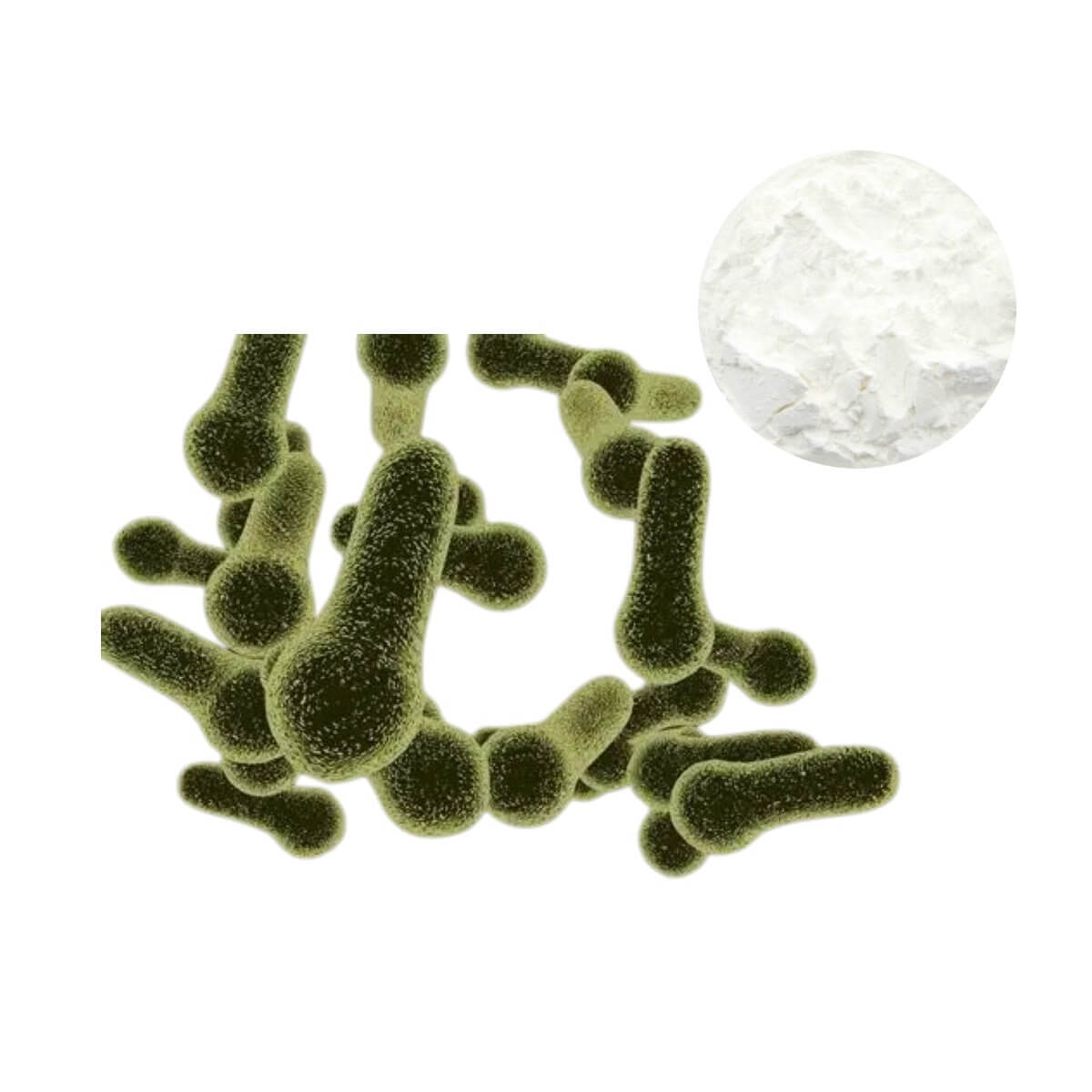
Bacillus Coagulans Probiotic Powder
| Product Name | Bacillus Coagulans Probiotic Powder |
| CAS Number | 68038-65-3 |
| Appearance | White to light yellow fine powder |
| Potency | ≥ 1.0 x 10¹¹ CFU/g (100 Billion CFU/g) |
| Packaging | 1 kg/bag, 5 kg/bag, 25 kg/drum |
| MOQ | 1 kg |
Bacillus Coagulans Probiotic: A Foundation for Stable, Multi-Functional Gut Health Formulations
For brands aiming to differentiate in the increasingly crowded digestive wellness market, traditional probiotic strains often introduce formulation trade‑offs: cold‑chain logistics, gastric sensitivity, and limited shelf life. Consumer demand for convenient, shelf‑stable supplements—gummies, bars, beverages—has made these limitations more acute. Bacillus coagulans, as a spore‑forming lactic acid bacterium, directly addresses this tension. Standardized to a minimum of 100 billion CFU/g and with a spore formation rate ≥95%, this ingredient maintains viability through tableting, encapsulation, and room‑temperature storage. The following sections translate its inherent stability into strategic advantages—guiding R&D and procurement teams through the critical decisions that de‑risk product development and accelerate market entry.
Spore Stability and Mechanistic Versatility: Beyond Simple Probiotic Support
For brands exploring new product formats, the spore biology of Bacillus coagulans is a game‑changer. Unlike vegetative probiotics that demand strict cold‑chain handling, the dormant endospore resists heat, gastric acid, and bile salts. Once in the small intestine, germination occurs, and the bacteria begin producing L‑lactic acid, short‑chain fatty acids, and enzymes that support a balanced gut microenvironment. A 2024 review in Frontiers in Cellular and Infection Microbiology (doi: 10.3389/fcimb.2024.1415790) consolidates evidence that Heyndrickxia coagulans (the re‑classified name) exhibits immunomodulatory effects and helps maintain intestinal barrier integrity. Practically, this dual action—direct gut modulation plus immune support—enables products that address both digestive comfort and general wellness, a positioning that resonates strongly with today’s health‑conscious consumers.
From a commercial standpoint, spore stability directly eliminates cold‑chain costs and opens categories where traditional probiotics cannot survive—functional foods, shelf‑stable beverages, and moisture‑sensitive bars. For procurement teams evaluating bulk Bacillus coagulans probiotic, the spore formation rate (≥95% in premium grades) becomes a non‑negotiable benchmark: it predicts the ingredient’s ability to deliver the labelled CFU through manufacturing and across a 24‑month shelf life. This consistency directly lowers the risk of batch failure and consumer complaints, translating into predictable production costs and stronger brand equity.
Defining Quality Benchmarks: What a Comprehensive COA Reveals
A certificate of analysis (COA) for Bacillus coagulans should extend beyond simple potency. While ≥1.0 x 10¹¹ CFU/g is the expected starting point, experienced formulators look for three additional parameters that signal true manufacturing excellence:
- Spore formation rate (≥95%): Confirms that the vast majority of cells are in the protective spore state, ensuring processing resilience and long‑term stability.
- Loss on drying (≤5.0%): Indicates low moisture content, critical for microbial control and shelf‑life performance.
- Heavy metals (Pb ≤1.0 mg/kg, inorganic As ≤1.0 mg/kg, Cd ≤0.5 mg/kg, Hg ≤0.5 mg/kg): These tight limits exceed many generic food‑grade specifications and reflect a commitment to purity required for global dietary supplement markets.
For a brand’s regulatory and quality teams, these parameters are the first line of defence against compliance surprises. In the U.S., several strains have FDA GRAS status; in the EU, Bacillus coagulans for food supplements is considered non‑novel following historical use data, though its use in conventional foods still requires a novel food authorisation. A thorough COA that verifies absence of pathogens (E. coli, Salmonella) and compliance with USP methods provides the documentation needed for smooth dossier submissions. Therefore, when evaluating a certified Bacillus coagulans supplier, requesting a full COA and checking these parameters is the first step in mitigating regulatory risk and avoiding costly reformulations.
Formulation in Practice: Stability, Synergy, and Dosage Insights
For in‑house formulation teams, the physical robustness of Bacillus coagulans simplifies product development. Its particle size (≥95% through 80 mesh) ensures excellent flow and uniformity in capsule and tablet blends, and it can be dry‑mixed with flavours, vitamins, and minerals for powdered beverages or functional foods. A practical insight from production environments: controlling humidity during manufacturing (keeping it below 45% RH) is more critical than opaque packaging for preserving potency, because moisture is the primary threat to spore viability over time. This nuance means that routine plant conditions, not just packaging, influence final product quality.
Clinical data help refine dosage strategies. A 2025 randomised trial in Frontiers in Immunology (doi: 10.3389/fimmu.2025.1630447) administered Bacillus coagulans to patients recovering from gynaecological laparoscopic surgery. The study observed significantly accelerated first defecation time and reduced gastrointestinal adverse events (from 38.5% in placebo to 10.5% in the high‑dose group). The dose corresponded to approximately 1–3 billion CFU per day. For general wellness products, doses between 1 and 10 billion CFU are common. The table below illustrates typical synergistic pairings that allow brands to create differentiated product concepts:
| Synergistic Ingredient | Target Benefit | Typical Ratio |
|---|---|---|
| Inulin / FOS | Prebiotic support for germination | 1:10 to 1:50 (probiotic:prebiotic) |
| Zinc | Immune and intestinal barrier support | 5–10 mg per serving |
| Digestive enzymes (protease, amylase) | Enhanced macronutrient breakdown | Variable by enzyme activity |
These combinations enable clear positioning—such as “post‑biotic + prebiotic” blends or immune‑gut complexes—without compromising the probiotic’s viability. For marketing teams, such substantiated synergies provide compelling claims that resonate with informed consumers.
Mitigating Risk: A Sourcing Checklist for Bacillus Coagulans
Selecting a Bacillus coagulans supplier involves more than comparing price per kilogram. The following checklist, distilled from industry best practices, helps procurement and quality teams evaluate potential partners objectively:
- Full traceability: Does the supplier provide batch‑specific COAs with test methods (USP, AOAC, etc.)? Can they trace raw materials back to fermentation records?
- GMP compliance: Is the manufacturing facility GMP‑certified for dietary supplements? This ensures consistent quality and adherence to hygiene standards.
- Stability data: Request accelerated and real‑time stability studies that support the claimed 24‑month shelf life under recommended storage conditions.
- Regulatory support: Can the supplier provide technical dossiers for GRAS, Novel Food, or other regional filings? This reduces the burden on your own regulatory team.
- Consistency across lots: Ask for COAs from three different production batches to verify that spore rate and CFU count remain within tight specifications.
For brands sourcing Bacillus coagulans for gut health or sports nutrition applications, partnering with a supplier who routinely meets these criteria directly lowers the risk of product failure, recall, or non‑compliance. The total cost of ownership—including potential reformulation costs and lost market time—far outweighs any upfront price difference. From a strategic standpoint, a reliable supply chain also protects brand reputation and ensures continuity for fast‑growing product lines.
Next Steps for Your Product Development
Bacillus coagulans offers a scientifically validated, stable, and versatile foundation for digestive and immune health products. Its spore biology ensures that the benefits observed in clinical trials can be reliably delivered to consumers, while its compatibility with various formats and ingredients supports rapid innovation. To move from concept to commercial reality, the next step is to evaluate a sample and its accompanying technical documentation firsthand. Request Your Complimentary Sample & Technical Dossier to review full COAs, stability data, and formulation guidance—everything needed to de‑risk your sourcing decision and accelerate your next product launch.
Frequently Asked Questions
Share this product
Related Products
Ready to get started?
Contact our team for technical specifications, pricing, and customized solutions.