
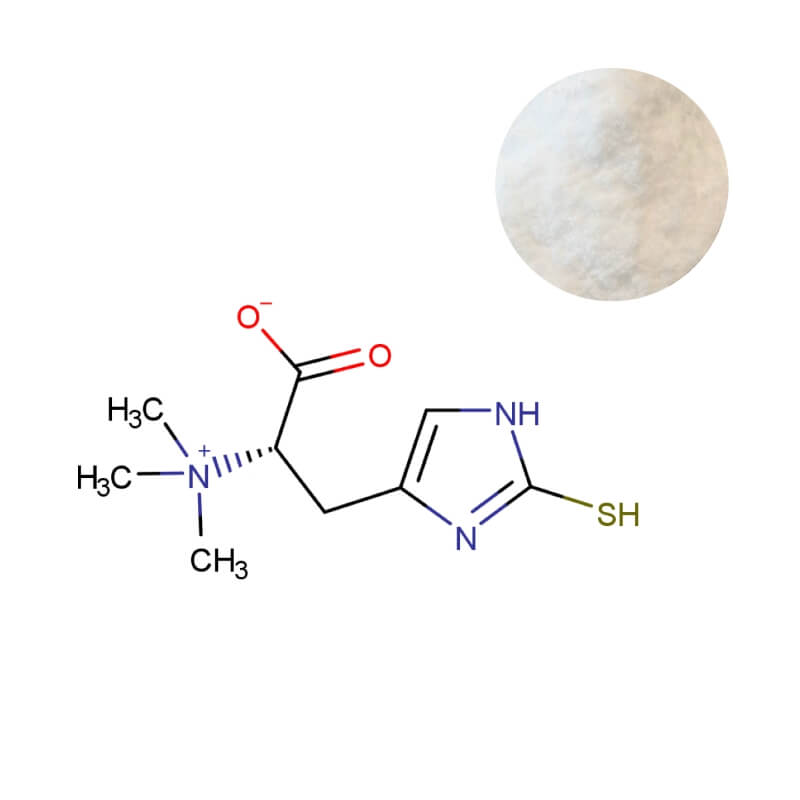
L-Ergothioneine Powder
| Product Name | L-Ergothioneine Powder |
| CAS Number | 497-30-3 |
| Appearance | White to off-white crystalline powder |
| Purity | ≥ 99.0% (by HPLC) |
| Packaging | 1 kg/bag, 5 kg/bag, 25 kg/drum |
| MOQ | 1 kg |
High-Purity Fermented Ergothioneine Powder for Cognitive Health & Premium Supplement Formulations
Formulating premium cognitive health supplements demands a clinically validated active ingredient capable of justifying premium retail positioning. Sourcing bulk L-Ergothioneine Powder from a reliable L-Ergothioneine supplier directly impacts formulation success, yet the ingredient's value lies not in its mere presence but in its verified enantiomeric purity and documented clinical endpoints. A wholesale partner providing lot-to-lot COA consistency and audit-ready supply chain protocols transforms R&D validation into a competitive market advantage—compressing development timelines while maintaining regulatory safety across multiple jurisdictions.
Clinical Evidence and DTC Claim Architecture for Cognitive Resilience
Transitioning from a generic antioxidant to a scientifically backed longevity ingredient requires establishing a robust clinical evidence chain that directly supports DTC marketing claims. The compound's unique absorption pathway via the OCTN1 transporter and its selective accumulation in mitochondria and the brain provide a mechanistic foundation for cognitive resilience claims. A comprehensive review synthesizes observational data associating low blood ergothioneine levels with cognitive impairment and neurodegenerative risks, alongside interventional trials demonstrating improved memory and sleep quality with no adverse effects at doses up to 25 mg/day. This evidence positions the ingredient for premium "cellular defense" and "healthy aging" narratives (Proceedings of the Nutrition Society, 2025; doi: 10.1017/S0029665125101754).
- Observational data consistently link low plasma EGT with cognitive decline, cardiovascular disorders, and frailty.
- Intervention trials (8-16 weeks) confirm subjective cognitive and sleep quality improvements (p < 0.05).
- Mechanisms encompass oxidative stress mitigation, neuroinflammation reduction, and mitochondrial preservation.
These validated clinical endpoints empower brands to deploy compliant structure/function claims such as "supports healthy brain aging" and "promotes cellular resilience against oxidative stress." This scientifically defensible positioning reflects the premium market value of fermentation-derived EGT (global average of $23.4/g for raw material), creating a compelling commercial justification for investing in high-purity material over cheaper synthetic analogs.
Innovative Dosage Forms and Synergistic Formulation Engineering
Clinical efficacy must translate into stable, consumer-friendly finished products, yet L-Ergothioneine's sensitivity to oxidation and thermal degradation complicates formulation. Moving beyond basic capsules, the ingredient demonstrates exceptional potential in next-generation softgels, gummies, and ready-to-drink (RTD) beverages. A systematic formulation study on emulgel systems evaluated nine oil-gelling agent combinations, identifying Carbopol 934 with liquid paraffin as delivering superior drug-release performance in the pH 5.5-6.5 range, providing a clear blueprint for semi-solid dosage formats (EPJ Web of Conferences, 2026; doi: 10.1051/epjconf/202634801008).
Synergistic stacking with reduced glutathione and PQQ establishes a foundational mitochondrial support network, while integrating CoQ10 (Ubiquinone) further reinforces cellular energy metabolism. For gummy applications, microencapsulated EGT combined with ascorbic acid preserves potency during high-temperature processing, and liquid stick packs benefit from chelating agents that stabilize the thione group against metal-ion catalyzed degradation. This formulation versatility enables brands to target diverse consumer demographics—from senior nutrition with high-potency softgels to active lifestyle RTD beverages. The ability to innovate beyond standard tablets provides a distinct SKU differentiation advantage, capturing emerging market segments where convenience and novel delivery systems command premium pricing.
CMO Line Adaptation and Air-Freight Stability Assurance
Innovative formulations are only as viable as their manufacturability at scale; the physical characteristics of the raw powder often dictate success or failure on commercial production lines. High-purity crystalline EGT (≥99% HPLC) provides a distinct advantage in automated manufacturing. The following table maps specific physical parameters to measurable CMO efficiency gains and financial savings:
| Physical Parameter | Specification | CMO/Production Efficiency Gain |
|---|---|---|
| Bulk Density | 0.40-0.70 g/mL | Enables direct compression; eliminates secondary granulation (reduces production time and raw material loss). |
| Angle of Repose | Ideally < 35° | Ensures consistent die fill in high-speed capsule/tablet presses; minimizes equipment stoppages. |
| Particle Size | ≥95% through 80 mesh | Promotes uniform blending with excipients; prevents content uniformity failures. |
| Loss on Drying | ≤ 0.5% | Prevents moisture-induced sticking during compaction; reduces cleaning downtime. |
The crystalline nature also minimizes hygroscopicity during air freight, where pressure fluctuations and tarmac temperature extremes often degrade less stable powders. Optimizing these parameters allows formulators and procurement directors to compress process validation timelines by an estimated 8-12 weeks through first-pass quality approval. This physical robustness protects supply chain integrity against in-transit degradation, lowers rejection rates, and preserves inventory investment.
Global Regulatory Pathways and ADI-Compliant Labeling Frameworks
Manufacturing efficiency is wasted if market access is blocked by regulatory non-compliance; understanding the global legal landscape is paramount for a successful launch. The regulatory status of Fermented Ergothioneine is highly evolved yet fragmented across key regions. In the EU, it holds Novel Food status (Commission Implementing Regulation 2018/462) with a strict ADI of 30 mg/day for adults. In the US, GRAS status allows broad application in foods and supplements. China's National Center for Food Safety Risk Assessment opened public consultation in April 2026—subject to final regulatory approval following the consultation, commercial availability could potentially begin in 2027.
- EU (Novel Food): ADI of 30 mg/day for adults; 20 mg/day for children over 3 years.
- US (FDA GRAS): Self-affirmed GRAS notices (e.g., GRN #734, #1191) support broad dietary use.
- China (Pending): Public consultation finalized April 2026; legal sale for food use contingent on final approval.
Brands must program these ADI limits into their formulation calculators to avoid labeling violations that trigger customs detention. This compliance-first approach mitigates the financial risk of rejected shipments and supply chain delays. Moreover, aligning finished product claims strictly with approved structure/function language—such as "supports neurological health" for US markets—navigates the regulatory minefield, enabling smooth customs clearance and building long-term brand equity through rigorous adherence to global food safety standards.
Chiral Authentication and Supply Chain Traceability for Brand Protection
Navigating complex regulations and scaling production provides entry, but protecting the brand's reputation in a market with rising counterfeit risks requires a final, impenetrable quality moat. The optical rotation of authentic L-Ergothioneine is the definitive chemical fingerprint against synthetic racemic mixtures or adulterated substitutes. Commercial batches should consistently exhibit specific rotation of ≥ +122° (c=1, H2O).
- Specific Rotation: ≥ +122° ensures 100% bioactive L-enantiomer identity.
- Heavy Metal Guardrails: Pb ≤1.0 ppm, As ≤1.0 ppm, Hg ≤0.1 ppm ensure global safety compliance.
- Residual Solvent Control: Compliance with USP <467> confirms USP-compliant processing standards.
Automated polarimetry on every production lot ensures that every shipment is chemically authentic. This forensic-level authentication provides brands with an "anti-copycat shield," allowing them to market their finished goods with verified 100% bioidentical L-form claims—a competitive advantage that chemically impossible for competitors using lower-cost racemic alternatives. This traceability, from fermentation to final batch, builds lasting brand integrity and consumer trust. Batch-to-batch polarimetry verification, combined with third-party heavy metal and residual solvent screening, defines specification-grade material meeting Oclean Nutra quality benchmarks for global brand protection programs.
Accelerating R&D Validation with Full Technical Dossiers and Sample Trials
Verifying these technical attributes independently is the critical bottleneck for R&D teams and procurement officers. Instead of lengthy back-and-forth, initiating the qualification process through a streamlined sampling program eliminates uncertainty. Each sample request is paired with a comprehensive technical dossier, including batch-specific HPLC chromatograms, heavy metal ICP-MS reports, and optical rotation certificates. This approach directly eliminates the 4-6 week delay typically associated with supplier onboarding and external laboratory validation, allowing product development to proceed immediately with confidence in the material's compliance and physical integrity.
Request a certified bulk L-Ergothioneine Powder sample with documentation to accelerate your formulation project and secure supply chain reliability from the first trial batch.
Frequently Asked Questions
Share this product
Related Products

Ready to get started?
Contact our team for technical specifications, pricing, and customized solutions.