
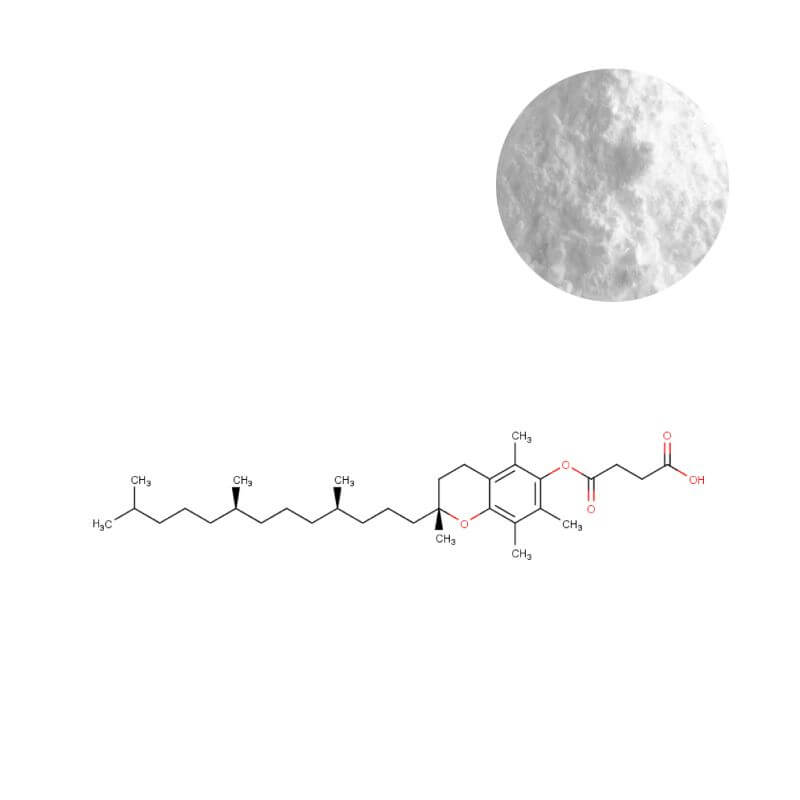
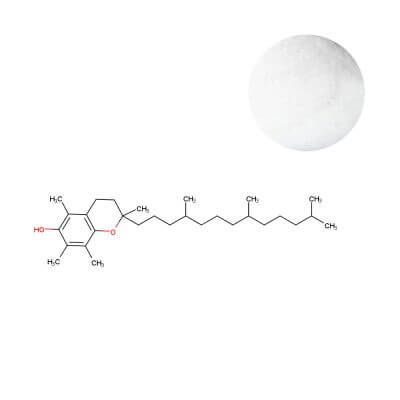
Vitamin E Succinate Powder
| Product Name | Vitamin E Succinate Powder |
| CAS Number | 4345-03-3 |
| Appearance | White to off-white crystalline powder |
| Potency | 1185 IU/g, 1210 IU/g |
| Packaging | 1 kg/bag, 5 kg/bag, 25 kg/drum |
| MOQ | 5 kg |
Crystalline Vitamin E Succinate Powder for Premium Tableting and Clean-Label Formulations
Bulk Vitamin E Succinate Powder bypasses the oily constraints of standard tocopherols, opening direct-compression tableting and hard-capsule filling as a spec-verified distributor alternative. The core commercial dividend unlocks premium DTC positioning around mitochondrial bioenergetics and cellular integrity, while rigorous lot-to-lot COA enforcement delivers procurement risk mitigation and audit-ready traceability for global brand owners seeking formulation exclusivity.
Bioenergetic Mechanisms and Structure-Function Claim Architecture
Transitioning from procurement risk to clinical credibility, the differentiation of this ingredient hinges on the succinate moiety itself. Unlike free tocopherols, the succinate ester feeds directly into the Krebs cycle, generating cellular energy while simultaneously providing potent free-radical scavenging activity. Human serum response data (Horwitt et al., 1984) quantify a 41.2% increase in α-tocopherol concentration within 24 hours post-ingestion of the succinate ester, while Cheeseman et al. (1995) independently confirmed a relative bioavailability ratio of 1.0 versus the acetate form. This dual mechanism allows formulators to bypass generic "antioxidant" claims and target sophisticated DTC narratives around "cellular energy support" and "mitochondrial integrity." For the brand owner, this translates into a defendable premium pricing tier, distancing the finished product from commoditized vitamin E oils and establishing a science-backed narrative that resonates with discerning consumers willing to pay a premium for validated bioefficacy.
Key validated DTC claim zones for this crystalline format include:
- Cellular Protection & Immune Vigilance: Directly supports the neutralization of reactive oxygen species (ROS) in lipid membranes, forming the basis for immune health positioning.
- Cardiovascular & Endothelial Support: Helps maintain the structural integrity of vascular tissues by inhibiting LDL oxidation, a core metric for heart health formulations.
- Healthy Aging & Neurological Integrity: Supports neuronal cell membrane fluidity, providing a foundational claim for age-related cognitive wellness products.
Cyclodextrin Complexation and Synergistic Pairing for High-Loading Delivery
Having established robust clinical credibility, the next formulation hurdle involves overcoming the intrinsic water insolubility of the crystalline ester to achieve consistent systemic delivery. The 2026 characterization study on VES-cyclodextrin inclusion complexes provides a pivotal solution, demonstrating an AL-type phase solubility profile that elevates aqueous solubility from negligible levels to quantifiable, formulation-friendly ranges via DSC-confirmed thermal stability enhancement. This technology directly enables the development of high-growth finished formats such as transparent ready-to-drink (RTD) beverages, rapid-dissolve powders, and high-potency gummies. To maximize synergies, formulators should pair this VES-CD complex with high-purity ascorbic acid (USP-grade, 80-mesh) to regenerate tocopherol activity, and selenium (as L-selenomethionine, ≥98.0%) to provide complementary glutathione peroxidase pathways. For the product manager, this translates into a distinctive market edge: launching a stable, water-compatible Vitamin E product while competitors remain stuck with oily, limited-format releases, effectively shortening TTM by eliminating complex emulsification troubleshooting. The feasibility of this complexation pathway is supported by recent physicochemical evidence (Journal of Molecular Structure, 2026; doi: 10.1016/j.molstruc.2026.146779).
Particle Engineering and CMO Line Integration for Accelerated TTM
While innovative complexation drives consumer appeal, the economic viability of these formats depends entirely on factory-floor physics. The solid crystalline nature of this raw material (melting point range of 73°C-78°C, bulk density 0.45-0.60 g/mL) presents a distinct advantage over liquid alternatives, yet requires precise engineering to prevent cohesive clumping during high-speed rotary pressing. Specifically, the standard particle size distribution (≥95% through 80 mesh) ensures uniform die-filling, while the anti-adherent properties of the ester eliminate sticking to punch faces-a frequent cause of catastrophic downtime with lower-melting-point variants. For the CMO, these parameters translate into the elimination of costly secondary granulation steps, allowing direct compression (DC) processing that, by industry estimates, boosts line speeds by 30-40%. This engineering efficiency cascades directly to the brand owner: reducing scrap rates, lowering per-unit labor costs, and compressing the typical pilot scale-up phase from 12 weeks down to 3-4 weeks, thereby accelerating retail shelf placement and capturing early-mover advantages in trending supplement categories.
CMO Production Readiness Checklist for this crystalline format:
- Direct Compression (DC) Suitability: Bypasses wet granulation, reducing energy consumption and processing time.
- Thermal Stability (75°C Melting Point): Mitigates sticking and picking on high-speed rotary presses operating at ambient pressures.
- Uniform Flow Dynamics: Requires minimal glidant modification (e.g., ≤0.5% silica) to maintain optimal hopper flow rates.
Global Regulatory Clearance and Clean-Label Claim Safety Zones
Having secured manufacturing efficiency, the ability to legally access global markets dictates ultimate revenue potential. This crystalline succinate ester is firmly established within the FDA GRAS framework for dietary supplements, fully compliant with USP/EP monographs, and complies with EU Regulation (EC) 1881/2006 on contaminant limits in food matrices. Critically, the synthetic esterification process ensures the absence of chlorinated hydrocarbons and keeps residual solvents strictly within USP <467> limits (Class 3 solvents ≤5,000 ppm). For the quality assurance director, the definitive advantage lies in verifiable compliance metrics: heavy metals controlled at Pb ≤1.0 mg/kg, As ≤1.0 mg/kg, and a maximum Benzo[a]pyrene limit of ≤2 ppb as specified under the EU PAH regulatory framework (EC 1881/2006). Meeting these stringent thresholds directly compresses customs clearance cycles and neutralizes port-of-entry detention risks for finished goods. This regulatory clarity empowers the compliance team to fast-track international registrations, avoiding the 6-18 month novel food application delays that plague new chemical entities, while the "clean-label" identity allows brands to prominently display a "Non-GMO" and "Synthetic Solvent-Free" badge on packaging, justifying a significant retail markup.
| Market | Regulatory Status | Key Compliance Threshold (Audit Target) |
|---|---|---|
| United States (FDA) | GRAS / Dietary Supplement | 21 CFR 211 (cGMP), USP Monograph |
| European Union (EFSA) | Permitted Food/Supplement Ingredient | EC 1881/2006 (PAHs), EC 1169/2011 Labeling |
| International (Codex) | Accepted Vitamin E Source | JECFA Specifications, FCC Compliance |
Total Cost of Ownership Optimization and Supply Chain Resilience
With regulatory gates wide open, the final arbitrage for procurement chiefs lies in total cost of ownership (TCO). Because this ingredient is supplied as a dense, stable crystalline powder, it entirely eliminates the complex, costly adsorption or microencapsulation steps required to handle liquid tocopherols. This singular physical trait delivers a cascading TCO reduction: no expensive excipients (like silica or starch) needed to convert a liquid to a powder, vastly lower freight volumes (reducing shipping weight and class), and a full 24-month shelf life that minimizes inventory write-offs. Furthermore, the 75°C melting point acts as a natural physical buffer against "clumping" during summer air-freight in low-pressure cargo holds, drastically reducing return rates and logistical friction. For the procurement director, this translates into direct margin expansion of 4-6% per unit, while the commodity-grade stability ensures multi-source supply chain resilience, mitigating the volatility associated with specialized fermentation or complex extraction processes that plague other novel antioxidants. The resultant cost structure-verified through specification-grade material protocols meeting Oclean Nutra quality benchmarks-offers procurement leaders a defensible financial model against volatile feedstock markets.
Strategic supply chain financial benefits realized:
- Freight & Storage Efficiency: Solid morphology reduces logistics volume and minimizes expensive cold-chain requirements.
- Process Elimination Savings: Removes the cost of adsorbents and the capital expense of microencapsulation spray drying.
- Risk Mitigation (Shelf-Life): 24-month stability data guarantees minimal expiry-related inventory loss.
Accelerated R&D Verification and Sample Procurement Protocol
Transitioning from technical dossier review to commercial production requires decisive physical validation. Requesting a sample immediately bypasses the standard 8-week vendor qualification bottleneck by providing the complete technical infrastructure for immediate evaluation. Each sample shipment is accompanied by the full compliance package, including 3-Lot COAs, accelerated stability data, and the master regulatory dossier.
Verify Vitamin E Succinate Powder technical dossier to directly streamline R&D validation and procurement assessment.
Frequently Asked Questions
Share this product
Related Products
Ready to get started?
Contact our team for technical specifications, pricing, and customized solutions.