
EAA vs. BCAA: Decoding the Shift in Muscle Protein Synthesis Formulas for 2026
The sports nutrition market is shifting toward Essential Amino Acids (EAAs). This article analyzes latest clinical evidence and market trends to help brand owners and R&D directors formulate high-efficacy muscle health products for 2026.
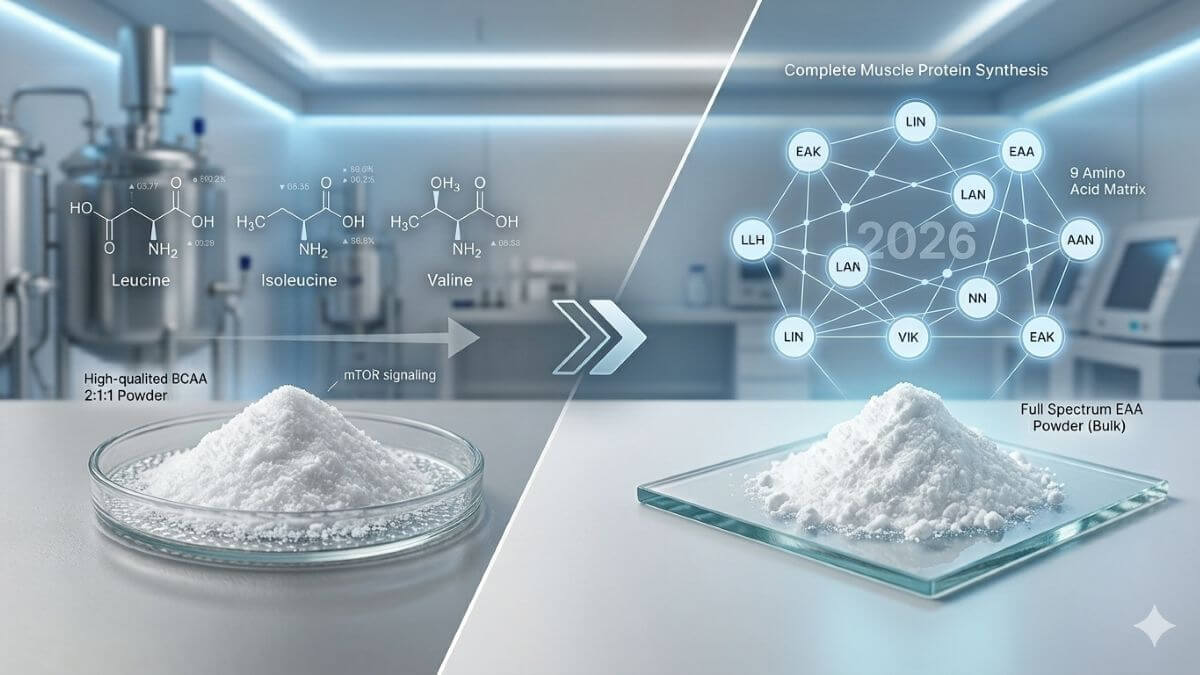
The sports nutrition landscape is currently undergoing a significant paradigm shift. For decades, Branched-Chain Amino Acids (BCAAs) have been the undisputed cornerstone of the amino acid supplement category, lauded for their ability to trigger muscle protein synthesis (MPS). However, as we look toward 2026, market data and emerging clinical research suggest a decisive transition toward Essential Amino Acids (EAAs). This evolution is driven by a more sophisticated understanding of "complete nutrition" among both professional athletes and the expanding "active aging" demographic. For brand owners and R&D directors, understanding this transition is a strategic necessity to maintain market relevance and meet the rising consumer demand for efficacy and transparency.
Current market projections indicate that while the BCAA segment remains a multi-billion dollar industry, its growth rate is being eclipsed by the double-digit CAGR of EAA-based formulations. This shift reflects a broader movement within the global health and wellness industry: the transition from "singular stimulants" to "holistic recovery." This article examines the scientific, market, and technical factors driving this change, providing procurement and product development teams with the insights needed to navigate the next generation of anabolic nutrition.
The Science of Anabolism: Why the "Leucine Trigger" Isn't Enough
To understand why the industry is moving toward EAAs, it is essential to revisit the fundamental mechanics of muscle protein synthesis. Historically, BCAAs—comprising Leucine, Isoleucine, and Valine—were prioritized because Leucine acts as a primary signaling molecule that activates the mTOR pathway. This "anabolic switch" is critical; however, a growing body of evidence suggests that flipping the switch is ineffective if the "building blocks" are missing. Scientific consensus is now shifting toward the following core realizations:
- The Substrate Limitation: While BCAAs initiate the signaling process, the absence of the other six essential amino acids limits the actual rate of new muscle tissue formation. From a formulation standpoint, this means a BCAA-only product acts like a light switch with no electricity; the signal is sent, but the raw material for construction is absent.
- Catabolic Attenuation: Clinical evidence suggests that EAAs uniquely suppress protein degradation. A 2022 randomized crossover study demonstrated that EAA ingestion facilitates better leucine utilization and significantly attenuates myofibrillar protein breakdown compared to BCAA (doi: 10.3390/nu14173532).
- Sustainability of Synthesis: Pure BCAA intake may lead to a transient spike in MPS. Without a full spectrum of amino acids, however, the body may pull from endogenous protein stores to complete the synthesis process.
Direct Clinical Comparison: EAA vs. BCAA Performance
To provide product developers with quantitative insights, the table below summarizes the key findings from two pivotal randomized controlled trials (RCTs) comparing EAA and BCAA supplementation, including the latest 2025 dileucine data.
| Parameter | Study 1 (2025) doi: 10.1080/15502783.2025.2590090 |
Study 2 (2022) doi: 10.3390/nu14173532 |
|---|---|---|
| Design | Randomized, double-blind, crossover; 12 healthy adults after resistance exercise | Randomized, double-blind, crossover; 12 young adults after bodyweight exercise |
| Comparators | Dileucine-enriched EAA (DIEAA) vs. BCAA vs. Collagen | EAA+ (9g EAA + 3g leucine) vs. BCAA (6g BCAA + 3g leucine) |
| Leucine Retention (Whole-body anabolism) | No significant difference (both > control) | No significant difference (both > placebo) |
| Muscle Protein Synthesis (MPS) | DIEAA showed a medium effect size advantage over BCAA (dz = 0.81) | Not measured |
| Muscle Protein Breakdown (3MH:Cr Ratio) | No significant difference | EAA+ reduced breakdown by 23% compared to BCAA (p = 0.026) |
What this means for brands: The 2022 study reveals a distinct advantage of EAA: a 23% reduction in myofibrillar protein breakdown compared to an equivalent BCAA dose. This insight shifts the narrative for brand developers: the goal is no longer just "triggering growth," but "preventing loss." In a market where recovery speed is the ultimate currency, providing a comprehensive anti-catabolic shield is a much stronger value proposition than traditional MPS stimulation alone.
Market Dynamics: Identifying the 2026 Growth Segments
The consumer base for amino acid supplements has expanded far beyond the bodybuilding community. Today, the target audience is highly fragmented, requiring brands to tailor their ingredient choices to specific lifestyle needs. As we move toward 2026, three primary market drivers are pushing the adoption of EAA Powder:
- The "Silver Economy" and Sarcopenia: Older adults are increasingly focused on preventing age-related muscle loss. EAAs are perceived as a more "medical-grade" and complete solution for maintaining functional mobility compared to traditional gym-focused BCAAs.
- The Rise of Intra-Workout Hydration: Consumers are moving away from stimulant-heavy pre-workouts toward "functional hydration" during exercise. EAAs fit perfectly into this "sip-all-day" category.
- Clean Label Transparency: Modern consumers demand to know the origin and completeness of their protein sources. EAAs provide a more transparent and scientifically sound profile for those scrutinizing nutritional labels on platforms like TikTok and Instagram.
The takeaway for procurement teams is clear: while BCAA remains a reliable volume driver for cost-conscious entry-level lines, the high-margin growth for 2026 lies in the premium EAA space. Brands that fail to transition their "Pro" or "Elite" lines to a full EAA profile risk being viewed as scientifically outdated by an increasingly literate consumer base.
Overcoming Physical Barriers: Solubility and the Rise of Instantization
Market data explains why brands should switch, but technical challenges often dictate how. Historically, the poor physical properties of Leucine have been a major barrier. As a naturally hydrophobic ingredient, raw BCAA powder often results in clumping and poor mouthfeel. To capture the premium segment, technical innovation has focused on surface-active treatments. Consequently, the shift toward Instantized BCAA 2:1:1 Powder has become the industry standard for several technical reasons:
- Rapid Dispersion: Micro-coating particles with emulsifiers like sunflower lecithin allows the powder to wet and disperse in cold water within 10-30 seconds.
- Improved Sensory Profile: High-quality instantization reduces the "chalky" texture and bitter aftertaste associated with poorly dissolved amino acids.
- Manufacturing Efficiency: Instantized materials reduce blending time and prevent equipment clogging during high-speed packaging.
This means that "Instantized" is no longer a premium feature—it is a baseline requirement. For R&D managers, choosing non-instantized materials to save on COGS often backfires through increased processing costs or poor consumer reviews due to "floaties" in the shaker bottle. As we move into 2026, this standard is extending to EAA blends. The technical complexity of balancing nine different solubility profiles requires even more sophisticated supplier expertise.
Formulating for 2026: Balancing Cost, Efficacy, and Innovation
While EAA raw materials are typically more expensive due to the complexity of sourcing amino acids like Tryptophan and Methionine, the premium price point at retail often offsets these costs. Innovation is also occurring in the "hyper-advanced" category, where brands are looking for a competitive edge to justify these higher prices. For R&D teams, Study 1 (2025) signifies that the "EAA vs. BCAA" debate is only the beginning; the next era is about "Functional Bio-availability." Strategies to consider include:
- The Hybrid Approach: Combining a high-ratio BCAA with a base EAA profile to satisfy both traditional signaling and modern building-block requirements.
- Advanced Peptide Bonds: Incorporating dileucine to increase cellular uptake and metabolic efficiency.
- Application Diversification: Adapting these ingredients for "clear" beverages and gummies, where thermal stability and acidity-tolerance are paramount.
The core conclusion for product innovators: The winners in 2026 will not be those with the longest ingredient list, but those who can most effectively solve the "bio-availability gap" while maintaining a clean sensory profile.
Sourcing Excellence: A Critical Checklist for B2B Procurement
As global regulations tighten, particularly regarding heavy metal limits and microbial standards, evaluating a supplier requires a rigorous framework. Brand owners should focus on the following criteria when selecting an amino acid partner:
- Manufacturing Origin: Is the material derived from high-efficiency fermentation (vegan-friendly) or chemical synthesis?
- Technical Documentation: Does the supplier provide a comprehensive COA for every batch, including standardized impurity profiles and allergen statements?
- Supply Chain Transparency: Can the supplier guarantee consistent lead times and provide proof of GMP-compliant manufacturing environments?
- Sustainability Metrics: Is the production process optimized for water and energy conservation?
Ultimately, a supplier is no longer just a vendor of powder; they are a guardian of your brand's regulatory and reputational safety. Transparency in the supply chain ensures that the declared nutritional profile remains consistent throughout the product's shelf life, protecting the brand from the rising tide of consumer litigation and regulatory scrutiny.
Conclusion: The Shift Is Real—Prepare Your Portfolio
The evidence is clear: while BCAA will continue to serve a segment of the market, EAA formulations offer a scientifically superior profile for demanding consumers. Two recent RCTs confirm that EAA not only matches BCAA in supporting anabolism but also uniquely attenuates muscle breakdown—a dual action that resonates across sports, weight management, and healthy ageing categories. As you plan your 2026 product roadmap, consider incorporating both instantised BCAA for accessible, high-solubility options and fully profiled EAA for premium, evidence-driven lines. For detailed technical data, COAs, and formulation guidance, explore our product pages or reach out to our technical team.
Share this article
Found this helpful? Share it with others!
Related Products
Products mentioned in this article
Want to learn more?
Explore our products or contact our team for personalized solutions and expert advice.