
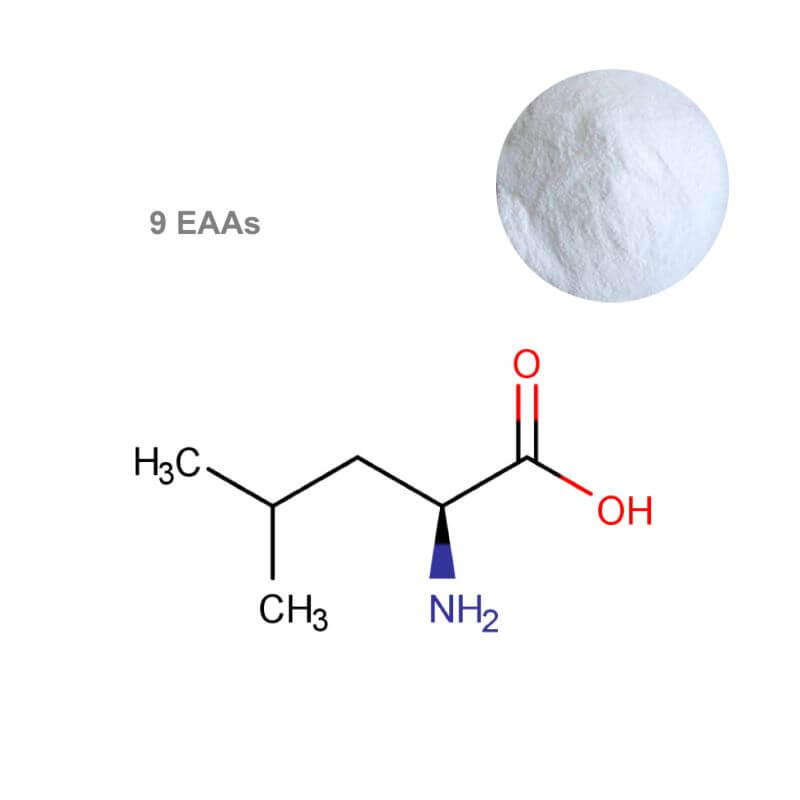
EAA Powder
| Product Name | EAA Powder (Essential Amino Acids Blend) |
| CAS Number | Multiple (Individual components: 61-90-5, 72-18-4, 73-32-5, etc.) |
| Appearance | White to off-white crystalline powder |
| Purity | 98% min. Total Amino Acids (HPLC-verified) |
| Packaging | 1 kg/bag, 5 kg/bag, 25 kg/drum |
| MOQ | 1 kg |
EAA Powder: Essential Building Blocks for Muscle Health and Recovery Formulations
For brands developing next‑generation sports nutrition or healthy aging products, the challenge is no longer simply adding protein—it is delivering precise, fast‑acting support for muscle protein synthesis. Consumer demand for cleaner labels, vegan‑friendly sources, and scientifically backed efficacy has raised the bar. Essential Amino Acids (EAAs) have emerged as a cornerstone of premium formulations, offering a complete profile of the nine amino acids the body cannot produce on its own. A premium EAA ingredient—such as the ≥98% purity, instantized powder derived from microbial fermentation—provides formulators with a versatile, highly soluble base that ensures rapid absorption and batch‑to‑batch consistency, as documented in comprehensive Certificates of Analysis (COA). This article translates these considerations into actionable insights for your product development roadmap—from underlying mechanisms and quality benchmarks to practical formulation and resilient sourcing.
Science‑Driven Muscle Support: How EAAs Drive Anabolism Beyond Whole Proteins
The superiority of EAAs over intact proteins or branched‑chain amino acids (BCAAs) alone lies in their direct role as both substrates and signals for muscle protein synthesis (MPS). Leucine, in particular, activates the mTORC1 pathway, triggering the translation machinery that builds new muscle tissue. A recent randomized controlled trial demonstrated that a low‑dose (3.6 g) EAA blend enriched with leucine significantly increased postprandial MPS in older individuals, with approximately 80 % of the ingested amino acids incorporated into new protein (doi: 10.3389/fnut.2024.1360312). This efficiency is clinically meaningful: even a moderate serving can deliver measurable anabolic benefits—a key consideration for formulating cost‑effective yet potent products. For brands targeting the healthy aging demographic, this low‑dose efficacy opens opportunities to formulate accessible daily wellness products that still deliver clinically meaningful benefits.
For active populations, the anabolic response is equally compelling. Another 2025 study found that supplementation with an EAA formula containing dileucine after resistance exercise produced a large effect size on mixed muscle protein synthesis compared with collagen (dz = 1.47) and a moderate effect versus BCAAs alone (dz = 0.81) (doi: 10.1080/15502783.2025.2590090). The practical implication for brands is clear: using a complete, high‑quality EAA ingredient enables formulations that deliver superior recovery and muscle‑building benefits—benefits that resonate with both serious athletes and aging consumers seeking to maintain function. These comparative effect sizes provide your marketing team with compelling differentiation points when positioning your product against standard BCAA offerings. From a product development standpoint, this science supports claims around "accelerated recovery" and "muscle preservation" without venturing into drug‑like language.
Quality Benchmarks: Defining a Premium EAA Ingredient
When sourcing bulk EAA powder, the distinction between a commodity ingredient and a premium one hinges on a few critical, verifiable parameters. The first is purity. A specification of ≥98 % total amino acids, confirmed by HPLC, ensures that what you are paying for is the active material, not fillers or by‑products. The second is physical form: an instantized, readily dispersible powder (≥95 % through 80 mesh) guarantees ease of use in ready‑to‑mix powders and ready‑to‑drink liquids, eliminating clumping and improving consumer experience. Third, the source matters: microbial fermentation (vegan‑friendly) avoids allergens associated with animal‑derived amino acids and provides a clean, traceable origin.
These quality indicators are not abstract; they are quantified in the batch‑specific COA that a reliable EAA powder supplier provides. Key sections to scrutinize include:
- Assay / Purity: ≥98 % total amino acids (HPLC) – confirms potency.
- Physical properties: Loss on drying ≤1.0 % (USP <731>) – ensures stability and resistance to microbial growth.
- Heavy metals: Pb ≤1.0 mg/kg, As ≤1.0 mg/kg, Cd ≤0.5 mg/kg, Hg ≤0.1 mg/kg (ICP‑MS) – guarantees compliance with global supplement safety standards.
- Microbiological profile: Total plate count ≤1,000 CFU/g, absence of pathogens – essential for GMP‑certified production.
These parameters serve as the foundation for your own quality claims—each a verifiable point of trust that can be highlighted on product labels and marketing materials. For brands, a certified COA from a GMP‑adherent distributor reduces regulatory risk and supports confident marketing of a clean, safe ingredient. It also streamlines your incoming inspection process, easing the burden on internal quality assurance teams.
Formulation Flexibility: Integrating EAA into Modern Delivery Systems
The true value of an instantized EAA powder reveals itself during formulation. Because it disperses readily in water without excessive stirring, it is ideal for stick packs, tablets, and even clear RTD beverages—a format gaining popularity for its refreshing, non‑milky appearance. Practical formulation considerations include:
- Dosing: Clinical studies typically employ doses ranging from 6 to 15 g per serving. The low‑dose efficacy data (doi:10.3389/fnut.2024.1360312) suggest that even 3.6 g can be effective for specific populations, offering flexibility in positioning.
- Synergy: EAAs work well with electrolytes (for hydration formulas), vitamins, and targeted ingredients like l-citrulline or betaine for enhanced performance blends. They also complement plant proteins to improve amino acid profiles.
- Stability: The low moisture content (≤1.0 %) and absence of reactive impurities make this ingredient compatible with most excipients. However, in high‑humidity environments, it is advisable to process rapidly and use moisture‑barrier packaging to maintain flowability.
An effective formulation often combines EAAs with a rapid‑release carbohydrate source to stimulate insulin, further driving amino acid uptake. This synergy can be presented in a simple table for formulators:
| Ingredient Pairing | Rationale | Typical Use Level (per serving) |
|---|---|---|
| EAA Powder + Dextrose | Insulin spike enhances amino acid uptake into muscle | 10‑15 g EAA + 20‑30 g dextrose |
| EAA Powder + Electrolytes (Na, K) | Supports hydration during endurance exercise | 5‑10 g EAA + 200‑400 mg sodium |
| EAA Powder + Vitamin D3 | Synergistic support for muscle function and bone health | 5‑10 g EAA + 25‑50 mcg D3 |
These combinations allow brands to create differentiated products targeting recovery, hydration, or daily wellness—all while leveraging the same high‑quality EAA base. The table illustrates how a single EAA ingredient can anchor multiple product concepts, from high‑performance recovery blends to everyday hydration formulas. This versatility simplifies inventory management while allowing your brand to address diverse consumer needs with a consistent, validated core.
Strategic Sourcing: Ensuring Supply Chain Reliability and Cost Efficiency
In the B2B ingredient market, the total cost of ownership extends far beyond the price per kilogram. A dependable EAA powder exporter or supplier provides value through consistent quality, transparent documentation, and supply security. When evaluating partners, consider the following checklist:
- Full disclosure COA: Does the COA include all relevant parameters (assay, heavy metals, microbiology, residual solvents)?
- GMP certification: Is the supplier’s facility certified to current Good Manufacturing Practices, ensuring consistent production standards?
- Traceability: Can the supply chain be audited back to the fermentation source? This is increasingly important for clean‑label positioning.
- Inventory and lead times: Does the supplier maintain safety stock to protect against disruptions?
Evaluating suppliers against these criteria ensures that you are securing a partnership that protects your brand’s reputation and continuity of supply—not just buying a powder. The hidden cost of a stock‑out or a failed compliance audit far outweighs any short‑term price savings. Choosing a GMP‑certified EAA powder distributor who provides batch‑specific documentation minimizes the risk of rejected shipments or formulation failures. It also shortens your time‑to‑market because you can rely on the ingredient’s performance without repeated qualification tests. From a commercial perspective, this reliability translates directly into lower regulatory and reputational risk—an often‑overlooked component of cost efficiency.
Next Steps for Your Product Development
A premium EAA ingredient—≥98 % pure, instantized, fermentation‑derived, and backed by rigorous quality control—offers a solid foundation for creating compelling sports nutrition, active lifestyle, and healthy aging products. By grounding your formulations in the latest clinical science and partnering with a supplier that prioritizes quality and transparency, you reduce development hurdles and build consumer trust faster. To move your project forward, we invite you to request a complimentary sample and the complete technical dossier, including batch‑specific COA and formulation guidance. This low‑risk step allows your R&D team to verify the ingredient’s performance in your own matrix, de‑risk scale‑up, and accelerate your path to market with confidence.
Frequently Asked Questions
Share this product
Related Products
Ready to get started?
Contact our team for technical specifications, pricing, and customized solutions.