
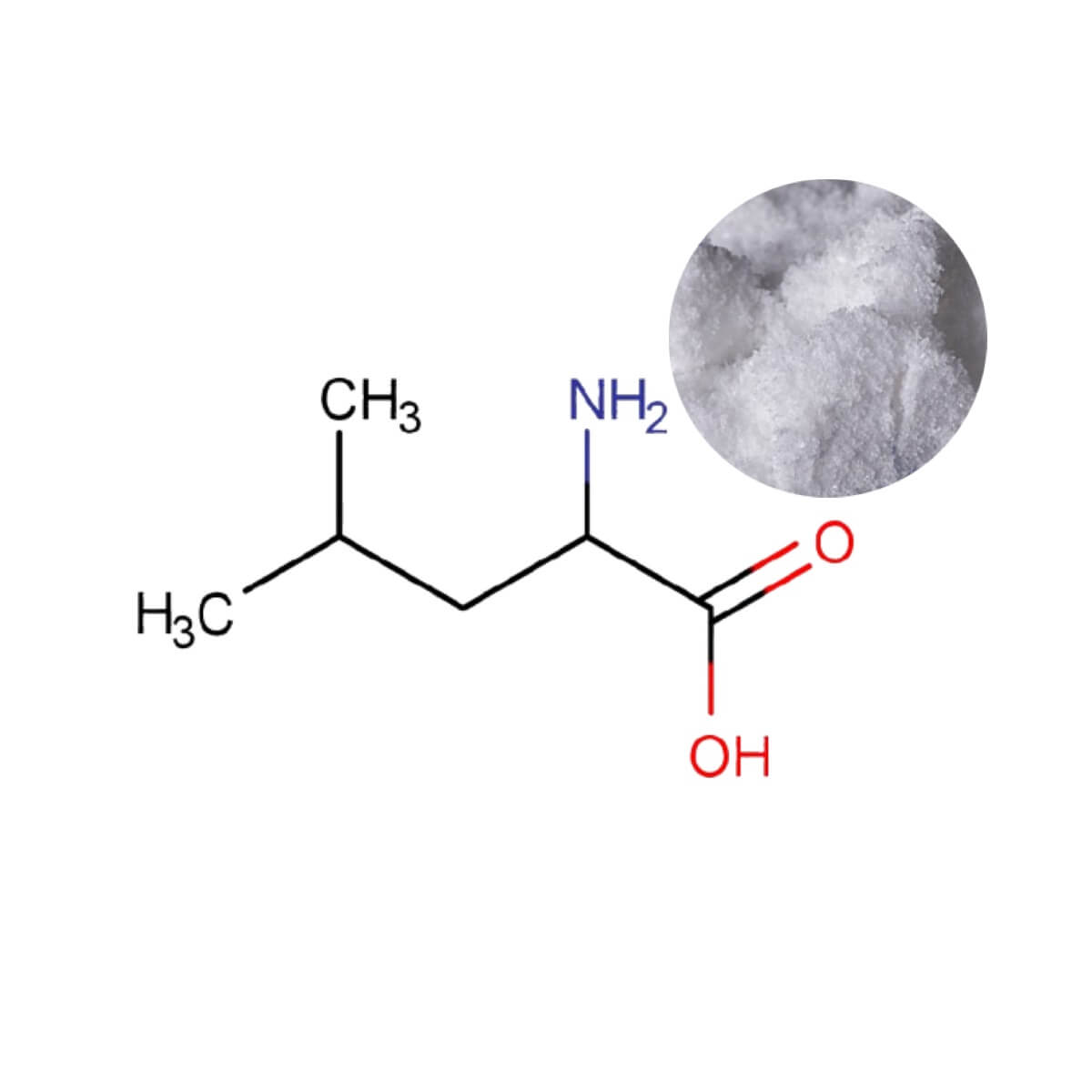
L-Leucine Powder
| Product Name | L-Leucine Powder |
| CAS Number | 61-90-5 |
| Appearance | White crystalline powder |
| Purity | ≥ 99.0% (by HPLC) |
| Packaging | 1 kg/bag, 5 kg/bag, 25 kg/drum |
| MOQ | 25 kg |
mTORC1 Pathway Activation: Bulk L-Leucine Powder for Premium Sports Nutrition Formulations
Muscle protein synthesis optimization now anchors premium sports nutrition positioning, with bulk L-Leucine Powder serving as the molecular trigger for mTORC1 pathway activation. Selecting a verified L-Leucine supplier with lot-to-lot COA documentation and audit-ready traceability de-risks formulation development while unlocking substantiated structure/function claims. Brand owners gain immediate access to one of the most clinically studied amino acids for muscle recovery positioning, supported by consistent ≥ 99.0% purity profiles, 80-mesh particle size, and USP <61>/<62> microbiological compliance. Such consistency accelerates R&D auditing and procurement approval cycles. Every shipment arrives with chiral purity data and residual solvent reports, eliminating incoming QC bottlenecks.
Clinical Validation Framework Driving Muscle Recovery Claim Substantiation
Establishing mTORC1 activation as the core mechanism marks just the first validation milestone. The commercial imperative extends further, requiring a clinical evidence framework that converts mechanism into substantiated DTC claims. A bulk L-Leucine Powder supplier with comprehensive documentation enables brands to cite precise pharmacokinetic data supporting muscle protein synthesis positioning.
| Clinical Parameter | Validated Data | Commercial Translation |
|---|---|---|
| mTORC1 pathway activation | Plasma leucine reaches 800 μM plateau at 53 mg/kg BW bolus | Supports "muscle synthesis activation" DTC claim |
| Peak plasma concentration (Tmax) | Approximately 30 minutes post-ingestion (10-90 mg/kg BW range) | Validates pre/post-workout timing claim |
| Sestrin2 target binding | Allosteric increase in Sestrin2 off-rate from GATOR2 | Mechanism differentiation anti-copycat shield |
The clinical evidence framework transforms into brand equity. Precise Tmax data validates pre-workout or post-training timing claims on product labels. The Sestrin2 mechanism provides a differentiated scientific narrative that commodity amino acid suppliers cannot replicate. For brands pursuing premium pricing strategies, referenced human trial data supports retail positioning above standard BCAA products. Each batch COA traces back to verified clinical parameters, enabling R&D teams to cross-reference formulation efficacy while procurement secures supply chain consistency. This evidence-to-claim pathway reduces regulatory review cycles and accelerates market entry for muscle recovery products.
Formulation Synergy Solutions for Stick Packs, Gummies, and Direct-Compression Tablets
Clinical substantiation creates consumer expectation that must survive formulation. The gap between proven efficacy and finished dosage performance determines whether premium claims translate into commercial reality. L-Leucine wholesale procurement strategies now prioritize excipient compatibility alongside purity specifications.
- BCAA 2:1:1 or 4:1:1 ratios with L-Isoleucine and L-Valine; higher leucine ratios support mTORC1-maximal dosing in premium formulations
- Instantized L-Leucine for stick packs delivers 3 g full dose with rapid dispersion and minimal sedimentation
- Direct-compression grade eliminates granulation, reducing gummy and tablet production steps
- EAA matrix integration adjusts leucine content independently for targeted amino profiles
Formulating with L-Isoleucine and L-Valine at the validated 2:1:1 ratio, or higher leucine ratios for maximal mTORC1 activation, preserves the leucine-triggered response. For extended recovery matrices, HMB, a leucine metabolite, provides sustained anti-catabolic support alongside leucine's acute mTORC1 signaling, while creatine monohydrate complements with independent energy buffering. Instantized grades address stick-pack manufacturing where rapid dissolution and minimal sedimentation define consumer acceptance and repeat purchase behavior. These co-ingredients integrate seamlessly into existing production workflows without additional equipment investment.
Dosage flexibility unlocks premium product tiers. Stick packs delivering 3 g full-dose leucine command higher retail prices than capsule-based alternatives. Gummy formulations become viable through instantized grades with reduced bitterness and improved taste profiles. Brands can launch differentiated delivery formats, expand SKU portfolios, and capture consumers seeking convenient muscle recovery solutions. This formulation latitude supports margin expansion and retail shelf differentiation.
Particle Engineering for CMO Line Efficiency and Air-Freight Stability
Formulation latitude depends on powder behavior under real manufacturing conditions. Particle size distribution and flow characteristics determine whether a premium stick-pack concept survives high-speed filling or collapses during direct-compression tableting. L-Leucine powder specifications translate into CMO line efficiency metrics.
| Physical Parameter | Standard Specification | CMO Line Impact |
|---|---|---|
| Particle size distribution | ≥ 95% through 80 mesh | Eliminates secondary granulation, improves direct-compression yield |
| Hygroscopicity | Moisture-resistant crystalline structure | High-humidity route shelf protection, standard foil packaging sufficient |
Direct-compression grade L-Leucine eliminates granulation equipment occupancy and associated rework, compressing timeline-to-market by 8-12 weeks. For applications requiring granulation, custom processing remains available; direct-compression grade serves formulations optimized for granulation-free production. The moisture-resistant crystalline structure enables standard foil packaging for Southeast Asian and Middle Eastern air freight routes, avoiding vacuum-seal cost premiums. For CMO partners, consistent particle size reduces blend segregation risk, lowering batch rejection rates. Brands gain supply chain predictability with every shipment arriving in free-flowing condition, ready for immediate production without conditioning delays.
Regulatory Pathway Navigation for US, EU, and Canadian Market Entry
Production efficiency alone cannot secure market access. Each destination market imposes distinct regulatory identities on L-Leucine, creating compliance divergence that impacts label claims and formulation strategy. A reliable L-Leucine supplier must provide documentation aligned with multiple pharmacopoeial standards.
- US FDA GRAS status permits 0.5-3 g per serving in meal replacements and sports drinks (GRN 308)
- L-Leucine is authorized as a nutrient supplement under 21 CFR §172.320
- EU E641 approval covers use as a carrier in table-top sweeteners in tablets at 50,000 mg/kg maximum (Commission Regulation (EU) 2015/649; sole authorized food category)
- Canada requires declaration of leucine and eight other amino acids in grams per serving when an amino acid claim appears on the label
- USP/EP/JP monograph compliance supports cross-border registration and master file audits
Navigating this regulatory mosaic requires claim substitution strategies across markets. US brands may deploy structure/function language ("supports muscle recovery") with FDA disclaimer (21 CFR 101.93); EU brands must pivot to neutral positioning around amino acid presence rather than specific health outcomes. Building a claim safe-zone matrix prevents costly label revisions and market withdrawal risk. Regulatory intelligence embedded in supplier documentation shortens compliance review cycles, compressing market entry timelines for multi-region product launches.
Total Cost of Ownership Optimization for Bulk L-Leucine Powder Procurement
Regulatory clearance and production readiness converge at the procurement desk, where total cost of ownership dictates long-term margin sustainability. Fermentation-derived L-Leucine wholesale pricing reflects raw material economics that fluctuate with energy costs and capacity cycles. Strategic sourcing must account for hidden costs beyond invoice price.
- Direct-compression grade eliminates granulation capex, associated rework, and yield loss
- 25 kg/drum standard packaging reduces handling labor and warehouse footprint per unit
- Quarterly reorder cadence with 24-month shelf life enables adequate safety stock optimization
- Lot-to-lot COA consistency eliminates incoming QC retesting and batch rejection risk
According to Global Info Research (2026), China accounts for approximately 34% of global BCAA production; industry estimates further suggest China supplies 65-75% of US BCAA raw material by volume, introducing supply chain vulnerability that proactive inventory planning mitigates. Brands maintaining adequate safety stock buffers avoid production halts during peak demand cycles or logistics disruptions. The elimination of secondary processing steps translates into measurable per-unit cost reductions. A verified L-Leucine supplier relationship anchored in consistent specifications enables accurate demand forecasting, reduces emergency air freight expenses, and protects gross margins through commodity price cycles.
Accelerate R&D Verification with Audit-Ready Sample Documentation
Sample evaluation packages include batch-specific COAs, HPLC chromatograms, chiral purity data, heavy metal ICP-MS reports, and residual solvent analysis by GC-HS per USP <467> methodology. This documentation bundle enables parallel assessment of supplier qualification while confirming CMO line compatibility. Secure L-Leucine powder samples with lot-specific compliance dossiers to initiate laboratory evaluation and accelerate procurement approval.
Frequently Asked Questions
Share this product
Related Products
Ready to get started?
Contact our team for technical specifications, pricing, and customized solutions.