
The Senolytic Revolution: Why Fisetin is Dominating the Next-Generation Longevity Formulations
The shift from antioxidants to senolytics is redefining healthy aging. This article analyzes Fisetin’s market dominance, clinical superiority, and strategic formulation stacks with NMN to help brands drive high-margin innovation.
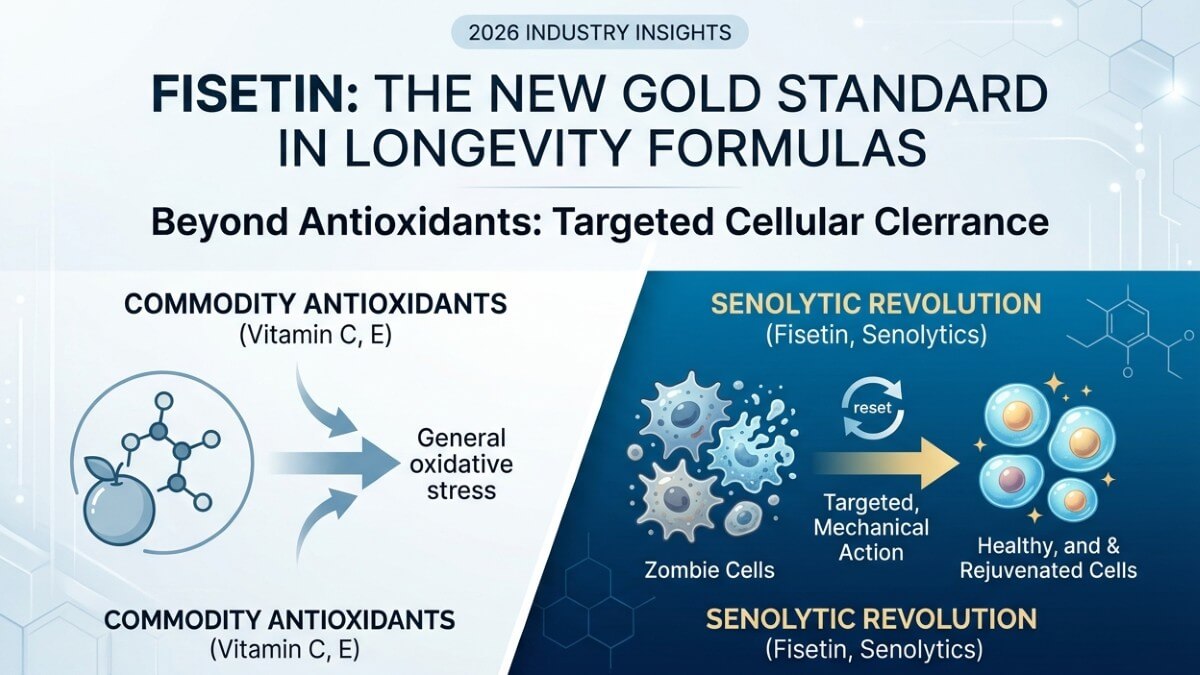
The shift from generic “antioxidant” claims to mechanism-based healthy aging solutions is redefining the premium supplement landscape. In 2024, the global senolytics market—therapies that selectively clear senescent cells—was valued at $4.2 billion and is projected to reach $12.8 billion by 2034 (Emergen Research). For brands still relying on traditional antioxidants, this is a clear signal: the market has moved from “reducing oxidative stress” to “eliminating the root cause of aging.” At the center of this revolution is a natural flavonol: Fisetin. Unlike traditional antioxidants that merely neutralize free radicals, Fisetin acts as a genuine senotherapeutic agent, targeting the cause of age-related decline. For brands seeking the next blockbuster ingredient beyond NMN or resveratrol, understanding the senolytic superiority of Fisetin is no longer optional—it is a strategic necessity.
Market Shift: From Antioxidant Redundancy to Senolytic Specificity
The clean-label and science-backed longevity market has matured. Consumers—and therefore brands—are no longer impressed by generic “antioxidant-rich” labels. According to GII Research, the healthy aging nutraceutical sector reached €34.7 billion in 2024, driven by demand for ingredients with validated mechanisms against cellular aging. Traditional antioxidants like vitamin C and even standard quercetin are now considered commodity ingredients with limited differentiation. What this means for brand owners: competing on “antioxidant content” alone is a race to the bottom. The only way to command premium pricing is to adopt ingredients with a clear, cause-and-effect mechanism—exactly what senolytics offer.
Senolytics offer a distinct advantage: they eliminate damaged cells that secrete inflammatory factors (the SASP phenotype), thereby rejuvenating tissue microenvironments. Fisetin Extract Powder has emerged as the most clinically advanced natural senolytic, with a safety profile superior to other senolytic candidates (FIRST Trial, NCT06399809). For R&D leaders, the economic opportunity is clear—the OTC/supplements senolytics segment alone is growing at a CAGR of 8.6% (Grand View Research, 2025). The takeaway: moving from “antioxidant” to “senolytic” is not just a label change; it is a complete category repositioning that justifies 30–50% price premiums.
Scientific Backbone: Why Fisetin Outperforms Traditional Flavonoids
A landmark 2024 review from the University of Copenhagen and Mayo Clinic’s Kogod Center for Aging systematically compared Fisetin against other senolytics (doi: 10.1016/j.mad.2024.111995). The authors, including senolytics pioneer Dr. James Kirkland, concluded that Fisetin exhibits superior senolytic activity compared to quercetin in both in vitro and animal models. Key differentiators include:
- Selective apoptosis induction – Fisetin clears senescent cells without affecting healthy proliferating cells.
- Multi-pathway SASP suppression – Reduces IL-6, IL-1β, and MMPs by over 50% in aged tissues.
- Synergy with other anti-aging axes – Works additively with NAD+ boosters and autophagy inducers.
Why this matters for formulation chemists: Simply substituting Fisetin for quercetin in an existing formula may not yield optimal results. The data suggest that formulators should consider either upgrading completely to Fisetin or strategically combining both to achieve broad-spectrum senolytic coverage across different tissues. For brands currently using Quercetin Dihydrate Powder as a standalone antioxidant, upgrading to Fisetin or formulating a Fisetin-quercetin hybrid can provide a defensible scientific narrative. The 2024 longitudinal DNA methylation study (Aging-US) even suggested that adding Fisetin to a dasatinib+quercetin regimen mitigates unwanted epigenetic age acceleration, highlighting its role as a modulator rather than a simple scavenger. Core insight: In the senolytic category, specificity beats generality—and Fisetin is the most specific natural option available today.
Formulation Architecture: Building the Ultimate Longevity Stack
The most innovative brands are moving away from single-ingredient products toward multi-target “longevity stacks.” But why stack at all? Because aging is not a single pathway; it is a network of interconnected hallmarks. Fisetin’s senolytic action occupies one pillar—senescence. To offer a complete cellular resilience solution, leading formulators combine Fisetin with two other evidence-backed ingredients that address complementary hallmarks: NAD+ decline and impaired autophagy.
| Ingredient | Primary Mechanism | Typical Dosage (adult) | Key Parameter |
|---|---|---|---|
| Fisetin | Senolytic (clears p16INK4a-positive cells) | 100–500 mg (intermittent, e.g., 3 days/week) | ≥98.0% by HPLC |
| NMN | NAD+ booster (supports sirtuins & DNA repair) | 250–500 mg daily | ≥99.0% (enzymatic grade) |
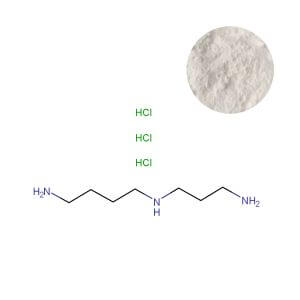
| Spermidine | Autophagy inducer (mitochondrial quality control) | 2–6 mg daily | ≥99% (trihydrochloride) |
This three-pronged approach addresses senescence (Fisetin), metabolic decline (NMN), and impaired autophagy (spermidine). What this means for procurement: Sourcing all three from one reliable supplier simplifies quality assurance and reduces logistical costs—but more importantly, it allows the brand to tell a cohesive story of “systemic rejuvenation” rather than a disjointed set of claims. NMN Powder, in particular, has regained full regulatory clarity after the FDA’s September 2025 reversal of its previous exclusion, making it a legal and safe dietary ingredient via the NDI pathway. Meanwhile, Spermidine Trihydrochloride Powder is gaining traction due to the ongoing POLYCAD trial (NCT06186102), the first human RCT testing 24 mg/day spermidine in coronary artery disease patients. Takeaway for brand strategists: The longevity stack is not a random cocktail—it is a scientifically defensible combination of orthogonal mechanisms. Fisetin provides the “cleanup”; NMN provides the “energy reboot”; spermidine provides the “quality control.”
Clinical Deep-Dive: Fisetin’s Edge in Vascular and Metabolic Health
Beyond general longevity, Fisetin shows remarkable organ-specific benefits that translate directly to consumer benefits. A 2024 study in Aging Cell demonstrated that intermittent oral Fisetin supplementation (3 days on, 2 weeks off) significantly improved arterial function in old mice by reducing aortic senescent cell burden by up to 47%. Why this is not just animal data: The same intermittent dosing protocol is now being tested in human trials for vascular endpoints (NCT06133634). For brands targeting the cardiovascular health segment—which represented 58% of the global healthy aging supplement market in 2024—Fisetin offers a mechanistic story that traditional heart-health ingredients (like CoQ10 or plant sterols) cannot match.
When evaluating Fisetin suppliers, R&D managers should demand the following technical specifications. These parameters are not just quality metrics—they directly determine whether your final product will pass stability testing and deliver reproducible benefits.
- Purity: ≥98.0% (Fisetin content by HPLC), free of heavy metals (Pb ≤0.5 ppm, As ≤1.0 ppm). Lower purity introduces unknown flavonoids that may interfere with senolytic activity.
- Solubility: Practically insoluble in water (<0.1 mg/mL) but soluble in ethanol & DMSO; lipophilic formulations (e.g., self-emulsifying systems) are essential for bioavailability. Brands that ignore this will launch products that fail in human absorption studies.
- Particle size: D90 ≤50 μm for uniform blending in capsules or tablets.
- Microbiological: Total plate count <1,000 CFU/g; absence of Salmonella and E.coli.
The core insight: In the senolytic space, “ingredient quality” is not a checkbox—it is the difference between a clinically effective product and an inert pill. Experienced formulators know that without rigorous supplier specifications, even the most promising molecule will fail to deliver.
Strategic Roadmap for Brand Owners: 2026–2030 Outlook
The next five years will see senolytic ingredients become a staple in premium longevity lines. However, market differentiation will depend on three key decisions. Each of these decisions carries a strategic trade-off that brand owners must actively manage.
- Dosing regimen: Intermittent (pulsatile) Fisetin protocols show better safety/efficacy than daily low-dose strategies. This means your label must educate consumers on “on/off” weeks—a communication challenge but a competitive advantage once understood.
- Co-ingredient selection: Combining Fisetin with NMN or spermidine creates a “clean-sweep + recharge” story, justifying premium pricing (30–50% above simple antioxidants). However, this requires more complex stability and synergy testing.
- Regulatory readiness: Ensure your supplier provides full HPLC analysis, stability data (24 months), and a Drug Master File (DMF) where required. Without these, your brand may be locked out of international markets or face FDA warning letters.
Competitive intelligence from Nutrition Insight confirms that over 40% of new longevity supplement launches in Q1 2026 contained at least one senolytic, with Fisetin being the fastest-growing botanical ingredient in this category. The final point: The senolytics race is not about being first—it is about being the brand that consumers trust to get the science right. That trust starts with rigorous ingredient sourcing and transparent communication.
Conclusion: Partner with a Science-First Ingredient Supplier
The senolytic revolution is not a distant promise—it is already reshaping the premium nutraceutical aisle. Fisetin, backed by Mayo Clinic-affiliated research and multiple phase II human trials, offers brand owners a credible, patentable, and consumer-friendly active. To stay ahead, your development team needs access to rigorously tested, high-purity Fisetin, as well as complementary senolytic and metabolic ingredients. Contact our technical team to request a full product dossier, including stability studies, third-party COAs, and formulation prototypes. Lead the longevity market—starting with the right senolytic foundation.
Share this article
Found this helpful? Share it with others!
Related Products
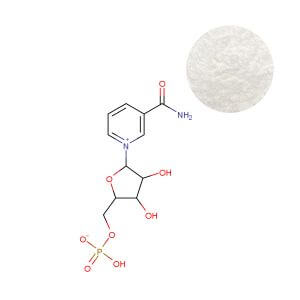
Products mentioned in this article
Related Articles
You might also be interested in
Fisetin vs. Quercetin & Resveratrol: Senolytic Potency, Synergistic Formulations, and Cost-Effective Absorption
An technical guide evaluating Fisetin, Quercetin, and Resveratrol across LogP, PK metrics, and processing stability. Resolve scale-up challenges and optimize cost-effective absorption strategies.
Want to learn more?
Explore our products or contact our team for personalized solutions and expert advice.