
Beyond Vitamin C: Why Hydroxytyrosol is the "New Gold Standard" for Anti-Aging Formulations in the Clean Label Era
Is Hydroxytyrosol the successor to Vitamin C? This article evaluates why this potent olive polyphenol is becoming the new "Gold Standard" for clean-label anti-aging formulations, backed by 2024-2025 clinical data.
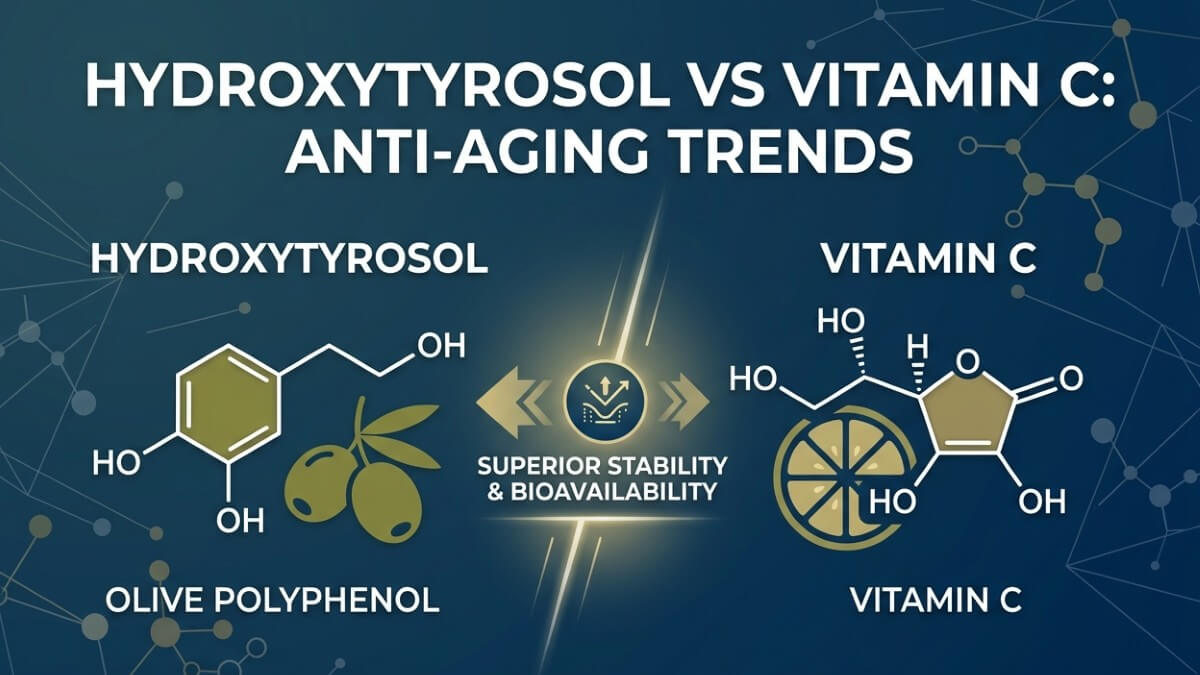
For years, vitamin C has dominated the antioxidant space in anti-aging supplements and functional foods. However, a quiet but powerful shift is underway. Formulators and procurement leaders are now evaluating next-generation polyphenols that deliver superior radical scavenging activity while aligning with clean label mandates. One ingredient, derived from the Mediterranean olive fruit, is rapidly ascending: hydroxytyrosol. Backed by recent human clinical trials and a strong consumer narrative tied to the Mediterranean diet, hydroxytyrosol offers brands a credible, science-driven opportunity to create high-margin, future-proof anti-aging products. What this means for decision-makers: the window to lead this category is open, but those who wait risk entering a crowded field where differentiation becomes harder and more expensive.
The Clean Label Shift: From Synthetic to Nature-Identical Powerhouses
Consumer distrust of synthetic additives has never been higher. According to NIQ and FMCG Gurus data, more than 65% of global supplement users actively avoid artificial antioxidants like BHA and BHT. Even traditional natural options face scrutiny regarding their sourcing and processing. While L-ascorbic acid remains a benchmark, its instability in liquid formulations and its pro-oxidant potential in certain metal-ion-rich environments limit its utility in complex, shelf-stable products. The clean label era demands ingredients that are not only effective but also traceable, minimally processed, and culturally resonant. This is where olive-derived polyphenols, particularly hydroxytyrosol, gain a decisive edge. The implication: synthetic antioxidants are losing shelf space not because they are ineffective, but because consumers now equate "natural origin" with safety and efficacy. Brands that continue to rely on synthetic actives will struggle to command premium pricing.
For brands formulating high-end nutricosmetics or functional beverages, selecting a Hydroxytyrosol Powder standardized to 10% or 20% offers a clean, plant-based identity that resonates with the "Mediterranean wellness" story—a proven marketing lever that reduces consumer education costs.
Quantitative Advantage: Hydroxytyrosol vs. Vitamin C and Other Antioxidants
The antioxidant capacity of hydroxytyrosol is not merely incremental; it is transformative. Comparative ORAC (Oxygen Radical Absorbance Capacity) values illustrate the gap clearly:
| Antioxidant | Approx. ORAC Value (μmol TE/g) | Key Limitation in Anti-Aging Formulas |
|---|---|---|
| Hydroxytyrosol | 45,000 | Higher cost compared to synthetic Vitamin C |
| Resveratrol | 30,000 | Poor water solubility, photodegradation |
| Vitamin C (L-Ascorbic Acid) | 2,000 | Thermal instability, pro-oxidant potential |
| Reduced L-Glutathione | 1,800 | Low oral bioavailability, oxidation susceptibility |
Beyond raw ORAC numbers, hydroxytyrosol demonstrates superior stability across pH ranges (3.0–8.0) and thermal processing up to 100°C for short durations. In contrast, vitamin C degrades rapidly above 60°C, and Resveratrol Powder requires encapsulation to prevent isomerization under light exposure. These technical differentiators directly impact production yields and finished product shelf life—critical KPIs for any brand’s operations team. What this means for formulators: choosing hydroxytyrosol is not a simple "swap" for vitamin C. It is a systems-level upgrade that reduces manufacturing waste, extends product freshness, and allows cleaner labels because fewer stabilizers are needed.
Clinical Validation: New Human Data Strengthens the Value Proposition
The transition from "promising lab molecule" to "commercial blockbuster" hinges on human clinical evidence. Two recent, high-quality studies now provide robust support for hydroxytyrosol’s anti-aging claims:
- 2025 RCT (overweight/prediabetes adults): A 16-week, randomized, double-blind, placebo-controlled trial demonstrated that daily supplementation with 15 mg hydroxytyrosol significantly improved antioxidant capacity and reduced inflammatory markers (IL-6, CRP) compared to placebo (doi: 10.1016/j.clnu.2025.07.006). These endpoints are directly linked to biological aging processes.
- 2024 systematic review: Analysis of 12 RCTs involving 683 participants confirmed that olive polyphenols (oleuropein and hydroxytyrosol) benefit cardiovascular risk factors, glucose metabolism, bone and joint health, and cognitive outcomes (doi: 10.3390/antiox13091040). No single antioxidant has demonstrated such multi-systemic efficacy in recent consolidated evidence.
For R&D directors, this evidence base reduces formulation risk. It allows brands to build anti-aging products around a single, well-documented active rather than blending multiple marginal antioxidants. Here is the key takeaway: with a 2025 RCT and a 2024 systematic review both showing positive human outcomes, hydroxytyrosol now offers the same level of clinical confidence as vitamin C—but with broader systemic benefits. Brands can directly cite these studies in marketing materials without relying on animal data, lowering regulatory scrutiny in key markets.
How Hydroxytyrosol Compares to Other "Anti-Aging" Ingredients
Procurement leaders often compare hydroxytyrosol with resveratrol and reduced glutathione. Each has merits, but the decision depends on product positioning, target region, and regulatory strategy.
| Parameter | Hydroxytyrosol (10-20% powder) | Resveratrol (98% powder) | Reduced Glutathione (GSH) |
|---|---|---|---|
| Regulatory health claim | EFSA approved for LDL protection* (olive polyphenols) | None in EU/US | None |
| Oral bioavailability | Moderate (improved with lipid matrix) | Low (<1% free form) | Very low (<5% without encapsulation) |
| Stability in beverages (pH 3-4) | High (>85% after 6 months) | Low (photodegradation) | Moderate (requires reducing agents) |
| Consumer story strength | Mediterranean diet, olive fruit | French paradox, red wine | Detox, skin brightening |
| Cost per daily dose (15 mg active) | $$ (mid-range) | $$$ (high) | $$ (mid-range) |
*Claim applies to extra virgin olive oil context; however, the ingredient’s efficacy is widely cited in supplements.
For brands targeting the premium anti-aging segment, hydroxytyrosol offers the best balance of regulatory readiness, stability, and marketing narrative. In contrast, Reduced L-Glutathione Powder remains better suited for detox or skin whitening lines where the mechanism of action is intracellular glutathione replenishment—not extracellular radical quenching. The strategic insight: hydroxytyrosol wins in broad anti-aging positioning; resveratrol still works for specific longevity concepts (SIRT1 activation); glutathione is a specialist for skin tone. Procurement should match the ingredient to the precise benefit claim, not default to a one-size-fits-all antioxidant blend.
Formulation Parameters for Anti-Aging Success
To achieve consistent clinical effects, formulators must adhere to specific parameters. Below are critical technical specifications derived from successful commercial launches and clinical protocols:
- Daily active dose: 5–20 mg hydroxytyrosol (target 15 mg based on 2025 RCT). For 10% extract, use 150 mg; for 20% extract, use 75 mg.
- Solubility: Hydroxytyrosol is highly water-soluble (>500 mg/mL at 25°C) – ideal for shots, beverages, and gummies.
- Stability buffer: Add 0.05-0.1% rosemary extract or vitamin E (mixed tocopherols) to prevent oxidative degradation in oil-based softgels.
- pH range for liquids: 3.5–6.5 optimal; avoid >7.5 where phenolic oxidation accelerates.
- Heat tolerance: Withstands 80°C for 30 minutes (pasteurization) without >10% loss. Higher temperatures require post-heat addition.
These parameters allow brands to incorporate hydroxytyrosol into a wider array of formats than vitamin C or resveratrol, reducing the need for expensive microencapsulation or liposomal delivery—though such technologies can further boost bioavailability. What experienced formulators recognize: hydroxytyrosol’s water solubility and heat stability mean it can be added at the beginning of the manufacturing process for most liquid and semi-solid formats, unlike vitamin C which often requires cold-point addition. This simplifies production, reduces contamination risk, and lowers labor costs.
Market Trajectory and Regional Opportunities
Global hydroxytyrosol market revenue is projected to grow at a CAGR of 7.2% to 11.5% through 2035, with the Asia-Pacific region leading due to China’s recent approval of olive fruit polyphenols as a novel food ingredient (November 2025). Meanwhile, North American and European brands are leveraging the EFSA-approved LDL protection claim (though currently limited to EVOO) and the strong "Mediterranean diet" halo. The nutricosmetics segment alone—targeting skin elasticity and UV protection—is expected to exceed $13 billion by 2032, creating ample white space for first-movers. For brand strategists, this regional divergence is actionable: APAC brands can immediately launch oral beauty products with novel food status, while EU brands should focus on cardiovascular anti-aging positioning using the EFSA claim. The same ingredient, two different go-to-market stories.
For brands sourcing bulk hydroxytyrosol powder, verifying supplier documentation (COA showing ≥10% or 20% by HPLC, heavy metals within Prop 65 limits, and non-GMO certification) is non-negotiable. Reliable distributors provide batch-specific stability data and formulation guides—essential for reducing time-to-market.
Conclusion: Building a Credible Anti-Aging Portfolio with Hydroxytyrosol
The era of generic antioxidant formulas is ending. Today’s discerning consumers demand science-backed, naturally derived actives with a compelling origin story. Hydroxytyrosol meets all three criteria: clinical proof from human RCTs, a clean label identity rooted in Mediterranean olive culture, and superior technical performance across diverse dosage forms. For brand owners and procurement heads, moving beyond vitamin C and embracing hydroxytyrosol is not just a trend—it is a strategic decision to lead the next generation of anti-aging nutrition. Final takeaway: the next blockbuster anti-aging supplement won’t be built on a single molecule’s ORAC value alone; it will be built on a molecule that delivers clinical results, a clean label story, and manufacturing flexibility. Hydroxytyrosol checks all three boxes.
To explore full technical specifications, stability reports, and sample requests for our GMP-certified hydroxytyrosol powder (10% and 20% grades), contact our technical team or request a quote through the product page. For formulation assistance using complementary actives like resveratrol or glutathione, our R&D specialists are ready to support your innovation pipeline.
Share this article
Found this helpful? Share it with others!
Related Products
Products mentioned in this article

Want to learn more?
Explore our products or contact our team for personalized solutions and expert advice.