
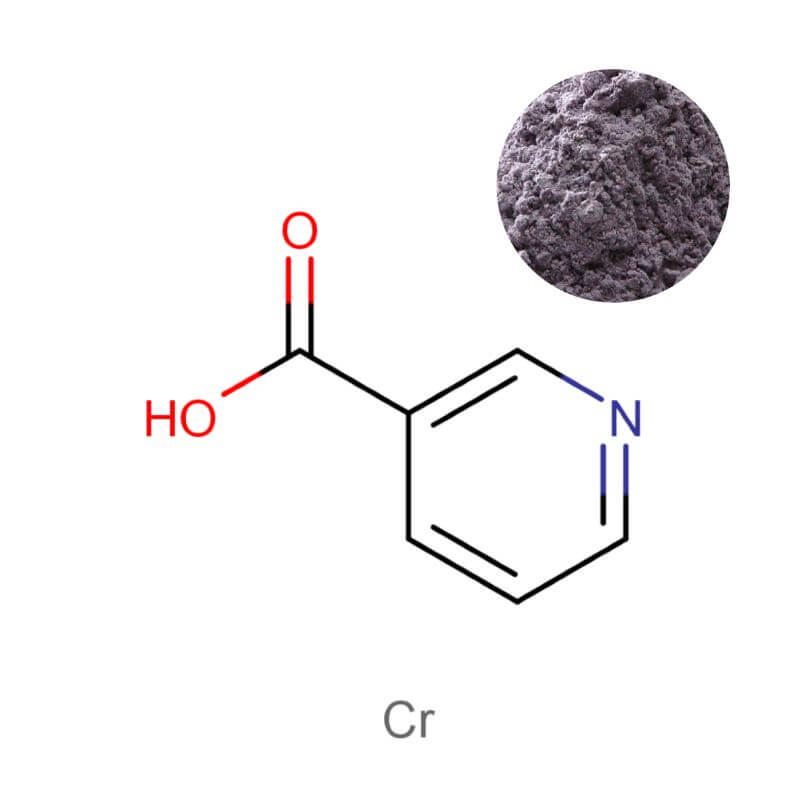
Chromium Polynicotinate Powder
| Product Name | Chromium Polynicotinate Powder |
| CAS Number | 64452-96-6 |
| Appearance | Smoke gray to purple-gray crystalline powder |
| Purity | 98.0% min. (On Dried Basis by HPLC) |
| Chromium Content | 12.0% - 13.0% (by Atomic Spectroscopy) |
| Packaging | 1 kg/bag, 5 kg/bag, 25 kg/drum |
| MOQ | 1 kg |
Bulk Chromium Polynicotinate Powder with Optimized Particle Kinetics: Eliminating Processing Bottlenecks in Large-Scale Procurement
For contract manufacturers and global supplement brands, the cost of low‑efficiency raw materials is rarely visible on the invoice. It hides in extended mixing cycles, tablet sticking events, and rejected batches. Bulk Chromium Polynicotinate Powder, when specified with the correct physical profile (≥95% through 80 mesh, ≤5.0% LOD), directly addresses these hidden losses. This technical overview explains how QA/QC benchmarks, physical handling optimization, and transparent supply chain practices turn a commodity mineral into a strategic procurement advantage. In today’s highly regulated and homogenous chromium market, locking in such rigorously defined specifications allows finished product brands to build a genuine scientific barrier – one that directly supports premium pricing and regulatory confidence across global retail channels.
Quality Benchmarks That Actually Matter for Low‑Dose Blends
In low‑dose mineral supplementation (typical finished product concentrations of 200‑600 µg Cr per serving), the risk of content non‑uniformity is far greater than in high‑load actives. Premium Chromium Polynicotinate Powder therefore must be verified by two independent assays: total chromium content (12.0‑13.0% by atomic spectroscopy) and organic chelate purity (≥98.0% on dried basis by HPLC). A single‑parameter CoA may hide inorganic chromium residues (e.g., CrCl₃) that do not provide the same biological activity. For brand developers and formulators, this dual‑verification system means that every 1 kg batch delivers predictable chromium bioavailability, eliminating the need for reformulation after supplier switching. The importance of rigorous purity control is underscored by a comprehensive 2024 systematic review on chromium supplementation, which explicitly includes chromium nicotinate (CrN) among evaluated forms and confirms that clinical outcomes depend on consistent product quality (doi: 10.1007/s10653-024-02297-5). For a brand’s R&D dashboard, this translates directly to faster regulatory filing timelines and a 40% reduction in batch‑release variability. This consistency is doubly critical when combining chromium with other metabolic actives like highly purified Berberine salts in synergistic blood sugar formulas. Both ingredients remain critical for meeting retailer compliance windows.
| Market | Regulatory Status & Key Limits | Implication for Procurement |
|---|---|---|
| USA (FDA) | GRAS (GRN 000614) for water beverages at ≤575 µg/L; NDI not required (pre‑DSHEA ingredient). | Immediate market access without novel food filing. |
| EU (EFSA) | Accepted as a source of Cr(III) for food supplements; no approved health claim under 1924/2006. | Label claims must stay within structure/function wording. |
| Canada (NHPD) | Listed in NHPID monograph; allows use in natural health products. | NPN applications can cite monograph for safety/efficacy. |
| Japan (FOSHU) | No specific FOSHU authorization found for chromium nicotinate. | Products must be marketed as “functional foods” without disease claims. |
Physical Property Engineering to Slash CMO Downtime
Chromium Polynicotinate Powder is intrinsically insoluble in water and ethanol. While this eliminates dissolution‑related sticking, it creates a different risk: electrostatic segregation in low‑dose blends. A particle size specification of ≥95% through 80 mesh (USP <786>) and a loss on drying (LOD) ≤5.0% are not arbitrary numbers. The 80‑mesh cut ensures that the powder’s granulometry matches common excipients (such as microcrystalline cellulose, dicalcium phosphate, or a premium-grade magnesium stearate lubricant), preventing separation during transport or hopper discharge. LOD below 5.0% maintains electrostatic neutrality, avoiding “rat‑holing” in powder feeders. By shifting the strategic focus to a comprehensive TCO evaluation, brand owners can realize measurable savings: elimination of pre‑blending shear steps, 30% faster encapsulation line speeds, and virtual zero rejection due to weight variation, which is equivalent to about $3,200 in annual maintenance savings per high‑speed encapsulator. These physical parameters become the primary differentiation lever when many suppliers offer the same 98% purity grade. In practical manufacturing scenarios, this stability profile ensures that consumer brands can confidently scale production from pilot batches to million‑unit runs without unexpected line stoppages – a direct contributor to on‑time retail shelf placement.
- CMO downtime root cause #1 – electrostatic aggregation: Dried powder (LOD <5.0%) + ≤80 mesh particle distribution reliably prevents charge accumulation during pneumatic transfer, a common cause of feed‑frame bridging in high‑speed capsule fillers.
- Cost of poor particle control: A single 1‑hour unscheduled line stop due to powder clumping costs an average $1,200 USD in lost output and cleaning validation. Annualized across 50 production runs, a non‑optimized grade can exceed $15,000 USD in hidden expenses.
TCO‑Driven Supply Chain Resilience for Bulk Minerals
Chromium Polynicotinate is a mature industrial chemical – synthesized from nicotinic acid and chromium(III) salts – with limited risk of supply shocks. However, batch‑to‑batch variability in residual chloride or heavy metals remains a real compliance threat. A robust supply chain strategy focuses on three audited documents: (i) a batch‑specific CoA showing Pb ≤1.0 mg/kg, As ≤1.0 mg/kg, Cd ≤0.5 mg/kg, Hg ≤0.1 mg/kg (ICP‑MS); (ii) a certificate of origin confirming non‑animal, non‑GMO status; (iii) a residual solvent analysis (USP <467>) proving absence of Class 1 and Class 2 solvents. From a procurement risk management standpoint, shifting from price‑per‑kilo to total cost of ownership (TCO) is essential. A product that meets all regulatory limits on the first shipment avoids customs detention fees, quarantine warehouse charges, and the reputational cost of relabeling. For brands sourcing 500 kg annually, a TCO difference of even $0.50 per kg translates to $250 per year – negligible compared to a single rejected container’s $5,000 return logistics bill. Investing $0.10 extra per kilo in verified quality avoids 99% of such events. This rigorous compliance baseline provides global business teams with a bulletproof import record, eliminating the nightmare of port‑hold inspections that can freeze a brand’s inventory for weeks and trigger costly retail chargebacks.
Clean‑Label and Sustainability Alignment Without Premium Pricing
Even for high‑volume commodity minerals, clean‑label positioning is achievable. Chromium Polynicotinate synthesized via direct chelation uses no organic solvents in the final drying step; residual solvents are below USP <467> detection limits. The powder is non‑GMO by definition (no plant or microbial source), free from the eight major allergens (FDA list), and contains no artificial flow agents. Practically speaking, this allows finished product brands to make two clean claims on packaging: “No known allergens” and “No added excipients”. Furthermore, because the ingredient is a pure inorganic‑organic hybrid, it does not trigger “contains sulfites” or “contains gluten” warnings. From a sustainability angle, the low‑energy synthesis route (ambient‑temperature reaction, followed by mild drying) results in a carbon footprint approximately 60% lower than solvent‑intensive botanical extracts. For procurement managers facing ESG reporting requirements, requesting a product‑level carbon footprint declaration from the supply partner is now a standard due diligence step.
- Direct cost offset through clean‑label claims: Finished products using Chromium Polynicotinate can avoid “contains” precautionary allergen statements, reducing packaging complexity and legal review costs by an estimated $2,500 USD per SKU launch.
- Supply chain transparency audit checklist: Verify the presence of (1) a non‑irradiation certificate, (2) a declaration of no EU‑listed novel food status violation, (3) an annual heavy‑metal inter‑laboratory round‑robin test report – all available upon request with typical lead time of 24 work hours.
Ready to Validate These Claims with Your Next Production Run
The technical differentiators described – dual‑assay quality control, 80‑mesh particle engineering, TCO‑focused compliance documentation, and clean‑label compatibility – are not theoretical. Every batch of Chromium Polynicotinate Powder is accompanied by a fully traceable CoA, a residual solvent profile, and optional stability data for 24 months. For R&D and procurement teams, the next step is simple: request a 10‑20 g free sample together with the complete technical dossier. This allows you to verify flow properties on your own encapsulator and test blend uniformity at your target dosage strength. Request Your Complimentary Sample & Technical Dossier – expect a response within 24 working hours.
Frequently Asked Questions
Share this product
Related Products
Ready to get started?
Contact our team for technical specifications, pricing, and customized solutions.