
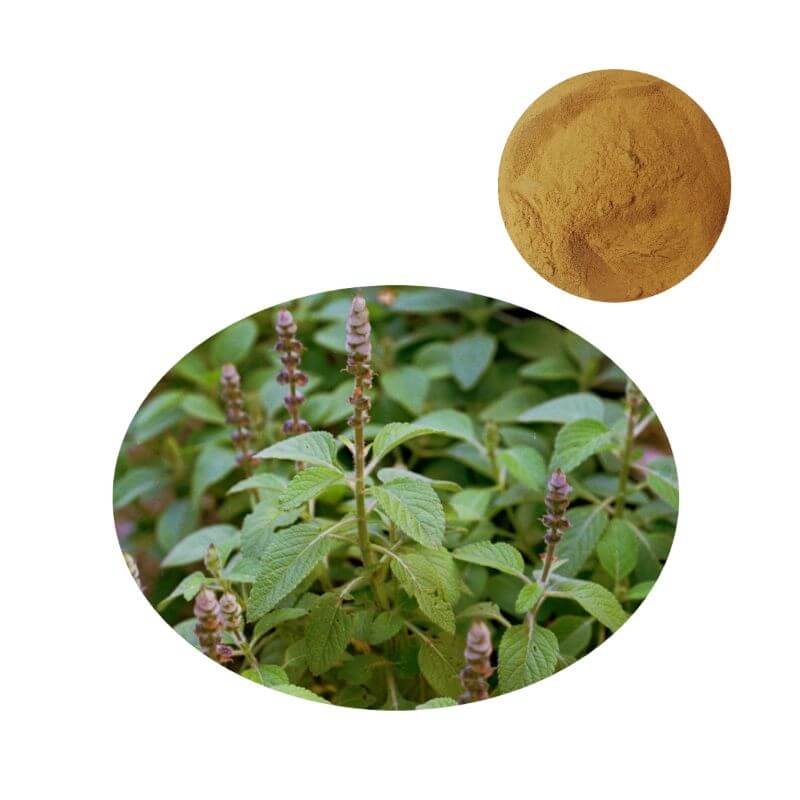
Coleus Forskohlii Extract Powder
| Product Name | Coleus Forskohlii Extract Powder |
| CAS Number | 66575-29-9 |
| Appearance | Brown to dark brown fine powder |
| Purity | 10.0% min. / 20.0% min. (Forskolin by HPLC) |
| Packaging | 1 kg/bag, 5 kg/bag, 25 kg/drum |
| MOQ | 1 kg |
Engineered Purity and Supply Chain Integrity for Coleus Forskohlii Extract
Standardized Coleus Forskohlii Extract (10% / 20% forskolin by HPLC) serves metabolic health formulations, yet its value is routinely destroyed by three failures: undetected adulteration, undocumented heavy metal carryover, and potency loss during ocean freight. For R&D and procurement leaders, batch-specific COA packages now function as verifiable passports that link each kilogram to GAP farm origin, multi-modal transport stability data, and third-party authenticated fingerprint profiles. Selecting a supplier that delivers verified chromatographic fingerprints transforms raw material sourcing into a brand-level differentiation lever against commodity-grade alternatives.
Multi-Dimensional Fingerprinting: Moving Beyond Single-Peak HPLC Release
Routine HPLC quantification of total forskolin content fails to differentiate authentic root extract from diluted or substituted material. A 2025 market survey using flow injection analysis-mass spectrometry (J. Chromatogr. A, 2025; doi: 10.1016/j.chroma.2024.465547) reported that 45% of commercial Coleus products contained no detectable forskolin, while 69% failed label claim accuracy. Such failures originate from species substitution (using other Plectranthus species or green tea leaf) or spiking synthetic forskolin into inert biomass. An effective counterfeit barrier requires three orthogonal analytical layers.
- HPTLC fingerprint with marker-to-marker peak ratio: Profiles forskolin, isoforskolin, and 1,9-dideoxyforskolin. Authentic Coleus forskohlii exhibits a fixed peak area ratio (1.0 : 0.35-0.45 : 0.12-0.18) that cheap substitutes cannot replicate.
- LC-MS/MS confirmatory ion ratio verification: Quantifies the parent compound (m/z 411 → 375) and two diagnostic fragments (m/z 357 and 315). Any deviation from expected ion ratio flags potential adulteration within 45 minutes.
- Carbon-14 (AMS) natural abundance test: Differentiates 100% plant-derived biomass from petrochemical-sourced forskolin isolates. Natural products show 100% biobased carbon content; synthetic or diluted lots drop below 95%.
Eliminating the 45% adulteration risk at the receiving dock enables brand-owner QA/QC departments to avoid downstream formulation failures caused by misidentified active content. Routine provision of LC-MS chromatograms and peak ratio data repositions the extract supplier as a formulation-aligned partner, safeguarding clinical trial investments and consumer safety. For brand owners operating premium metabolic portfolios, deploying this multi-layered forensic testing framework forms an ironclad quality defense, successfully mitigating batch rejection rates during incoming inspection and avoiding catastrophic recalls that destroy market credibility.
Redline Contaminant Control: Heavy Metals, Residual Solvents & Pathogen Clearance
Root-based botanicals concentrate soil-borne lead (Pb), cadmium (Cd), and arsenic (As) during cultivation. Simultaneously, ethanol or water extraction, if not coupled with rigorous drying, can leave residual solvents that trigger customs holds. The table below summarizes current B2B specification limits and the specific process interventions used to achieve them.
| Contaminant Class | B2B Specification (Typical COA) | Process Intervention |
|---|---|---|
| Lead (Pb) | ≤ 1.0 mg/kg (ICP-MS) | GAP soil remediation + macroporous resin adsorption during purification |
| Arsenic (As) | ≤ 1.0 mg/kg | Source water reverse osmosis pretreatment + chelating resin polishing |
| Cadmium (Cd) | ≤ 0.5 mg/kg | Advanced chromatography utilizing divalent-selective chelating resin (iminodiacetic acid functionalized) to capture ionic Cd without altering botanical sensory profiles. |
| Mercury (Hg) | ≤ 0.1 mg/kg | Activated carbon filtration + validated ICP-MS screening |
| Residual ethanol | ≤ 5000 ppm (USP <467> Class 3) | Vacuum drying at 60°C for 8 hours + headspace GC confirmation |
| Pseudomonas aeruginosa | Absent in 1g (USP <62>) | Low water activity (≤5% LOD) + physical steam sterilization (no EtO) |
Procurement compliance officers benefit from documented non-EtO sterilization and third-party ICP-MS scans below 1 ppm Pb/As; these practices directly cut customs rejection risk in FDA and EU border inspections. This advanced, divalent-selective chelating resin chromatography platform represents the standard heavy metal clearance framework applied across all our root-based matrices—including the purification pathways engineered for standardized polyphenol-rich rhizome extracts—delivering a legally defensible audit trail for finished product notifications while protecting the botanical's original sensory profile from chemical residues. Screening every lot against USP <232> and <233> standards provides batch-level compliance verification, with the analytical method validation per ICH Q2(R1) independently confirming recovery rates between 85-115% for the ICP-MS procedure. Adherence to these limits shortens customs hold periods by eliminating repetitive re-testing requests, accelerating cross-border release for just-in-time inventory models.
Full-Chain Traceability: GAP Agriculture, Non-GMO Certification & Clean-Label Processing
Long-term supply agreements (MSAs) now require documented traceability from certified Good Agricultural Practice (GAP) farms. Commercial Coleus forskohlii is cultivated in red sandy loam (pH 5.5-7.0) regions of India and China, where controlled irrigation and virus-indexed cuttings produce consistent forskolin yield (0.4-0.6% dry weight). The following elements constitute a complete traceability packet for procurement audits.
- Farm-to-batch linkage system: Each production lot carries a unique alphanumeric ID that links harvest date, GPS coordinates, extraction log, blending record, and third-party audit certificate. No blind spots.
- Physical sterilization only – no EtO, no irradiation: Steam or high-pressure processing at 105°C/15 psi for 30 minutes. Residual ethylene oxide tested to < 0.1 ppm (LOQ) by validated GC-MS.
- Non-GMO and organic certification pathways: Optional USDA NOP / EU organic certificates available, plus Non-GMO Project verification upon request.
Documented non-EtO sterilization and full latitude/longitude farm traceability satisfy both FDA FSVP (21 CFR 1.502-1.514) and EU Regulation 2015/2283 (Novel Food) requirements. Eliminating the two most common botanical supply chain violations – undeclared fumigants and origin fraud – supports premium "clean label" positioning on finished packaging while reducing audit findings during supplier onboarding.
Logistics-Driven Stability: Preventing Forskolin Degradation During Cross-Border Transit
The labdane diterpene core of forskolin undergoes pH-dependent isomerization at the C-9 position when moisture exceeds 6% (loss on drying). In ambient ocean freight, container sweat (temperature cycling) can elevate local humidity to 75-90% within 48 hours, accelerating degradation by a factor of three. Standard 25 kg fiber drums with single PE liners are insufficient. Advanced logistics protocols incorporate three defensive layers.
| Risk Factor | Degradation Outcome | Industrial Defense Layer |
|---|---|---|
| Moisture ingress (LOD rises from ≤5% to ≥7%) | Forskolin → isoforskolin → forskolin D; 3-fold faster rate at 30°C in 4 weeks | Vacuum-sealed triple-layer aluminum foil bag + 10g desiccant pouch inside liner |
| Oxygen exposure (>0.5% headspace O₂) | Oxidative ring opening at C-11/C-12, loss of cAMP-activating potency | Nitrogen flush to ≤0.1% residual O₂ + oxygen absorber sachet |
| Container sweat (temp cycle 5°C → 35°C) | Caking, particle size increase, microbial re-activation, hopper flow failure | Container-grade desiccant strips (20g/m³) + climate-controlled warehousing at port |
Requesting accelerated stability data (40°C/75% RH for 6 months, sampling every 4 weeks) allows logistics and formulation managers to precisely calculate re-order buffers. Time-course stability mapping from qualified suppliers enables brands to ship via slower sea freight without efficacy loss. The powder's critical relative humidity (CRH) of 52-58% – exceeding 58% triggers deliquescence within 72 hours – demands engineering standards equivalent to those used for preventing moisture-driven degradation in highly hygroscopic metabolic crystalline carriers, making climate-controlled container selection non-negotiable for TCO optimization. Avoiding forced air-freight of unstabilized material directly lowers landed cost per kilogram by 12-18%. Transparent degradation kinetics allow procurement directors to model multi-year freight cost scenarios, securing contract terms that exclude emergency air freight surcharges from supply agreements.
Request a Complete Technical Dossier for Formula Development and Regulatory Filing
Secure a qualified bulk sample together with batch-specific COA, heavy metal ICP-MS raw data, HPTLC fingerprint overlays, LC-MS confirmatory chromatograms, accelerated stability summaries, and non-EtO sterilization validation. This documentation directly supports NDI notifications, EU Novel Food pathways, and finished product label claims for weight management and metabolic support supplements.
Request a qualified bulk sample of Coleus Forskohlii Extract with full regulatory documentation for immediate R&D qualification and procurement auditing.
Frequently Asked Questions
Share this product
Related Products
Ready to get started?
Contact our team for technical specifications, pricing, and customized solutions.