
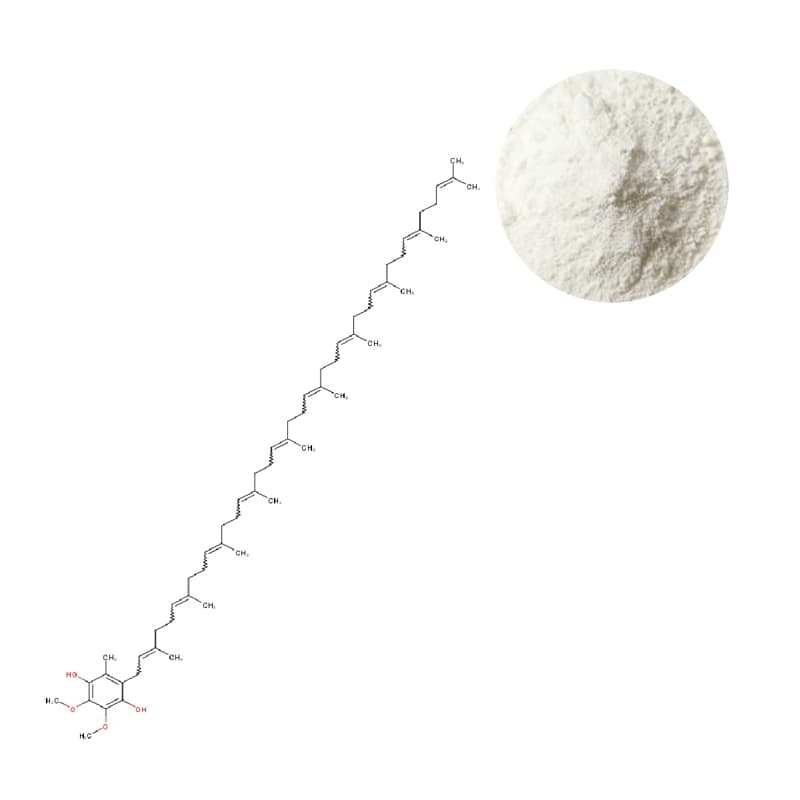
Ubiquinol CoQ10 Powder
| Product Name | Ubiquinol CoQ10 Powder |
| CAS Number | 992-78-9 |
| Appearance | White to pale yellow crystalline powder |
| Purity | ≥ 98.0% by HPLC (10%, 30% Microencapsulated Powder Available) |
| Packaging | 1 kg/bag, 5 kg/bag, 25 kg/drum |
| MOQ | 1 kg |
Ubiquinol CoQ10 Powder: Clinically Validated Bioavailability for Premium Supplement Formulations
Bulk Ubiquinol CoQ10 Powder delivers 3.43-fold greater systemic exposure than ubiquinone in human pharmacokinetic trials. Dose-reduction economics and premium DTC positioning for cardiovascular and mitochondrial support formulations follow directly from this clinical distinction. Every lot ships with batch-specific COA and stability documentation, enabling brand R&D teams to bypass prolonged analytical validation and accelerate procurement decisions through full supply chain traceability.
Clinical Pharmacokinetic Superiority Over Ubiquinone Drives DTC Differentiation
Premium pricing demands clinical data that quantify ingredient performance. The ubiquinol cocrystal formulation delivers measurable advantage over ubiquinone while staying within structure/function claim boundaries and avoiding pharmaceutical terminology. A double-blind, two-period crossover trial in healthy adults quantified geometric mean Cmax at 2.20 and AUC0-∞ at 3.43. These endpoints support consumer-facing claims such as "absorbed faster than conventional CoQ10" and "delivers superior cellular uptake," underpinning the retail premium ubiquinol commands in the premium supplement segment (Clinical Pharmacology in Drug Development, 2026; doi: 10.1002/cpdd.70042).
- 3.43-fold greater total CoQ10 AUC0-∞ than ubiquinone at equal 150 mg oral dose (90% CI: 1.47-8.00).
- 2.20-fold higher Cmax (90% CI: 1.59-3.04) ensures superior peak plasma concentration.
- Clinical endpoints directly translatable to consumer-facing DTC efficacy claims.
Bypassing the bioavailability debate inherent to ubiquinone-based products, this clinical data positions ubiquinol as the definitively superior molecular form. Brands shorten R&D claim-validation timelines by an estimated 8-12 weeks while building a science-backed narrative that commands premium shelf placement and higher per-unit retail pricing in the cardiovascular and healthy aging categories.
Microencapsulation and Cocrystal Engineering Overcome Oxidative Instability
Clinical efficacy remains theoretical unless the active molecule survives formulation, manufacturing, and shelf-life. Ubiquinol's hydroquinone moiety exhibits inherent oxidative lability, converting to ubiquinone under ambient conditions - a degradation pathway that directly compromises label claim accuracy and consumer trust. Microencapsulated and cocrystal technologies address this vulnerability by incorporating antioxidant matrices that retard oxidation without depressing absorption kinetics.
| Formulation Technology | Stability Outcome (40°C / 75% RH) | Bioavailability Translation |
|---|---|---|
| Ubiquinol-Nicotinamide Cocrystal (UQ-NC) | >90% potency at 6 months | 4.5-fold greater AUC vs. unmodified crystal (Pharmaceutics, 2023) |
| Reference Crystalline Ubiquinol | <80% at month 3; <60% at month 6 | Baseline comparator |
| Microencapsulated Powder (10%, 30% grades) | Oxidation rate <1% over 6 months | Enables tablet and powder applications |
Brand product managers gain a decisive formulation advantage from this stability-bioavailability nexus - direct compression tableting becomes viable beyond traditional softgel encapsulation. The 2023 cocrystal study demonstrated 12.6-fold higher maximum ubiquinol concentration in simulated intestinal fluid and 38.3-fold in simulated gastric fluid versus the reference crystalline form. Strategic formulation intervention transforms ubiquinol from a stability-liability ingredient into a formulation-robust active that supports premium softgels, gummies, and powdered RTD applications (Pharmaceutics, 2023; doi: 10.3390/pharmaceutics15102499).
Synergistic co-administration with medium-chain triglyceride (MCT) oil powder, high-purity d-alpha-tocopherol, and fermented vitamin K2 as MK-7 enhances ubiquinol's dispersion in oil-based systems while providing complementary cardiovascular and mitochondrial support. This multi-ingredient architecture enables finished products with differentiated mechanisms—supporting myocardial energy, vascular elasticity, and antioxidant defense. For enhanced mitochondrial biogenesis, PQQ (pyrroloquinoline quinone) disodium salt offers additional synergy through SIRT1/PGC-1α pathway activation, pairing with ubiquinol to optimize both existing and newly generated mitochondrial function—creating a premium platform competitors cannot replicate.
Particle Engineering and CMO Line Optimization Shorten Time-to-Market
Formulation innovation encounters a critical bottleneck at the manufacturing line. Ubiquinol's crystalline morphology - with ≥95% through 80 mesh, low bulk density, and a melting point of 48-52°C - creates flowability challenges that manifest as sticking, weight variation, and elevated reject rates during high-speed tableting and capsule filling. Direct compression grades eliminate secondary granulation steps, circumventing these production inefficiencies.
- Direct compression grades enable tableting without wet granulation, reducing processing time by 2-3 weeks.
- Particle size optimization (sub-100 mesh milling) improves blend uniformity and reduces tablet weight variation.
- Flow-enhanced grades minimize die filling inconsistencies and sticking, lowering reject rates from ~6% to below 2%.
- Nitrogen-flushed vacuum packaging preserves powder integrity during air freight transits, preventing moisture-induced caking.
Eliminating granulation steps reduces CMO processing costs by 15-20% and compresses the launch timeline by 8-12 weeks. This translates directly into improved quarterly P&L performance through reduced scrap rates and accelerated product-launch ROI. Vacuum nitrogen-flush packaging addresses degradation risks from altitude pressure and tarmac temperature extremes, ensuring specification-ready arrival at the CMO site.
Regulatory Pathways and Label Claim Safety Across Major Markets
Global market access demands compliance certainty. Ubiquinol's regulatory status varies across jurisdictions. The ubiquinol cocrystal formulation was filed as a New Dietary Ingredient (NDI) with FDA in a regulatory submission dating to 2005 and is self-affirmed as GRAS for food applications. EFSA's framework and Japan's FOSHU classification define distinct compliance requirements. The 2022 FDA warning letter to Anabolic Laboratories Inc. serves as a cautionary precedent: improper label claims and inadequate use instructions trigger regulatory action that damages brand equity and disrupts market presence.
- FDA regulates CoQ10 as a dietary supplement (not a drug) under DSHEA.
- EFSA requires structure/function claims only; specific health claims remain unapproved under Article 13.
- Japan's FOSHU classification permits approved health claims with substantiation documentation.
- Heavy metals strictly controlled (Pb ≤ 1.0 mg/kg, As ≤ 1.0 mg/kg, Cd ≤ 0.5 mg/kg, Hg ≤ 0.1 mg/kg).
This compliance architecture provides audit-ready documentation including NDI references, GRAS rationale, and market-specific claim restrictions. By pre-validating these regulatory requirements, procurement teams eliminate the risk of customs holds (particularly in the EU and Japan) and avoid costly last-minute label revisions. The margin protection is substantial: delayed market entry or product re-labeling typically erodes 10-15% of projected first-year revenue, a risk entirely avoided through proactive compliance mapping. These regulatory benchmarks, aligned with Oclean Nutra specification-grade material criteria, ensure finished-product label claims withstand jurisdictional scrutiny.
Authenticity Verification and Supply Chain Traceability Build Brand Defense
In the third phase of an ongoing surveillance program (following earlier rounds that flagged 9 and 11 products respectively), independent 2026 testing revealed four commercial ubiquinol products purchased through major e-commerce platforms contained ubiquinol below detectable limits (<0.001-<0.003 mg/serving) despite label claims of 200-300 mg/serving - a 100,000-fold discrepancy. Authenticated raw material procurement and validated analytical testing distinguish genuine ubiquinol from oxidized ubiquinone, structural analogs, and outright adulterants.
- Validated HPLC-UV methods achieve baseline separation of ubiquinol and ubiquinone within 12 minutes.
- HPLC-ESI-MS/MS quantifies both reduced and oxidized forms with LOD at 10 ng/mL.
- Fermentation-derived ubiquinol lacks cis-isomers present in synthetic alternatives - a critical purity marker.
- Third-party laboratory verification (Eurofins, SGS) provides independent authentication.
This analytical rigor constructs a counterfeit-resistant supply chain that protects brand equity and consumer trust. For procurement directors, the financial implication is stark: adulterated ingredient substitution erodes consumer confidence and exposes brands to liability and regulatory sanctions. The traceability chain - from fermentation records to third-party certificates - provides audit-ready documentation for Tier-1 retailer compliance and positions the brand as a quality leader in an adulteration-vulnerable segment.
Technical Documentation, Sample Validation, and Supply Chain Security
R&D validation consumes resources. Procurement risk assessment demands data. The sample program delivers both: a 10-20 g evaluation unit accompanied by three-lot COA, accelerated stability profiles (40°C/75% RH, 6-month), residual solvents by GC-HS, and complete heavy metals screening by ICP-MS. This documentation eliminates the typical 4-6 week vendor qualification delay and enables immediate formulation trials. Supply chain security is embedded through transparent traceability, vacuum packaging protocols, and validated analytical methods that ensure lot-to-lot consistency. Request a spec-verified Ubiquinol CoQ10 Powder sample with full compliance dossier and bypass the qualification bottleneck.
Frequently Asked Questions
Share this product
Related Products
Ready to get started?
Contact our team for technical specifications, pricing, and customized solutions.