
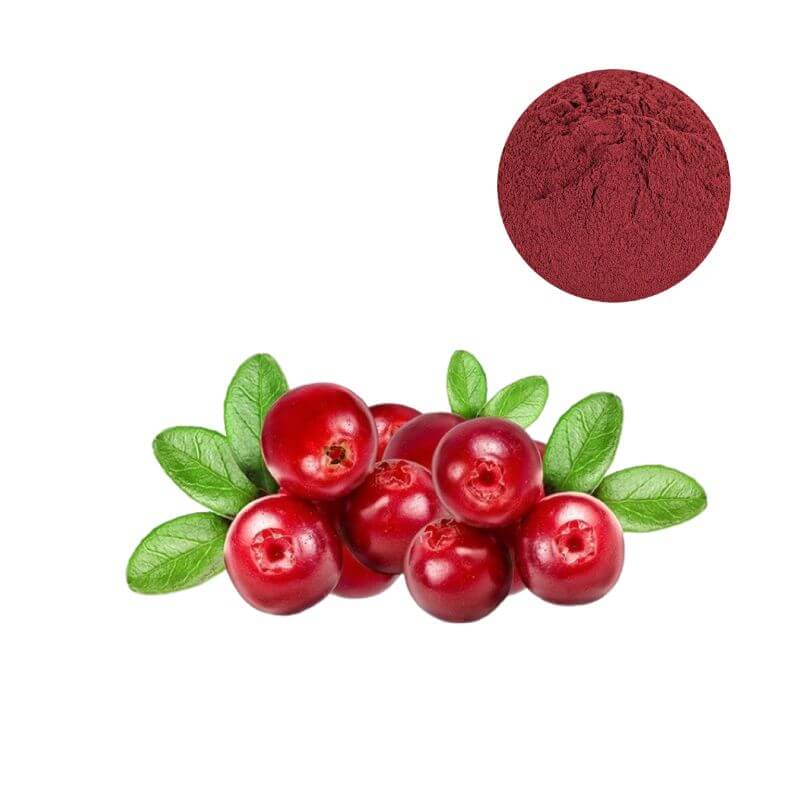
Cranberry Extract Powder
| Product Name | Cranberry Extract Powder |
| CAS Number | 91770-88-6 |
| Appearance | Reddish-purple fine powder |
| Purity (PACs) | 25% & 50% (by UV); 10% & 15% (by DMAC) |
| Packaging | 1 kg/bag, 5 kg/bag, 25 kg/drum |
| MOQ | 5 kg |
Bulk Cranberry Extract Powder – Industrial-Scale Quality Assurance and Application Engineering
Commercial cranberry extract powder requires contaminant clearance and orthogonal verification for FDA/EU compliance. A spec-verified supplier must show lot-to-lot PAC consistency via DMAC/UV-Vis and document residues on each COA for master file and customs. Specification-driven raw material selection positions finished brands to command premium pricing while reducing downstream corrective action overhead.
Contaminant Clearance – The Regulatory Gatekeeper for Cross-Border Shipments
Lead (Pb) and arsenic (As) are primary customs triggers, with USP <232> limits Pb ≤2.0 mg/kg, As ≤1.0 mg/kg. Residual solvents – ethanol, acetone – must meet USP <467> via GC. Resin adsorption and carbon filtration reduce pesticide loads below LOQ, mitigating container rejection.
| Contaminant | Critical Limit | Detection Method | Removal Protocol |
|---|---|---|---|
| Lead (Pb) | ≤ 2.0 mg/kg | ICP-MS (LOD 0.01 mg/kg) | Resin adsorption + chelation |
| Arsenic (As) | ≤ 1.0 mg/kg | ICP-MS (LOD 0.005 mg/kg) | Activated carbon filtration |
| Cadmium (Cd) | ≤ 1.0 mg/kg | ICP-MS | GAP-controlled feedstock |
| Mercury (Hg) | ≤ 0.1 mg/kg | ICP-MS | GAP-controlled feedstock |
| Residual Solvents | USP <467> compliant | GC Headspace | Controlled drying & purge |
Full contaminant clearance translates to accelerated port release and compressed procurement cycle time by 10-14 days per container, shielding brand owners from demurrage charges and storage penalties at destination ports.
Chemical Fingerprinting – Intercepting Botanical Adulteration at Receiving Inspection
Authentic cranberry extract fingerprinting must distinguish A-type proanthocyanidin linkages – the bioactive motif responsible for FimH antagonism – from B-type PACs abundant in cheap grape seed or peanut skin extracts. HPLC-DAD-Q-TOF-MS maps characteristic anthocyanin-3-galactoside peaks (Rt 12-18 min) and A-type PAC MS/MS fragments at m/z 545 and 863. Method selection critically alters reported values: DMAC quantifies 53.57% PACs versus 36.31% by Bate-Smith on identical lots, a 17.26-percentage-point delta (Scripta Medica, 2025; doi: 10.5937/scriptamed56-58808) that mandates explicit test method disclosure on each COA to prevent specification disputes.
- A-type PAC MS/MS confirmation – MRM transitions for dimer (m/z 577 → 451, 425) and trimer (865 → 739, 713); signals below 30% of reference trigger adulteration alert.
- Anthocyanin profile ratio – Cyanidin-3-galactoside/cyanidin-3-glucoside ratio must fall within 5:1 to 8:1; deviation indicates species substitution or pomace dilution.
- Total amino acid floor – Fresh fruit solids retain 2-3% free amino acids; spent pomace drops below 0.5%, prompting immediate lot rejection.
Incoming inspection teams using A-type fingerprinting intercept all adulterated shipments in validation studies, eliminating downstream reformulation rework and cutting requalification lead time by four business days per suspect lot. Fingerprint-verified lots arriving at European ports encounter fewer regulatory holds, compressing customs clearance variability and accelerating warehouse-to-production release.
Clinical PAC Quantitation – Linking Assay Data to Consumer-Relevant Endpoints
The anti-adhesion mechanism of A-type PACs is mechanistically well-defined: oligomers dose-dependently antagonize FimH adhesin on type-1 fimbriated UPEC, blocking bacterial docking to bladder epithelial uroplakin receptors. This pharmacological effect is quantifiable and distinct from antimicrobial activity. Daily PAC intake at or above 36 mg depresses UTI recurrence risk by 18% (RR=0.82, p=0.03), and 12- to 24-week intervention windows amplify reduction to 25% (RR=0.75, p=0.004) (Frontiers in Nutrition, 2024; doi: 10.3389/fnut.2024.1422121). Importantly, the 36 mg threshold applies exclusively to DMAC-quantified values, not UV total polyphenols – a distinction critical for label declaration accuracy.
- Minimum effective dose – 36 mg DMAC-PAC/day from clinical trials; 72 mg/day provides 16% recurrence risk reduction (female subgroup, RR=0.84, p=0.02).
- Pharmacokinetics – Plasma phenolics (metabolites: vanillic acid, p-hydroxybenzoic acid) reach Tmax at 2.3-2.8 hours; urinary bioactivity sustained through 24 hours.
- Antibiotic-independent advantage – Anti-adhesion mechanism bypasses resistance pathways, positioning cranberry PAC as first-line preventive intervention for recurrent UTI patients.
Formulators can directly map the 36 mg DMAC-PAC benchmark onto daily serving specifications across gummies, capsules, or powder sticks, providing substantiation-ready clinical data for product claims and regulatory filings. Minimizing serving size bulk density through precise PAC assay alignment directly improves consumer compliance and reduces packaging material consumption per daily dose.
Formulation Compatibility – Moisture Management and Synergistic Pairings
Cranberry extract powder exhibits a critical relative humidity (CRH) threshold of 45-50%, above which rapid moisture uptake depresses flowability, pushes the angle of repose beyond 40°, and triggers bridging in high-speed encapsulation hoppers. On automated lines running above 70,000 units/hour, this flow degradation can depress Overall Equipment Effectiveness (OEE) by 12-18% due to forced stoppages. Residual fruit sugars and organic acids accelerate caking when processed alongside hygroscopic co-ingredients. D-mannose powder (500 mg) paired with cranberry extract (36 mg PACs) provides target-complementary mechanisms: D-mannose occupies FimH binding sites while PACs disrupt fimbrial assembly – a combination that reduces UTI recurrence by 32% in observational cohorts. Formulating with ascorbic acid (Vitamin C) acts as an antioxidant buffer to retard anthocyanin degradation but requires dry granulation to prevent color deterioration. High-temperature processing above 60°C depolymerizes PACs; UV exposure reduces anthocyanin recovery by 22-28% over 12 weeks.
- Gummy systems – Low-moisture (≤ 8% LOD) extract with 0.5-1.0% magnesium stearate barrier prevents texture softening and color bleeding.
- Instant beverages – Xanthan-gellan blend (0.2-0.4%) maintains suspension viscosity at 800-1,200 cP, inhibiting sedimentation and phase separation.
- Hard capsules – Pre-drying at RH ≤ 30% for 2 hours eliminates sticking and extends tooling life by 18% on automated lines.
Specifying preconditioned extract (RH-adjusted, flow-enhanced) eliminates CMO dehumidification pre-treatment – a step that typically adds 1.5 days of scheduling and 3-5% material handling losses – directly compressing lead time and reducing scrap on high-speed rotary presses.
Supply Chain Traceability – From Farm Parcel to Batch-Specific Documentation
North American cultivation (Wisconsin, Massachusetts, Quebec) accounts for ~85% of global cranberry supply, creating geographic concentration risk. Weather anomalies historically trigger 15-30% seasonal price volatility and extend lead times from 4 to 6-8 weeks. Full lot-level audit trails reduce the procurement office's exposure to cargo rejection penalties and moisture-induced caking write-offs before production scheduling. Premium-grade suppliers employ five-tier traceability: farm parcel ID → harvest date code → cold-chain storage unit → extraction batch → finished SKU lot. This supports 24-hour backward audit from any lot to specific farm records and field application logs. Terminal sterilization uses pulsed light or saturated steam (105-115°C, 3-5 seconds) with ETO residue confirmed ND at a standard reporting limit of 0.1 mg/kg (0.1 ppm). Ultra-low third-party detection down to 0.01 mg/kg (0.01 ppm) is available upon request – a prerequisite for clean-label EU and US positioning.
- Farm-to-extract chain – GPS-mapped harvest polygons with timestamped logs; irrigation and crop rotation records retained.
- Cold-chain custody – Harvested fruit stored at 2-4°C, processed within 72 hours; temperature excursion alerts at ≥ 5°C.
- Physical sterilization – Pulsed light or steam; ETO residue ND (standard reporting limit 0.1 mg/kg, with 0.01 mg/kg capability available upon request) on each bulk shipment.
- Certification portfolio – Non-GMO, Kosher, and GFSI-benchmarked (FSSC 22000 or BRCGS) documentation standard.
Procurement directors prioritizing GFSI-certified status and full seed-to-extract traceability secure audit-ready packages without downstream investigation overhead, satisfying both FDA FSMA traceability and EU Directive 2011/62/EU supply-chain transparency mandates.
Qualify Spec-Verified Bulk Cranberry Extract Powder Samples for Formulation Trials
Premium cranberry extract powder lots sourced from GAP-controlled North American fruit, processed through solvent-free extraction with full contaminant clearance and orthogonal PAC assay verification. Each commercial lot ships with a spec-verified COA and independent third-party contaminant screen. Procurement and formulation teams may Request certified cranberry extract powder samples with complete COA packages prior to lot qualification.
Frequently Asked Questions
Share this product
Related Products
Ready to get started?
Contact our team for technical specifications, pricing, and customized solutions.