
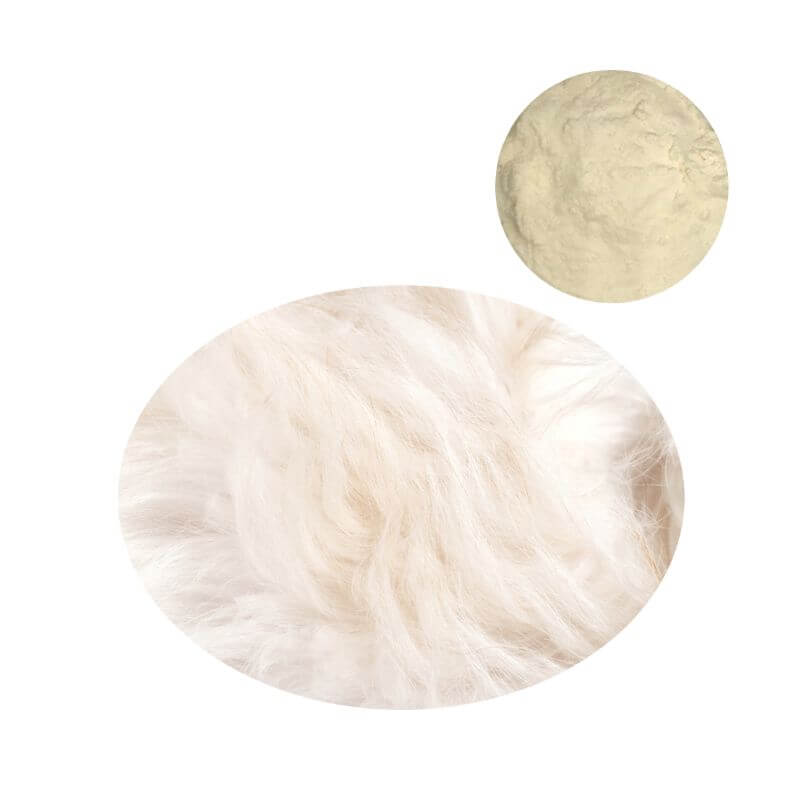
Hydrolyzed Keratin Powder
| Product Name | Hydrolyzed Keratin Powder |
| CAS Number | 69430-36-0 |
| Appearance | Off-white to light yellow fine powder |
| Protein Content | 90.0% min. (by Kjeldahl Method, Dry Basis) |
| Packaging | 1 kg/bag, 25 kg/drum |
| MOQ | 25 kg |
Hydrolyzed Keratin Powder for High-Speed Nutricosmetic Production
Bulk Hydrolyzed Keratin Powder from wool (sheep) exhibits an average molecular weight below 2,000 Da—a biochemical feature that depresses loose bulk density to approximately 0.17-0.25 g/mL and elevates inter-particulate friction during automated die filling. This physical profile directly influences compression behavior and downstream tableting efficiency. Commercial-scale lots from spec-verified distributors require rigorous SEC-HPLC peptide mapping and standardized USP <1174> flow characterization to maintain predictable fill-depth consistency across multi-ton annual supply agreements. Specification-driven sourcing of this peptide ingredient establishes a quality differentiation that directly supports finished-product premium positioning in the competitive nutricosmetic segment.
Managing Peptide-Driven Flow Constraints in High-Speed Rotary Tablet Presses
The low bulk density and high aspect ratio of hydrolyzed keratin particles introduce specific mechanical challenges in high-throughput encapsulation and tableting lines. At press speeds exceeding 70 RPM, the powder matrix exhibits significant bridging and ratholing within forced-feed frames, directly compromising fill-depth reproducibility.
| Powder Property | Typical Range | Impact on High-Speed Compression |
|---|---|---|
| Loose Bulk Density | 0.17-0.25 g/mL | Inconsistent die fill; weight variation exceeding USP <905> limits |
| Tapped Bulk Density | 0.30-0.45 g/mL | Prolonged settling time reduces hopper discharge rates |
| Angle of Repose | > 40° (typical for peptide powders) | Bridging and ratholing in feed frames; manual intervention required every 20-30 minutes |
| Compression Stickiness | High (due to low Mw peptide fractions) | Punch face adhesion; unplanned downtime for die cleaning |
Compression parameters - typically 10-20 kN force with die temperatures maintained below 30°C - require tight control; deviations elevate hardness-related reject rates by 5-8% per production shift. Effective mitigation involves pre-blending with 0.5-1.0% colloidal silicon dioxide or microcrystalline cellulose to enhance flow. Direct compaction without glidants produces hardness deviation exceeding 8% RSD. Particle engineering through customized milling (e.g., 80 mesh targeting) improves hopper discharge consistency and reduces scrap rates from weight variation rejects. Optimizing powder flow properties at the ingredient stage directly depresses compression reject rates, enabling shorter production runs with higher net yield per shift.
SEC-HPLC Peptide Mapping as the Defensive Standard Against Kjeldahl Adulteration
While the Kjeldahl method remains the industry default for total nitrogen quantitation, its inability to differentiate proteinaceous nitrogen from non-protein additives exposes buyers to adulteration risks. Melamine, urea, and biuret are known adulterants used to artificially elevate nitrogen values without contributing bioactive keratin peptides.
- SEC-HPLC peptide fingerprinting: Quantifies the exact distribution of peptide fractions below 1,000 Da and above 5,000 Da, providing a molecular-weight profile that authenticates true keratin hydrolysate identity.
- UPLC-MS/MS confirmatory analysis: Achieves a limit of detection (LOD) of 0.05 ppm for melamine and a limit of quantitation (LOQ) of 0.1 ppm—well below FDA's 2.5 ppm safety threshold—effectively intercepting nitrogen adulterants before they enter the manufacturing stream.
- Peptide map comparison: Matching the batch fingerprint against a reference standard identifies substitutions with gelatin hydrolysates or free amino acid blends, eliminating the risk of off-spec material acceptance.
Incoming inspection protocols anchored to SEC-HPLC and UPLC-MS/MS provide procurement managers with verifiable adulteration screening. This analytical rigor isolates non-protein nitrogen spikes that would otherwise compromise finished product integrity. Batch-to-batch SEC-HPLC profile reproducibility within ±5% peak area deviation is the industry norm for release; complete documentation includes raw material certificates, processing logs, and stability summaries for rapid QA review. Spec-verified lots arrive with full chromatographic documentation, enabling rapid lab-to-production release and protecting brand equity against adulterated supply chain incidents. Routine SEC-HPLC documentation accompanying each lot reduces port-of-entry hold frequency, accelerating customs clearance and minimizing warehouse storage cost exposure.
Systemic Bioavailability of Keratin-Derived Oligopeptides via the PEPT1 Transporter
The primary oral absorption mechanism for hydrolyzed keratin peptides involves active transport across intestinal epithelial cells via the oligopeptide transporter PEPT1, a pathway that preferentially translocates di- and tripeptides without competitive inhibition from free amino acids. This transport mechanism enables rapid systemic exposure.
- Pharmacokinetic profiling: In a human trial involving 10 healthy male subjects administered 5,000 mg of low-molecular-weight hydrolyzed keratin peptides, plasma amino acids reached peak concentration at approximately 20 minutes post-ingestion, confirming rapid absorption kinetics for low-molecular-weight keratin fractions.
- Fibroblast bioactivity: Enriched human serum collected post-ingestion promoted primary dermal fibroblast activities, increasing glycosaminoglycan secretion by 11% and hyaluronic acid release by 43% under oxidative stress conditions, while simultaneously suppressing ROS, caspase-3 activity, and cellular senescence markers.
- Substrate provision: The absorbed peptides serve as a cysteine and proline reservoir, supplying building blocks for keratin-associated protein synthesis in hair follicles and nail matrices.
Formulation stability considerations—optimal peptide integrity is maintained within pH 4-7 and below 60°C—avoid co-formulation with strong reducing agents that may cleave disulfide bonds. This dual-layer evidence—rapid systemic absorption coupled with quantifiable fibroblast stimulation—directly addresses the "biological availability" question that often undermines consumer confidence in oral beauty products. Serum metabolite enrichment drives measurable extracellular matrix deposition (Front. Nutr., 2026; doi: 10.3389/fnut.2026.1812320). For R&D directors, this kinetic data translates into formulation strategies designed to maximize peptide delivery to target tissues.
Molecular Weight Selection for Oral Nutricosmetic Formulations
Formulators selecting hydrolyzed keratin for oral liquid or solid-dose systems must recognize that molecular weight (Mw) distribution—rather than total protein content—dictates dissolution behavior, solution clarity, and processing compatibility in finished dosage forms. While higher-Mw fractions (above 3,000 Da) exhibit emulsifying properties suitable for topical applications, they present significant drawbacks in oral delivery: slow dissolution, persistent turbidity, and sedimentation in liquid systems over extended shelf life. For oral nutricosmetic applications—particularly clear beverages, fast-dissolve sachets, and high-density tablets—Mw below 2,000 Da represents the functional sweet spot, ensuring rapid hydration and crystal-clear reconstitution. The sub-1,000 Da fraction further maximizes PEPT1-mediated absorption while contributing minimal viscosity, preserving the sensory profile of low-viscosity liquid formats.
| Molecular Weight Range | Oral Formulation Performance | Optimal Application in Nutricosmetics |
|---|---|---|
| Mw < 1,000 Da | Rapid dissolution; zero turbidity; no viscosity contribution; enhanced PEPT1 transport | Clear beverages, effervescent tablets, fast-dissolve sachets, high-density compression |
| Mw 1,000 – 2,000 Da | Balanced solubility with moderate texture; stable in suspension; good compressibility | Capsules, gummies, chewable tablets, and semi-solid systems requiring moderate body |
| Mw > 3,000 Da | Slow hydration; persistent turbidity; sediment formation over time; limited oral suitability | Topical emulsions and creams (non-oral); not recommended for clear liquid nutricosmetics |
This functional differentiation establishes a clear selection criterion for formulation architects. The ≤2,000 Da peptide profile delivered by this ingredient eliminates the clarity and solubility concerns associated with higher-Mw fractions, making it the preferred choice for premium beverage and instant powder formats where visual appeal and rapid dispersion are non-negotiable. For premium liquid and instant sachet systems, Hydrolyzed Fish Collagen Powder shares comparable low-Mw dissolution kinetics, offering formulators a synergistic peptide matrix for comprehensive beauty-from-within applications. Maintaining water activity below 0.25 further suppresses Maillard browning in solid formats, preserving both color and peptide integrity. Systematic Mw characterization by SEC-HPLC therefore becomes a prerequisite for predicting processing behavior (ACS Omega, 2025; doi: 10.1021/acsomega.4c10755). This guidance reduces formulation trial iterations and accelerates time-to-market for new product concepts.
Streamlined Procurement with Batch-Specific Technical Documentation
Commercial procurement of Hydrolyzed Keratin Powder demands rigorous documentation for supplier audits and compliance. BSE/TSE-free, GMO-free, and non-irradiated certificates form the baseline package for multinational teams. Dossiers and samples are available on request for in-house verification. Traceability per shipment eliminates rejection risks and supply chain penalties. Request Hydrolyzed Keratin Powder samples with COA to validate SEC-HPLC profiles and compression behavior under line conditions.
Frequently Asked Questions
Share this product
Related Products
Ready to get started?
Contact our team for technical specifications, pricing, and customized solutions.